Sky Digest
Export Sky Digest PDF
Include finder charts for selected objects:
Tonight at a Glance
Bright moon tonight — deep-sky viewing will be limited
Aurora Forecast — Unlikely
Need Kp 7+ (currently 6.3). Watch for geomagnetic storm upgrades.
View full forecastPlanet Highlights
For Beginners (naked eye)
Binocular Targets
Small Scopes (3–6 inch)
Big Scopes (8–12 inch)
The Week Ahead
| Tue | Wed | Thu | Fri | Sat | Sun | Mon |
| 🌕 100% | 🌕 98% | 🌖 94% | 🌖 89% | 🌖 82% | 🌖 74% | 🌖 65% |
| — | — | — | — | — | — | — |
| Full Moon | Ursa Major Best Placed |
NASA Astronomy Picture of the Day
Flying over the North Pole of Mars
If you could fly over the North Pole of Mars, what would you see? Images from ESA’s Mars Express mission in 2019 were compiled into the featured video which shows just such a trip. First you see below you a landscape tinted orange by rusted iron in the fine soil, with some land appearing darker due to exposed rock. Soon the northern polar cap comes into view, mostly white because of its reflective frozen water. Surrounding the polar cap is the North Polar Basin, a layered depression covered with dust and sand. The frames in the featured video were captured during northern Martian Spring when the carbon-dioxide ice is evaporating, leaving the underlying water-ice in the cap. Mars Express continues to study the Martian surface and look for clues about the Red Planet's ancient climate and potential for life.
APOD is a service of NASA and Michigan Tech. U.
View on NASA APODSpace News
NASA's X-59 experimental supersonic aircraft completed its second flight, initiating a series of dozens of test flights planned for 2026 to demonstrate quiet supersonic flight technology.
NASA — 20 Mar 2026
NASA used advanced simulations to optimize launch conditions for Artemis II, analyzing airflow effects on the rocket to ensure the best possible conditions for this crewed test flight around the Moon.
NASA — 20 Mar 2026
NASA's newest astronaut candidate class of ten explorers, selected in 2025, are training at Johnson Space Center for future missions to the ISS, Moon, and beyond.
NASA — 19 Mar 2026
NASA's observations of the interstellar comet 3I/ATLAS from more than a dozen science missions will be preserved in public data archives as the comet leaves our solar system permanently.
NASA — 20 Mar 2026
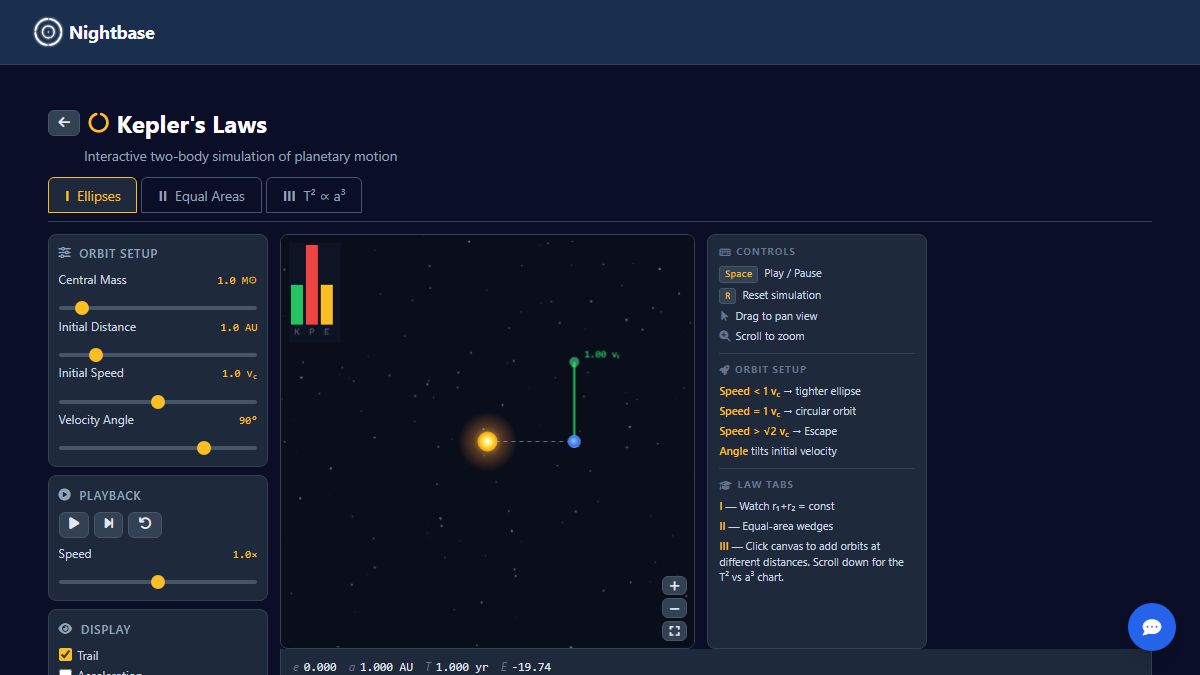
Kepler's Laws Come Alive
Drag velocity vectors to reshape orbits, watch equal areas sweep in equal times, and discover why distant planets orbit slower — all three laws animated in real time.
 Open Kepler's Laws
Sign in to get this digest by email and customize it for your location.