Sky Digest
Export Sky Digest PDF
Include finder charts for selected objects:
Tonight at a Glance
Bright moon tonight — best deep-sky viewing before moonrise (19:13)
Aurora Forecast — Unlikely
Need Kp 7+ (currently 6.3). Watch for geomagnetic storm upgrades.
View full forecastPlanet Highlights
No significant Jupiter events during tonight's dark window.
For Beginners (naked eye)
Binocular Targets
Small Scopes (3–6 inch)
Big Scopes (8–12 inch)
The Week Ahead
| Wed | Thu | Fri | Sat | Sun | Mon | Tue |
| 🌕 98% | 🌖 94% | 🌖 89% | 🌖 82% | 🌖 74% | 🌖 65% | 🌖 55% |
| — | — | — | — | — | — | — |
| Ursa Major Best Placed |
NASA Astronomy Picture of the Day
Shapley 1: An Annular Planetary Nebula
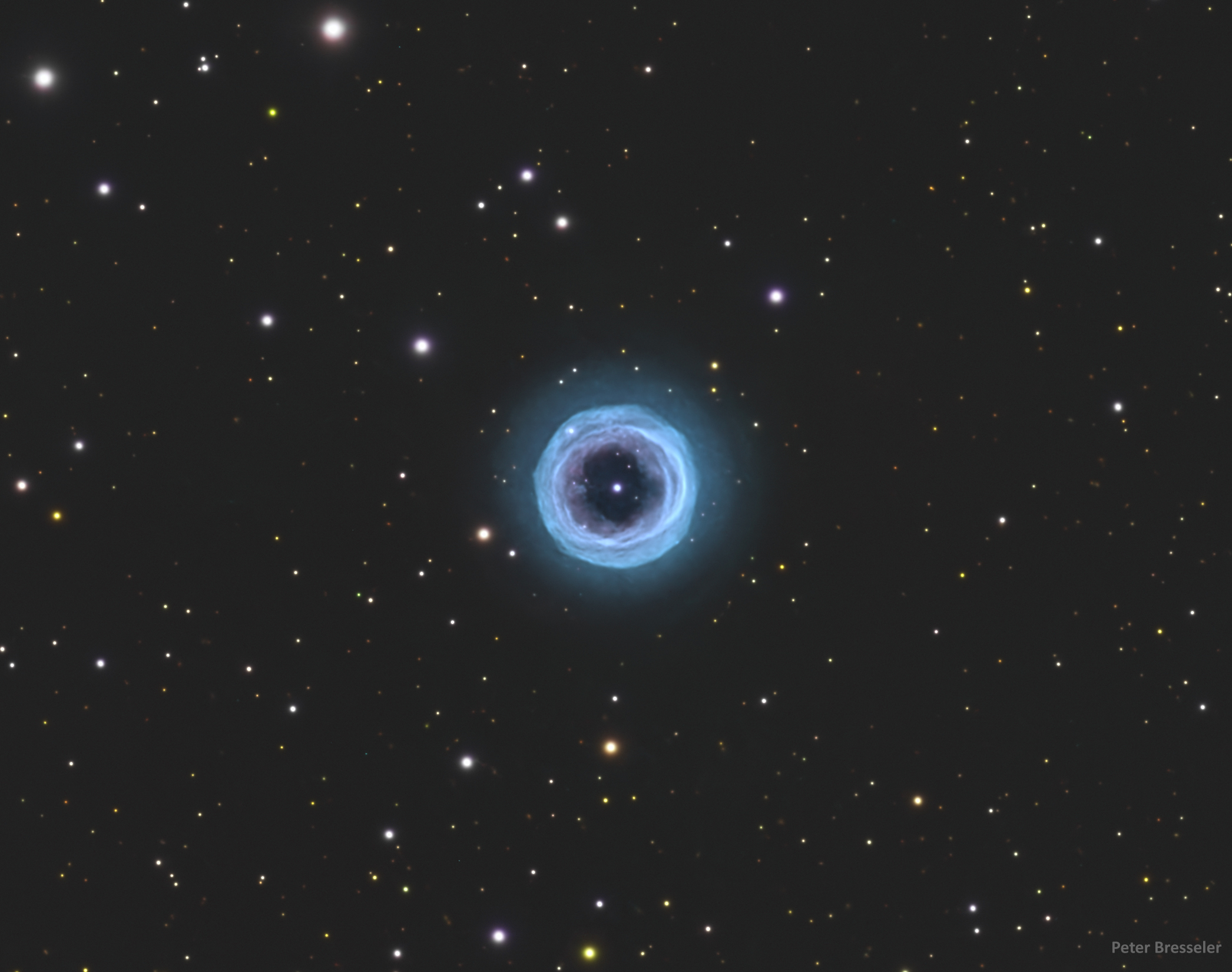
What’s looking back at you isn’t a cosmic eye, but Shapley 1, a beautifully symmetric planetary nebula. Shapley 1, also known as the Fine Ring Nebula or PLN 329+2.1, bejewels the southern sky constellation of the Carpenter's Square (Norma). The nebula is the result of a star near the mass of our Sun running out of fuel and shedding its outer layers. Glowing oxygen from those expelled layers makes up the circular halo. The bright central point is actually a binary: a white dwarf, the remaining stellar core after the outer layers are expelled into space, and another star, orbiting each other every 2.9 days. Shapley 1’s annular shape is due to our top-down view of the system and provides insight into the influence of central stars on planetary nebula structures.
Image credit: Peter Bresseler; Text: Keighley Rockcliffe (NASA GSFC, UMBC CSST, CRESST II) — APOD is a service of NASA and Michigan Tech. U.
View on NASA APODSpace News
NASA used advanced simulations to optimize launch conditions for Artemis II, a major crewed lunar mission that represents a critical step toward returning humans to the Moon.
NASA — 20 Mar 2026
NASA's X-59 experimental supersonic aircraft completed its second flight, initiating a series of dozens of test flights planned for 2026 to demonstrate quiet supersonic flight technology.
NASA — 20 Mar 2026
NASA's observations of the rare interstellar comet 3I/ATLAS from over a dozen space missions are being archived as public data, enabling future scientific discoveries about this one-time visitor to our solar system.
NASA — 20 Mar 2026
NASA's newest astronaut candidate class of ten explorers is training at Johnson Space Center to become flight-eligible for future missions to the ISS, Moon, and beyond.
NASA — 19 Mar 2026
Watch Earth from Space
A 3D globe with real-time day/night terminator, ISS position tracking, aurora oval overlay, and city lights. See where the sun is shining — and where the stars are out.
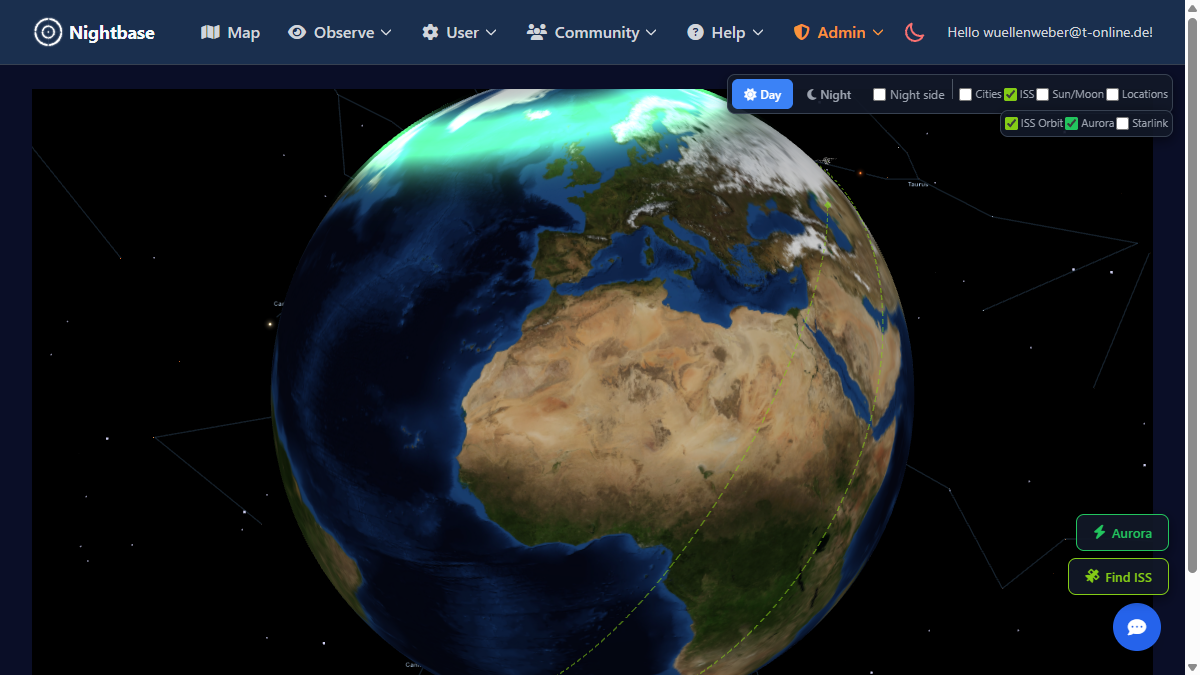 Open Earth
Sign in to get this digest by email and customize it for your location.