Sky Digest
Export Sky Digest PDF
Include finder charts for selected objects:
Tonight at a Glance
Bright moon tonight — best deep-sky viewing before moonrise (22:59)
Aurora Forecast — Unlikely
Need Kp 7+ (currently 6.7). Watch for geomagnetic storm upgrades.
View full forecastPlanet Highlights
For Beginners (naked eye)
Binocular Targets
Small Scopes (3–6 inch)
Big Scopes (8–12 inch)
The Week Ahead
| Sat | Sun | Mon | Tue | Wed | Thu | Fri |
| 🌖 82% | 🌖 74% | 🌖 65% | 🌖 55% | 🌗 46% | 🌗 36% | 🌗 27% |
| — | — | — | — | — | — | — |
NASA Astronomy Picture of the Day
Two Eclipses of Saros 133
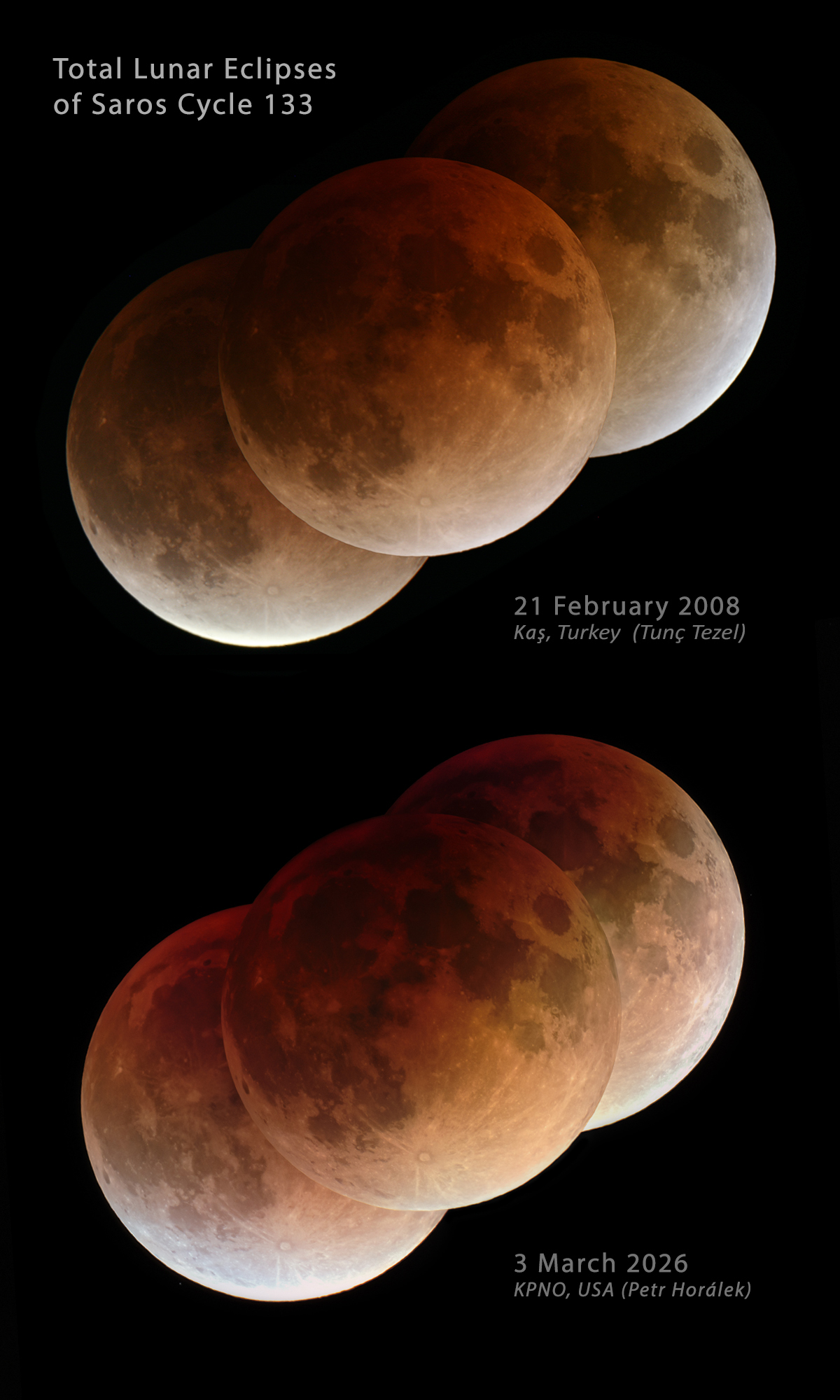
Centered on maximum eclipse, these two total lunar eclipse sequences look almost identical. Yet the one shown on top is composed of images recorded in February 2008, while at the bottom is the recent March 2026 total eclipse of the Moon. Why are they so similar? Because these two total lunar eclipses are from the same Saros cycle. The Saros cycle was discovered historically from observations of the Moon's orbit. With a period of 18 years, 11 and 1/3 days, the cycle predicts when the Sun, Earth, and Moon all return to the same relative geometry for a lunar (or solar) eclipse. Eclipses separated by one Saros period belong to the same numbered Saros series, in this case Saros 133. So expect the next lunar eclipse in Saros 133 to be a repeat of this year's March 3 eclipse. You can watch the next Saros 133 total lunar eclipse on March 13, 2044. Growing Gallery: Total Lunar Eclipse of March 3
Image credit: Tunc Tezel — APOD is a service of NASA and Michigan Tech. U.
View on NASA APODSpace News
NASA used advanced simulations to optimize launch conditions for Artemis II, the first crewed mission around the Moon, demonstrating critical preparation for the agency's lunar exploration program.
NASA — 20 Mar 2026
Artemis II rocket completed a second rollout to its launchpad at Kennedy Space Center, advancing the timeline for NASA's crewed lunar test flight.
ESA — 20 Mar 2026
NASA's observations of the rare interstellar comet 3I/ATLAS from over a dozen science missions will be preserved in public archives for future research discoveries.
NASA — 20 Mar 2026
ISS astronaut Chris Williams completed a spacesuit fit verification procedure, essential preparation for upcoming spacewalks and extravehicular activities on the International Space Station.
NASA — 20 Mar 2026
NASA's newest astronaut candidate class of ten explorers is training for future missions to the ISS, Moon, and Mars, representing the next generation of space explorers.
NASA — 19 Mar 2026
Watch Earth from Space
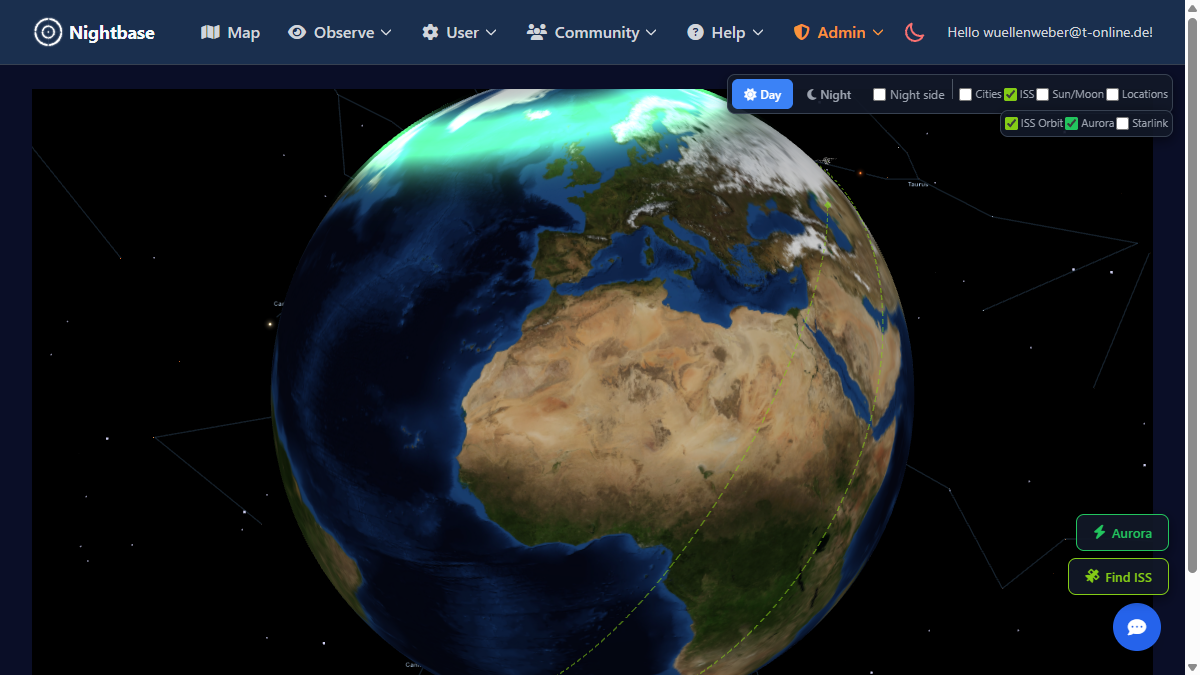
A 3D globe with real-time day/night terminator, ISS position tracking, aurora oval overlay, and city lights. See where the sun is shining — and where the stars are out.
 Open Earth
Sign in to get this digest by email and customize it for your location.