Sky Digest
Export Sky Digest PDF
Include finder charts for selected objects:
Tonight at a Glance
Aurora Forecast — Slight chance
Kp just below threshold, but southward Bz may push the oval further south.
View full forecastPlanet Highlights
For Beginners (naked eye)
Binocular Targets
Small Scopes (3–6 inch)
Big Scopes (8–12 inch)
The Week Ahead
| Wed | Thu | Fri | Sat | Sun | Mon | Tue |
| 🌗 46% | 🌗 36% | 🌗 27% | 🌘 19% | 🌘 12% | 🌘 6% | 🌑 2% |
| — | — | — | — | — | — | — |
| Moon occults Phi Sgr | Moon occults Gamma Cap | Moon occults Lambda Aqr |
NASA Astronomy Picture of the Day
CG 4: The Globule and the Galaxy
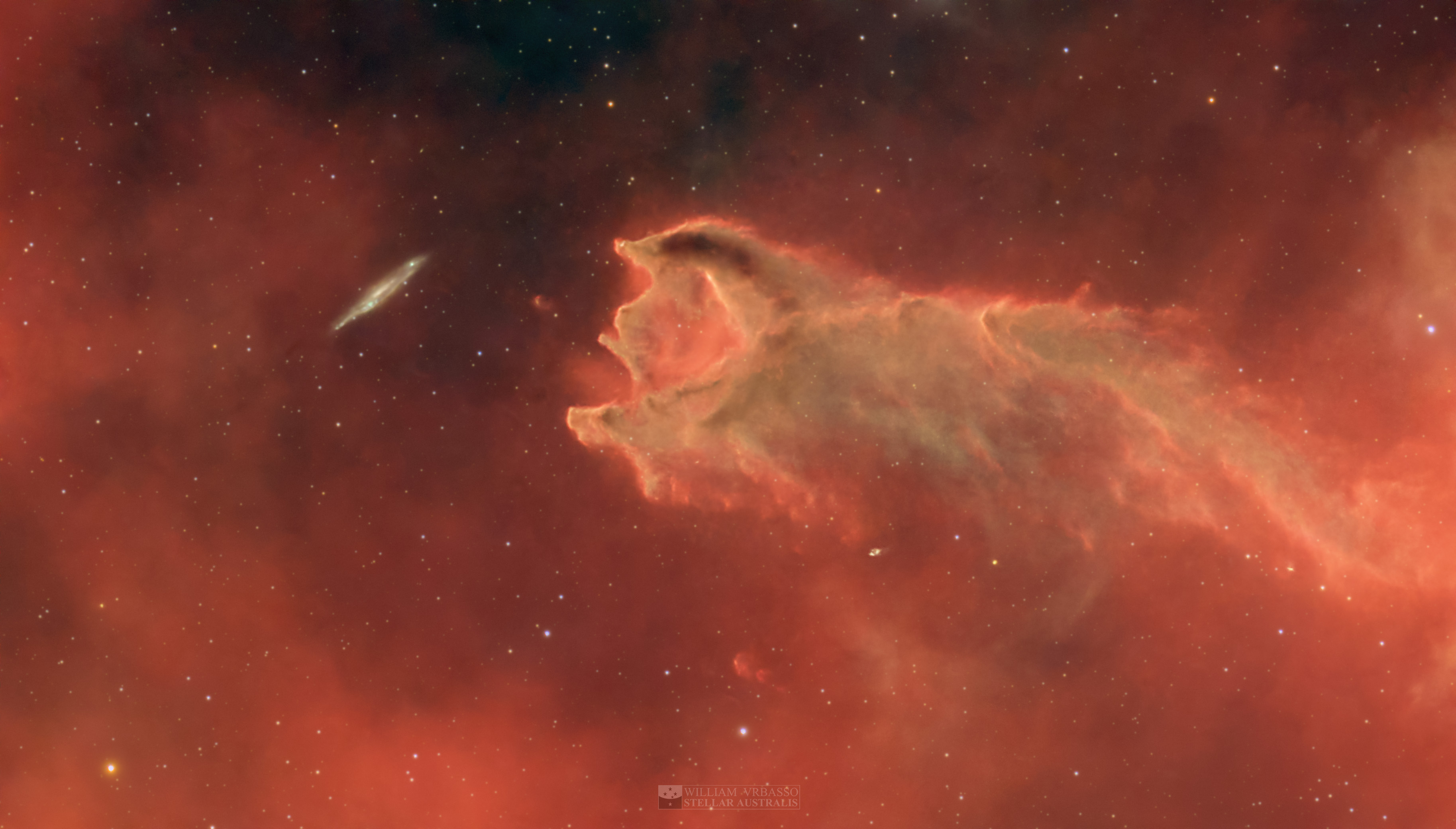
Is this a cosmic monster ready to devour an unsuspecting galaxy? Thankfully, that is not the case. The red “monster” shown in the featured image is Cometary Globule CG 4, 1,300 light-years away in the Constellation Puppis. CG 4 is a molecular cloud, where hydrogen becomes cold enough to form molecules that can be brought together by gravity to create stars. The shape of CG 4 resembles that of a comet, but its head is 1.5 light-year in diameter and its tail is 8 light-years long; for comparison, the distance from the Earth to the sun is only 8 light-minutes. Astronomers believe that the tail of a cometary globule could have been shaped by a nearby supernova explosion or by irradiation from hot, massive stars. Indeed, CG 4 and other nearby globules point away from the Vela Supernova Remnant, at the center of the Gum Nebula. The edge-on spiral galaxy, ESO 257-19, is more than a hundred million light-years beyond CG 4, and is completely safe from the “monster”.
Image credit: William Vrbasso — APOD is a service of NASA and Michigan Tech. U.
View on NASA APODSpace News
NASA conducted advanced simulations to optimize launch conditions for Artemis II, the first crewed lunar test flight, by analyzing airflow dynamics around the rocket during ascent.
NASA — 20 Mar 2026
Artemis II rocket completed its second rollout to the launchpad at Kennedy Space Center, marking progress toward the crewed lunar mission.
ESA — 20 Mar 2026
NASA astronaut Chris Williams completed spacesuit verification procedures on the International Space Station, ensuring proper fit and function for spacewalk operations.
NASA — 20 Mar 2026
NASA's observations of interstellar comet 3I/ATLAS from more than a dozen science missions will be preserved in public data archives for future scientific research.
NASA — 20 Mar 2026
Watch Earth from Space
A 3D globe with real-time day/night terminator, ISS position tracking, aurora oval overlay, and city lights. See where the sun is shining — and where the stars are out.
 Open Earth
Sign in to get this digest by email and customize it for your location.