Sky Digest
Export Sky Digest PDF
Include finder charts for selected objects:
Tonight at a Glance
Bright moon tonight — best deep-sky viewing before moonrise (02:32)
Aurora Forecast — Slight chance
Kp just below threshold, but southward Bz may push the oval further south.
View full forecastPlanet Highlights
For Beginners (naked eye)
Binocular Targets
Small Scopes (3–6 inch)
Big Scopes (8–12 inch)
The Week Ahead
| Tue | Wed | Thu | Fri | Sat | Sun | Mon |
| 🌖 55% | 🌗 46% | 🌗 36% | 🌗 27% | 🌘 19% | 🌘 12% | 🌘 6% |
| — | — | — | — | — | — | — |
| Moon occults Gamma Cap |
NASA Astronomy Picture of the Day
Sky Glows over Paranal Observatory
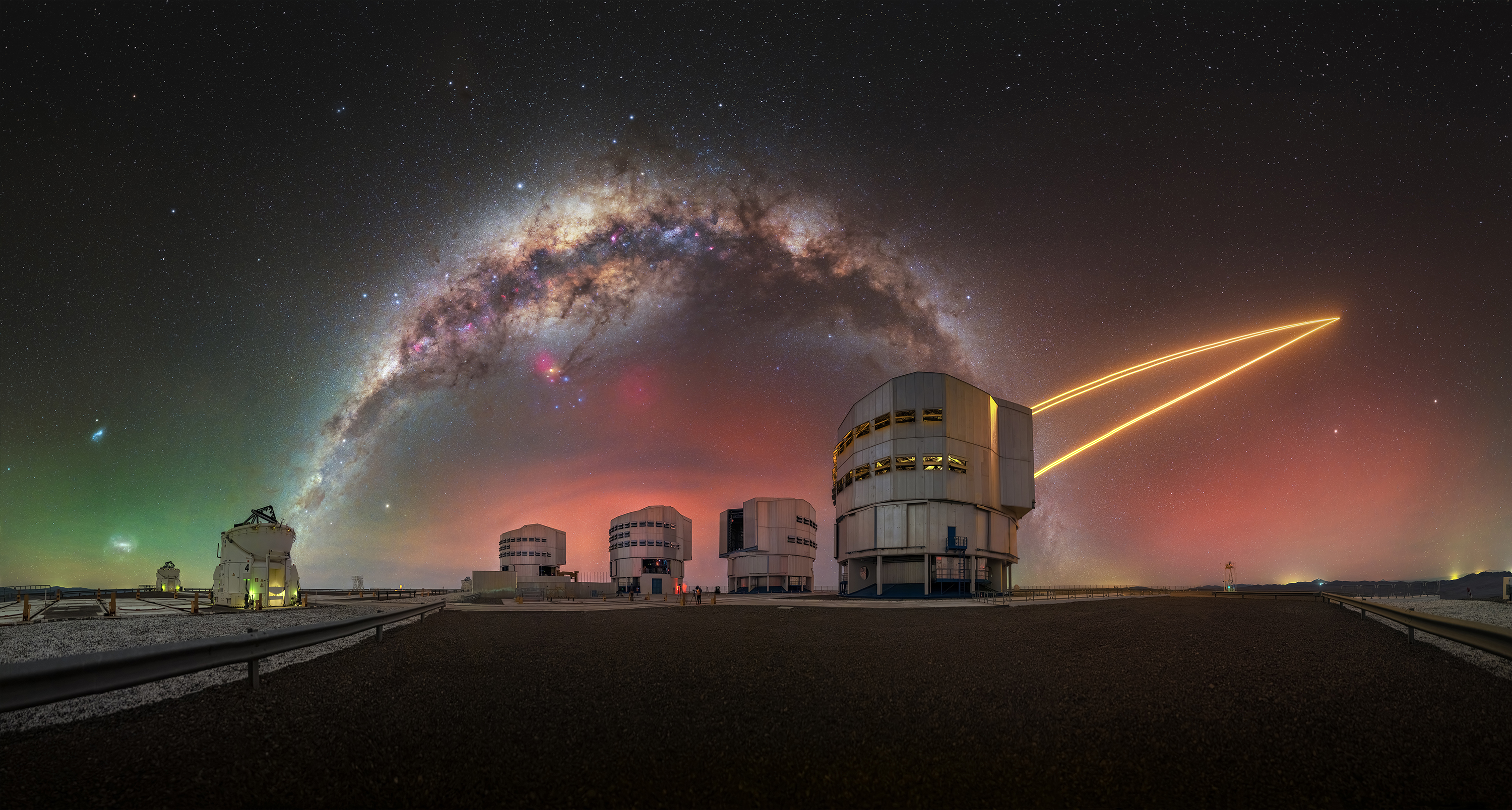
Are lasers from giant telescopes being used to defend the Earth? No. Lasers shot from telescopes are now commonly used to help increase the accuracy of astronomical observations. In some directions, Earth atmosphere-induced fluctuations in starlight can indicate how the air mass over a telescope is changing, but in other directions, no bright star exists. In these directions, astronomers can create an artificial star with a laser. Subsequent observations of the artificial laser guide star can reveal information so detailed about the changing blurring effects of the Earth's atmosphere that much of it can be removed by rapidly flexing a telescope's mirror. Such adaptive optics techniques allow high-resolution ground-based observations of real stars, planets, and nebulas. Pictured here, telescopes at Paranal Observatory in Chile study a colorful sky filled with green airglow and the Magellanic Clouds on the left, red airglow on the right, and the majestic central band of our Milky Way Galaxy arching across the center.
Image credit: Julien Looten — APOD is a service of NASA and Michigan Tech. U.
View on NASA APODSpace News
NASA used advanced simulations to optimize launch conditions for Artemis II, the crewed mission to the Moon that represents a major milestone in returning humans to lunar exploration.
NASA — 20 Mar 2026
Artemis II rocket completed its second rollout to the launchpad at Kennedy Space Center, advancing preparations for the critical crewed lunar test flight.
ESA — 20 Mar 2026
NASA astronaut Chris Williams conducted spacesuit verification procedures on the ISS, ensuring equipment readiness for ongoing human spaceflight operations.
NASA — 20 Mar 2026
Multiple NASA science missions observed the rare interstellar comet 3I/ATLAS, with data now available in public archives for future scientific discoveries.
NASA — 20 Mar 2026
Watch Earth from Space
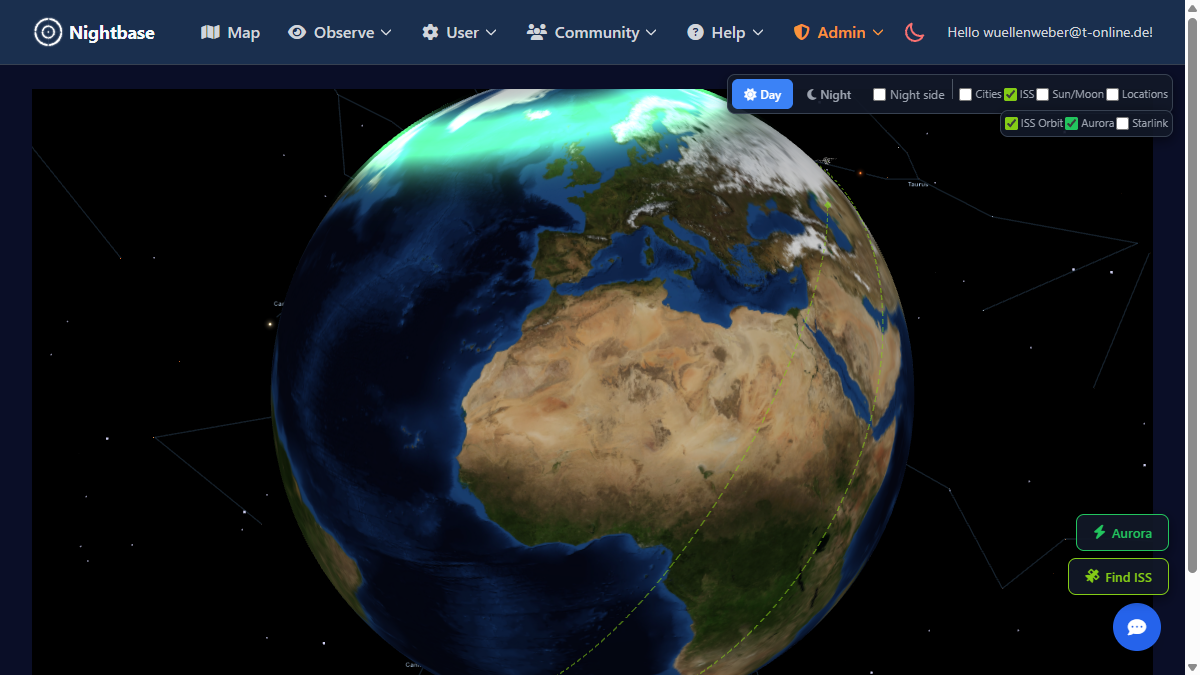
A 3D globe with real-time day/night terminator, ISS position tracking, aurora oval overlay, and city lights. See where the sun is shining — and where the stars are out.
 Open Earth
Sign in to get this digest by email and customize it for your location.