Sky Digest
Export Sky Digest PDF
Include finder charts for selected objects:
Tonight at a Glance
Bright moon tonight — deep-sky viewing will be limited
Planet Highlights
No significant Jupiter events during tonight's dark window.
Comets
For Beginners (naked eye)
Binocular Targets
Small Scopes (3–6 inch)
Big Scopes (8–12 inch)
The Week Ahead
| Sat | Sun | Mon | Tue | Wed | Thu | Fri |
| 🌕 100% | 🌕 97% | 🌖 92% | 🌖 85% | 🌖 77% | 🌖 68% | 🌖 58% |
| — | — | — | — | — | — | — |
NASA Astronomy Picture of the Day
Full Moonlight

The Full Moon is the brightest lunar phase, and tonight you can stand in the light of the first Full Moon of 2026. In fact, the Moon's full phase occurs on January 3 at 10:03 UTC, while only about 7 hours later planet Earth reaches its 2026 perihelion, the closest point in its elliptical orbit around the Sun, at 17:16 UTC. January's Full Moon was also not far from its own perigee, or closest approach to planet Earth. For this lunation the Moon's perigee was on January 1 at 21:44 UTC. You can also spot planet Jupiter, near its brightest for 2026 and close on the sky to the Full Moon tonight. But while you're out skygazing don't forget to look for rare, bright fireballs from the Quadrantid meteor shower.
Image credit: Jeff Dai — APOD is a service of NASA and Michigan Tech. U.
View on NASA APODSpace News
NASA officially presented the Artemis II crew of four astronauts (Wiseman, Glover, Koch, and Canadian Hansen) who will fly around the Moon on humanity's first crewed lunar mission since Apollo.
NASA — 30 Mar 2026
NASA awarded Intuitive Machines $180.4 million to deliver science payloads to the lunar surface as part of the Artemis program's Commercial Lunar Payload Services initiative.
NASA — 27 Mar 2026
NASA released the official launch countdown for Artemis II, targeting no earlier than April 1, 2026, to send the four-person crew on their 10-day journey around the Moon.
NASA — 26 Mar 2026
NASA selected 10 scientists to develop the lunar science plan for Artemis astronauts, including deployment of instruments and collection of Moon rocks at the lunar south pole.
NASA — 27 Mar 2026
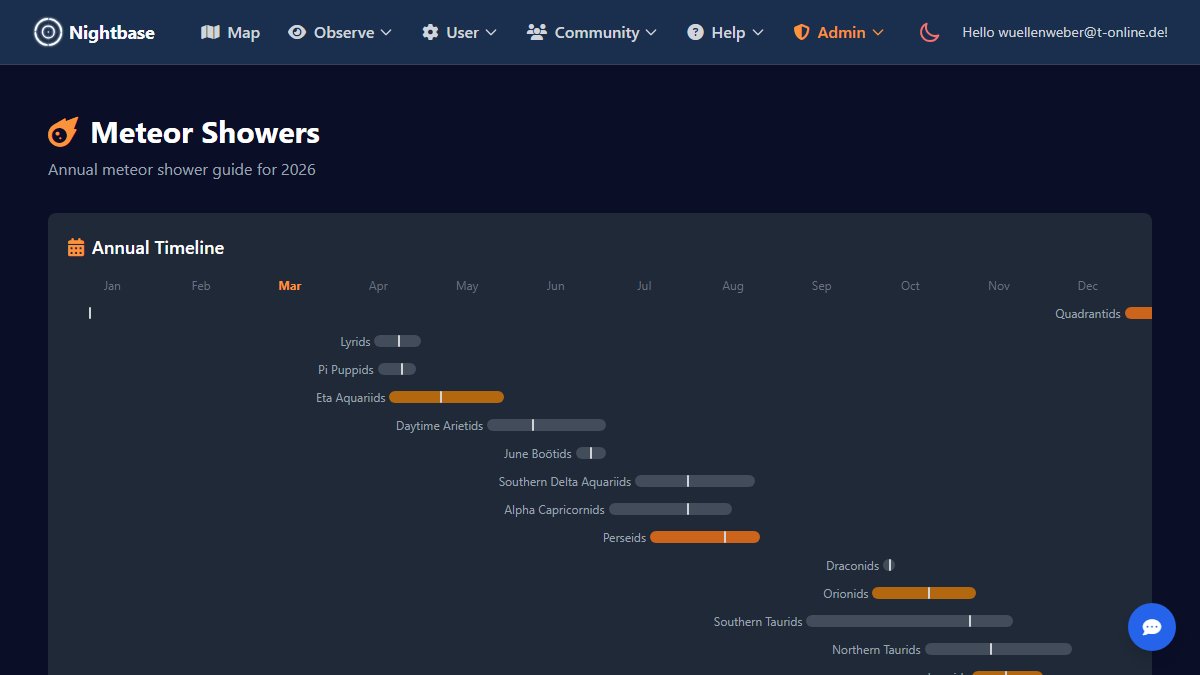
Never Miss a Meteor Shower
A complete calendar of annual meteor showers with peak dates, hourly rates, moon interference, and radiant positions. Plan ahead and know exactly when to look up.
 Open Meteor Showers
Sign in to get this digest by email and customize it for your location.