Sky Digest
Export Sky Digest PDF
Include finder charts for selected objects:
Tonight at a Glance
Bright moon tonight — deep-sky viewing will be limited
Planet Highlights
Comets
For Beginners (naked eye)
Binocular Targets
Small Scopes (3–6 inch)
Big Scopes (8–12 inch)
The Week Ahead
| Sun | Mon | Tue | Wed | Thu | Fri | Sat |
| 🌕 97% | 🌖 92% | 🌖 85% | 🌖 77% | 🌖 68% | 🌖 58% | 🌗 48% |
| — | — | — | — | — | — | — |
NASA Astronomy Picture of the Day
The Einstein Cross Gravitational Lens

Most galaxies have a single nucleus -- does this galaxy have four? The strange answer leads astronomers to conclude that the nucleus of the surrounding galaxy is not even visible in this image. The central cloverleaf is rather light emitted from a background quasar. The gravitational field of the visible foreground galaxy breaks light from this distant quasar into four distinct images. The quasar must be properly aligned behind the center of a massive galaxy for a mirage like this to be evident. The general effect is known as gravitational lensing, and this specific case is known as the Einstein Cross. Stranger still, the images of the Einstein Cross vary in relative brightness, enhanced occasionally by the additional gravitational microlensing effect of specific stars in the foreground galaxy. Almost Hyperspace: Random APOD Generator
APOD is a service of NASA and Michigan Tech. U.
View on NASA APODSpace News
NASA's Artemis II crew of four astronauts (Reid Wiseman, Victor Glover, Christina Koch, and Jeremy Hansen) is officially proceeding toward launch, marking humanity's first crewed lunar mission in over 50 years.
NASA — 30 Mar 2026
NASA awarded Intuitive Machines $180.4 million to deliver seven science payloads to the lunar surface as part of the CLPS initiative supporting the Artemis program.
NASA — 27 Mar 2026
NASA selected 10 scientists to develop the lunar science plan for Artemis astronauts, including instrument deployment and sample collection at the lunar south pole.
NASA — 27 Mar 2026
NASA released the Artemis II launch countdown, targeting no earlier than April 1, 2026, for the crewed mission to send four astronauts around the Moon and back to Earth.
NASA — 26 Mar 2026
Never Miss a Meteor Shower
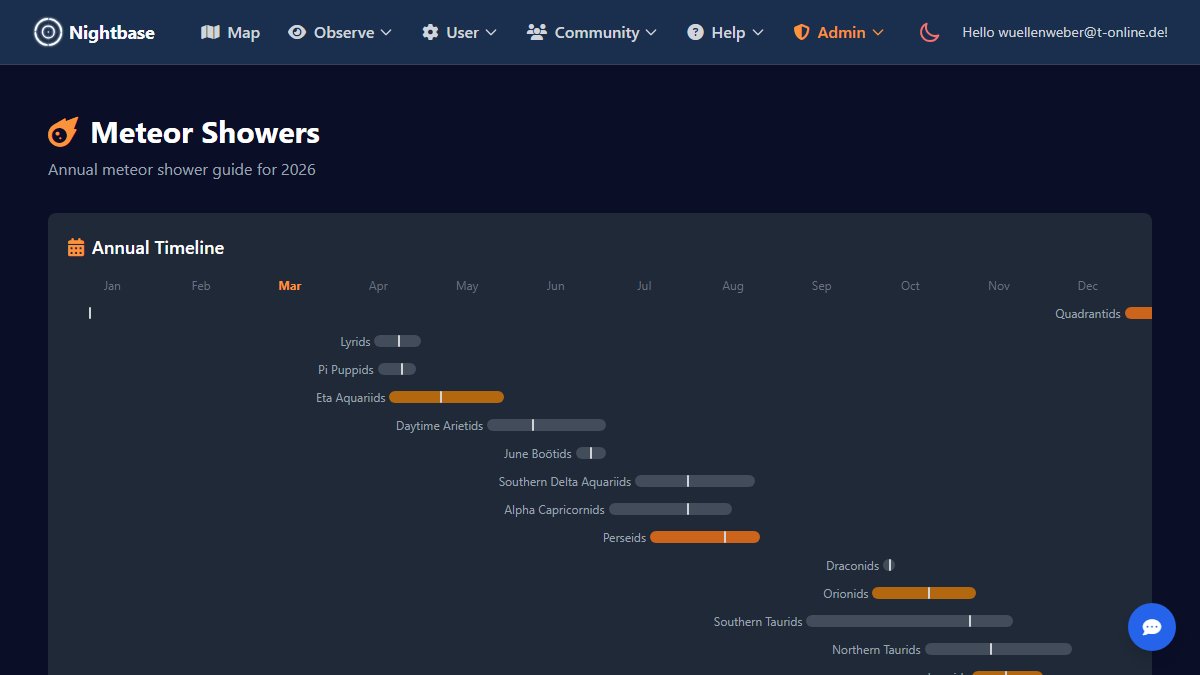
A complete calendar of annual meteor showers with peak dates, hourly rates, moon interference, and radiant positions. Plan ahead and know exactly when to look up.
 Open Meteor Showers
Sign in to get this digest by email and customize it for your location.