Der Sternenbote
Sternenbote-PDF exportieren
Aufsuchkarten für ausgewählte Objekte einschließen:
Heute Nacht auf einen Blick
Planeten-Highlights
Für Einsteiger (mit bloßem Auge)
Fernglasziele
Kleine Teleskope (3–6 Zoll)
Große Teleskope (8–12 Zoll)
Wochenausblick
| Do | Fr | Sa | So | Mo | Di | Mi |
| 🌘 21% | 🌘 13% | 🌘 7% | 🌑 3% | 🌑 0% | 🌑 0% | 🌑 2% |
| — | — | — | — | — | — | — |
NASA Astronomiebild des Tages
The Bay of Rainbows
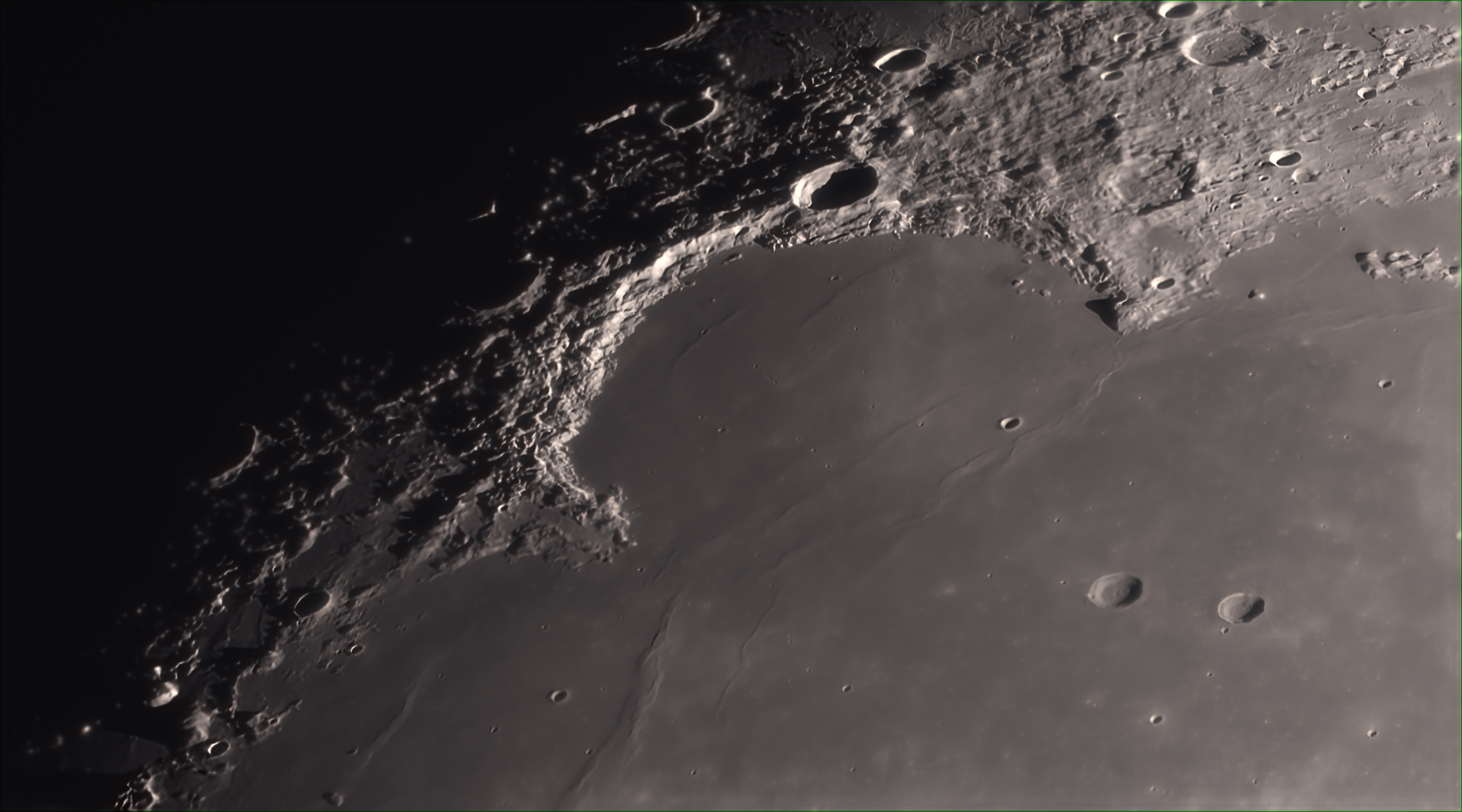
Dark, smooth regions that cover the Moon's familiar face are called by Latin names for oceans and seas. That naming convention is historical, though it may seem a little ironic to denizens of the space age who recognize the Moon as a mostly dry and airless world, and the smooth, dark areas as lava-flooded impact basins. For example, this telescopic lunar vista, looks over the expanse of the northwestern Mare Imbrium, or Sea of Rains and into the Sinus Iridum, the Bay of Rainbows. Ringed by the Jura Mountains (montes), the bay is about 250 kilometers across. Seen after local sunrise, the mountains form part of the Sinus Iridum impact crater wall. Their rugged sunlit arc is bounded at the top by Cape (promontorium) Laplace reaching nearly 3,000 meters above the bay's surface. At the bottom of the arc is Cape Heraclides, depicted by Giovanni Cassini in his 1679 telescope-based drawings mapping the moon, as a moon maiden seen in profile with long, flowing hair.
Bildnachweis: Olaf Filzinger — APOD ist ein Service der NASA und Michigan Tech. U.
Auf NASA APOD ansehenSpace News
NASA sets coverage for Artemis II, the first crewed mission around the Moon in over 50 years, targeting launch no earlier than April 1, 2026.
NASA — 25 Mar 2026
NASA's James Webb and Hubble Space Telescopes jointly captured unprecedented infrared and visible views of Saturn, providing scientists with complementary insights into the planet's atmosphere and ring system.
NASA — 25 Mar 2026
NASA-JAXA's XRISM telescope directly measured the speed of superheated gas expelled from the core of galaxy M82, marking a significant advancement in understanding galactic winds.
NASA — 25 Mar 2026
Artemis II rocket completed its second rollout to the launchpad at Kennedy Space Center, advancing preparations for the crewed lunar mission.
ESA — 20 Mar 2026
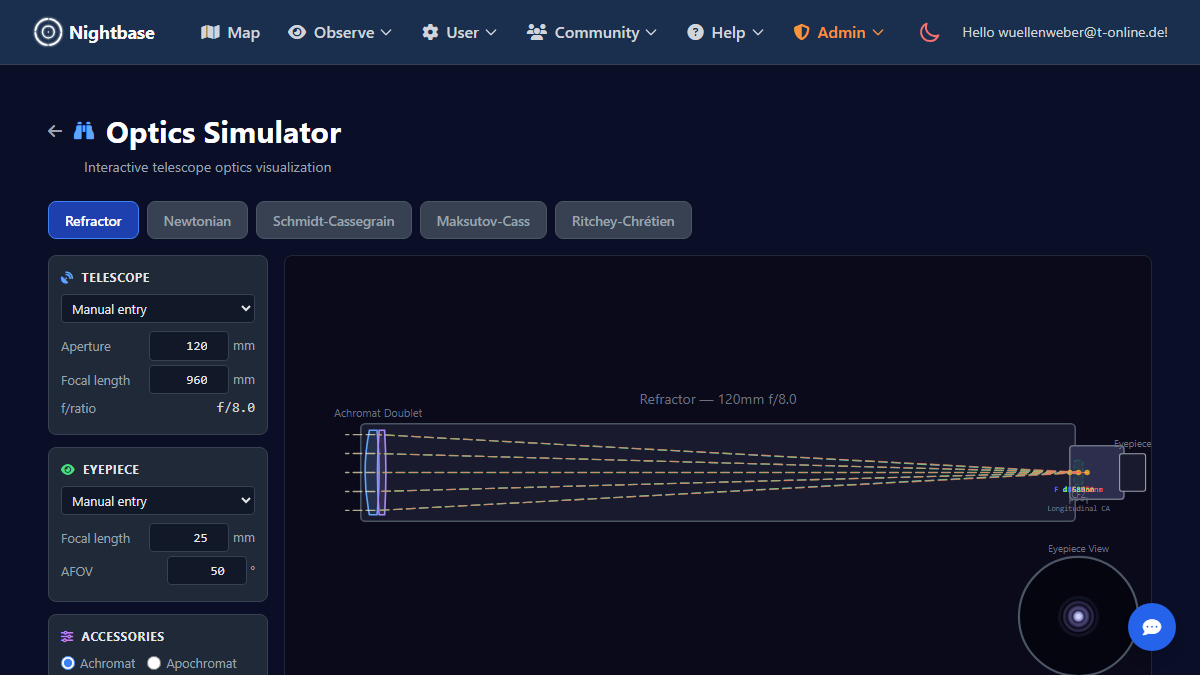
Understand Your Telescope
See the light path through six telescope designs: refractor, Newtonian, SCT, Maksutov, RC, and Gregorian. Adjust aperture, focal length, and eyepiece to calculate magnification and field of view.
 Open Optics Simulator
Anmelden, um den Sternenboten per E-Mail zu erhalten und für Ihren Standort anzupassen.