Star-Hop Drill
Slew from a bright anchor star to a deep-sky target through a realistic finder and eyepiece — the classic skill every visual observer needs.
What you'll do
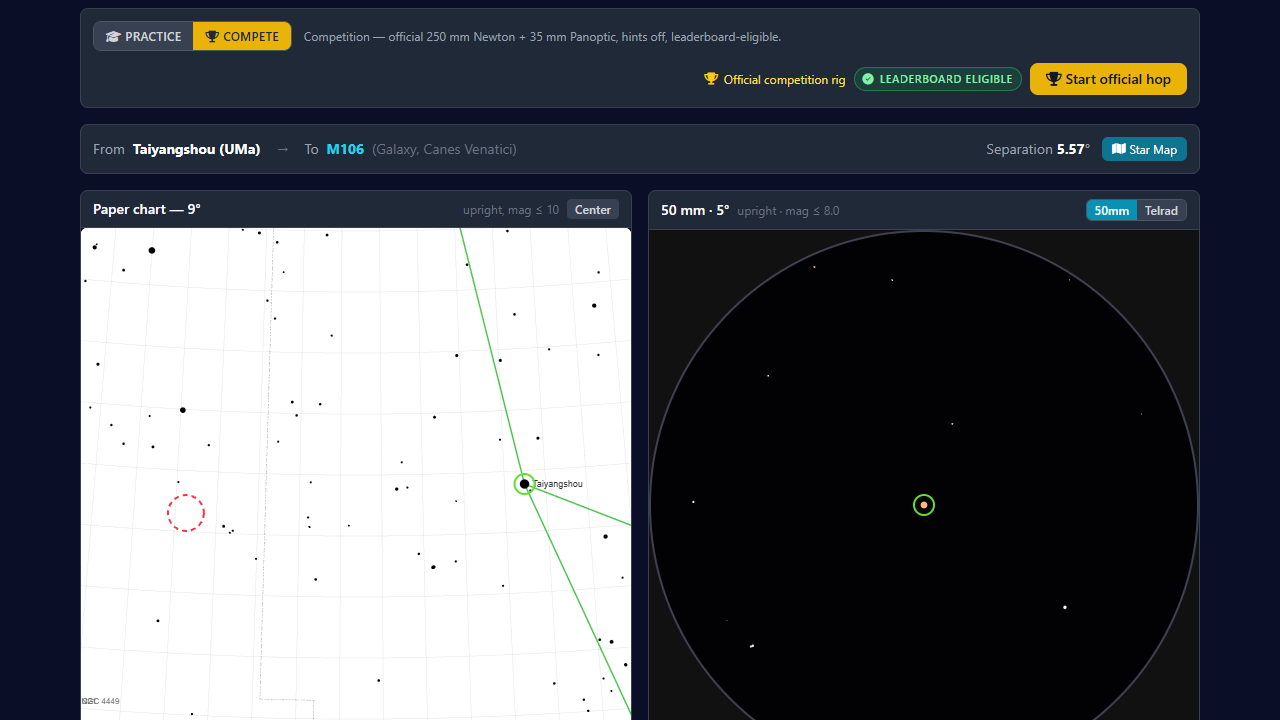
You're given a naked-eye start star and a deep-sky target. The screen shows three synchronized panes: a paper chart for the wide view, a finder scope for the medium hop, and an eyepiece for the final push. Slew with arrow keys (or on-screen d-pad) until the target lands in the eyepiece field, then click on it. The game tracks your time and counts every miss against you.
What it trains
-
Telescope orientation — the simulator obeys your scope type. Newtonian reflectors flip the image 180°; refractors and SCTs mirror east/west; erect finders show north up. Get used to it before you're under the sky.
-
Field-of-view intuition — what 1° actually looks like through your eyepiece. Different scopes mean different hop strategies.
-
Constellation geometry — you can't hop without knowing the bright stars and their patterns. Repetition cements them.
How to prepare
-
Get a feel for the sky. Open the interactive star map for tonight, set your real location, and just browse. Spot constellations, identify the brightest naked-eye stars, scroll across to your hemisphere of the sky.
-
Pick targets you'd actually observe. The northern drill biases toward Messier showpieces — the same objects you'll log first in real life. The catalog has detail pages with finder charts and difficulty matrices, so you can pre-study a target before drilling on it.
-
Match the simulator to your scope. Pick the preset that's closest to your real instrument (or define a custom one). The image flip and field of view will then match what you see when you go outside — the muscle memory transfers.
-
Plan the approach. Look for distinct star patterns between the start and target. Pick out a route on the paper chart before you start slewing.
Two modes: Practice and Competition
The setup bar at the top of the page has an explicit Practice / Compete toggle. Pick the one that matches your goal — your choice decides which gear you can use, whether hints are available, and whether your run can land on the leaderboard.


The mode toggle is yours to flip at any time, including mid-hop — switching modes scraps the active attempt (no streak hit, no leaderboard write) so you can start fresh under the new rules.
How to play
- Pick a mode. Practice for free experimentation with your own rig and optional hints, Compete for an official, leaderboard-eligible run.
- Start a hop. Press Random Training (Practice) or Start official hop (Competition) for a random target. In Practice you can also type a name into the search box and hit the search icon to drill that specific object.
- Slew. Arrow keys, WASD, or the on-screen d-pad. Hold to cruise, tap to nudge.
- Change eyepieces. For small objects choose a higher magnification to be sure.
- Click the target. When it's centred in the eyepiece, click. Hits stop the clock; misses cost you 5 seconds each.
- Score. Final score = elapsed seconds + (5 × misses). Lower is better.
Tips
- Use bright pattern stars as stepping stones. A short chain of clear hops beats one long blind sweep.
- If you keep missing in Competition, drop to Practice for a few rounds with hints on and let the pointing rings rebuild your sense of scale.
- Use the search box in Practice to drill the specific objects you intend to chase tonight — the muscle memory transfers straight to the eyepiece.
Competition rules
The leaderboard is per-target — fastest M57 hops, fastest Albireo hops, and so on — and only Competition-mode runs are submitted. Even a Practice run that happens to land on the official rig with hints off stays training-only; the leaderboard is opt-in via the mode toggle, not an accidental side-effect of gear choice.
- Mode: Compete tab active. Your choice, not your scope, decides eligibility.
- Official scope: 250 mm f/5 Newtonian (locked when in Competition).
- Official eyepieces: 35 mm Panoptic and a set of Naglers for higher magnification.
- Hints off. Forced off in Competition; pointing rings on the paper chart and finder are hidden.
- Random target only. The search box collapses in Competition — no cherry-picking which object you train on.
- Score: elapsed seconds + (5 × misses).
Practice on any rig you like. When you're ready to fight for a top time, flip the toggle to Compete and press Start official hop.
