Aurora Forecast
Aurora (polar lights) visibility depends on geomagnetic activity and your latitude. The Kp index determines how far south the aurora oval extends. A strongly negative Bz (southward interplanetary magnetic field) opens Earth's magnetosphere, making aurora more likely. High solar wind speed and density amplify the effect.
Loading aurora forecast...
Aurora Oval Map
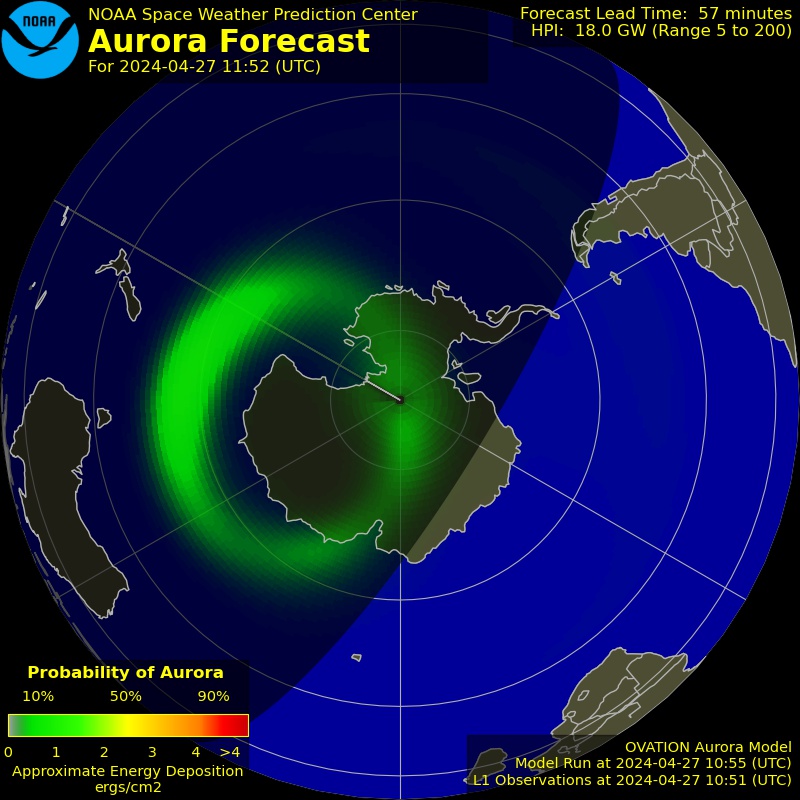
The OVATION model from NOAA shows the predicted aurora oval extent for the next 30 minutes. Green areas indicate likely aurora visibility; red areas show intense geomagnetic activity. The map updates automatically every 5 minutes.

Live Aurora Feeds
Churchill, Manitoba — Northern Lights Cam
Live HD camera at the Churchill Northern Studies Centre, directly under the aurora oval. Best viewing: nighttime, especially Feb–Mar.
explore.orgYellowknife, Canada — AuroraMAX Canadian Space Agency
HD camera in Yellowknife, NWT — one of the best aurora viewing locations on Earth (lat 62°N). A collaboration of the Canadian Space Agency, University of Calgary, and Astronomy North. Active during aurora season (Sep–Apr).
La Silla Observatory — All-Sky Cam ESO / Danish 1.54m
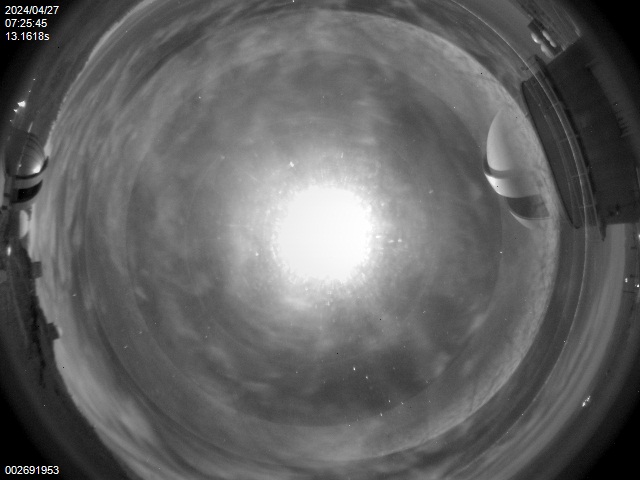
All-sky camera at ESO La Silla Observatory, Chile (lat 29°S, 2400m elevation). Shows the entire night sky including the Milky Way, planets, and occasionally southern aurora (aurora australis). Image updates every few minutes.
ESO Webcams
Aurora Observing Tips
Where to Look
Face north (or south in the Southern Hemisphere) with a clear, dark horizon. Get away from city lights — even faint aurora can be spectacular from a dark site.
When to Watch
Best between 10 PM and 2 AM local time, though strong storms can produce aurora all night. The equinox months (March & September) tend to have more geomagnetic activity.
What to Expect
Faint aurora may look like a pale green glow or clouds on the horizon. Give your eyes 20 minutes to dark-adapt. Strong displays show curtains, rays, and rapid movement in green, red, and purple.
Photography
Use a tripod, wide-angle lens, ISO 1600-6400, aperture f/2.8 or wider, and exposures of 5-15 seconds. Cameras capture aurora colors much better than the naked eye.
