Solar Disk
Solar imagery unavailable
NASA SDO and SOHO servers may be temporarily offline.
Active Sunspot Regions
Current active regions on the solar disk from NOAA Space Weather Prediction Center. Region numbers (AR/NOAA) let you identify and track sunspot groups across days.
| Region | Location | Spots | Area | Mag | Class | C% | M% | X% |
|---|
Solar Orientation
P (position angle of the solar north pole) tells you how far the Sun’s rotation axis is tilted from celestial north — essential for orienting sunspot sketches and photographs. B0 is the heliographic latitude of the disk center: when positive, the Sun’s north pole tips toward us, revealing more of the northern hemisphere; when negative, the southern hemisphere is favored. L0 is the heliographic longitude of the central meridian, advancing ~13.2°/day as the Sun rotates — use it to track sunspots across successive days. The Carrington rotation number counts complete solar rotations since November 1853; Rotation % shows how far through the current rotation we are.
Synoptic texture composited from daily NASA SDO HMI white-light images (public domain). The Sun rotates once every ~27 days; the map updates as new images arrive.
Sun in White Light
White-light observation reveals the photosphere — the Sun’s visible surface at ~5,800 K. This is the simplest and most accessible form of solar observing: a telescope with a certified solar filter (glass or film) is all you need. The photosphere shows sunspots, granulation, limb darkening, and bright faculae — features that trace the Sun’s magnetic activity and convective energy transport.
What to Look For
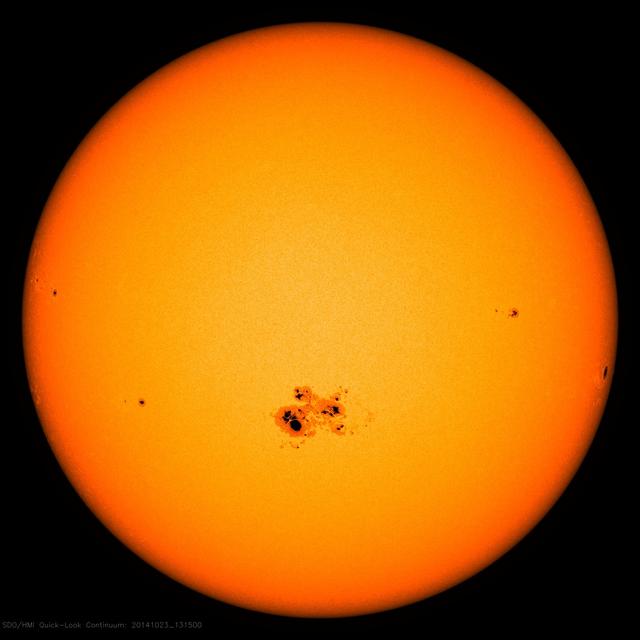
Dark patches on the photosphere where strong magnetic fields inhibit convection, making the surface ~1,500 K cooler. They range from tiny pores to groups spanning many Earth diameters. Track them day-to-day to see solar rotation (~27 days).
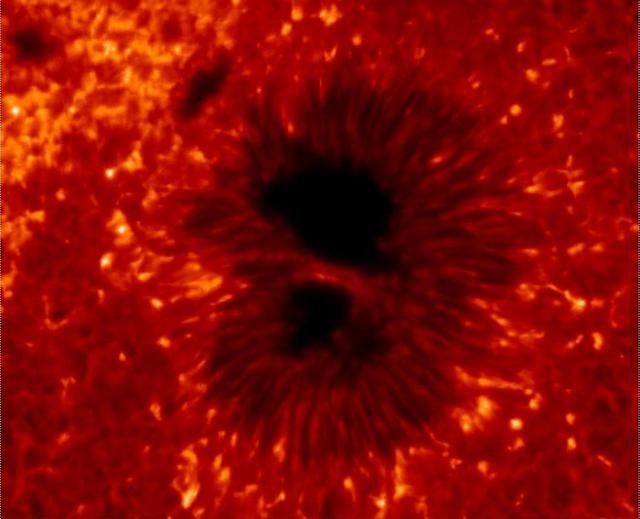
The dark core of a sunspot (umbra) is surrounded by a lighter, striated region (penumbra) with radial filaments. In good seeing, look for light bridges — bright lanes crossing the umbra where the magnetic field is weakening.
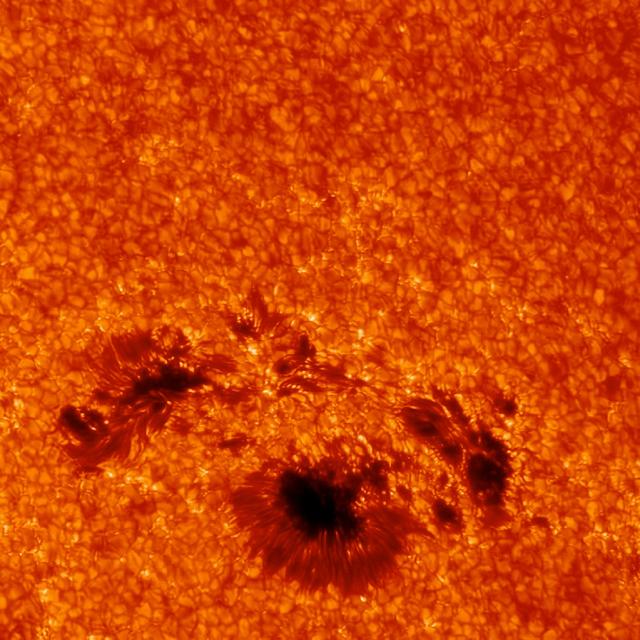
The photosphere is covered in a “rice-grain” pattern of convection cells ~1,000 km across. Each granule is a column of hot gas rising from below, with dark lanes of cooler gas sinking between them. Best seen in steady seeing at 100×+.
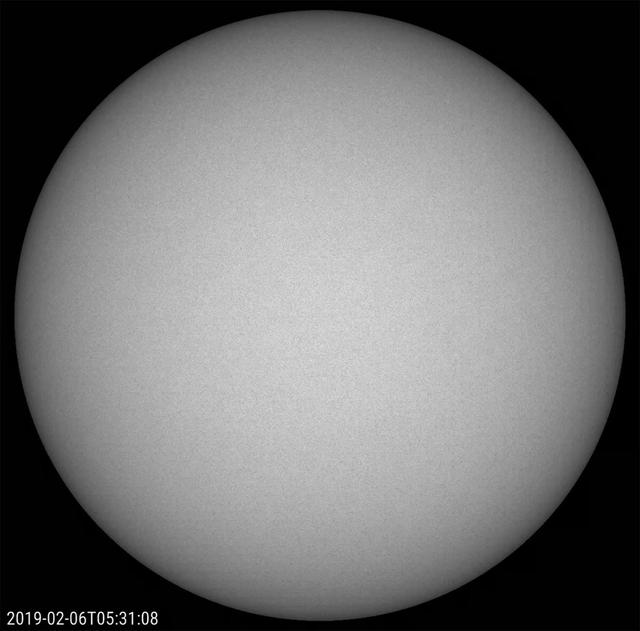
The Sun’s disk is noticeably brighter at center and gradually dims toward the edge. At the limb, we look obliquely through the photosphere and see higher, cooler (dimmer) layers. This is visible even in small telescopes.
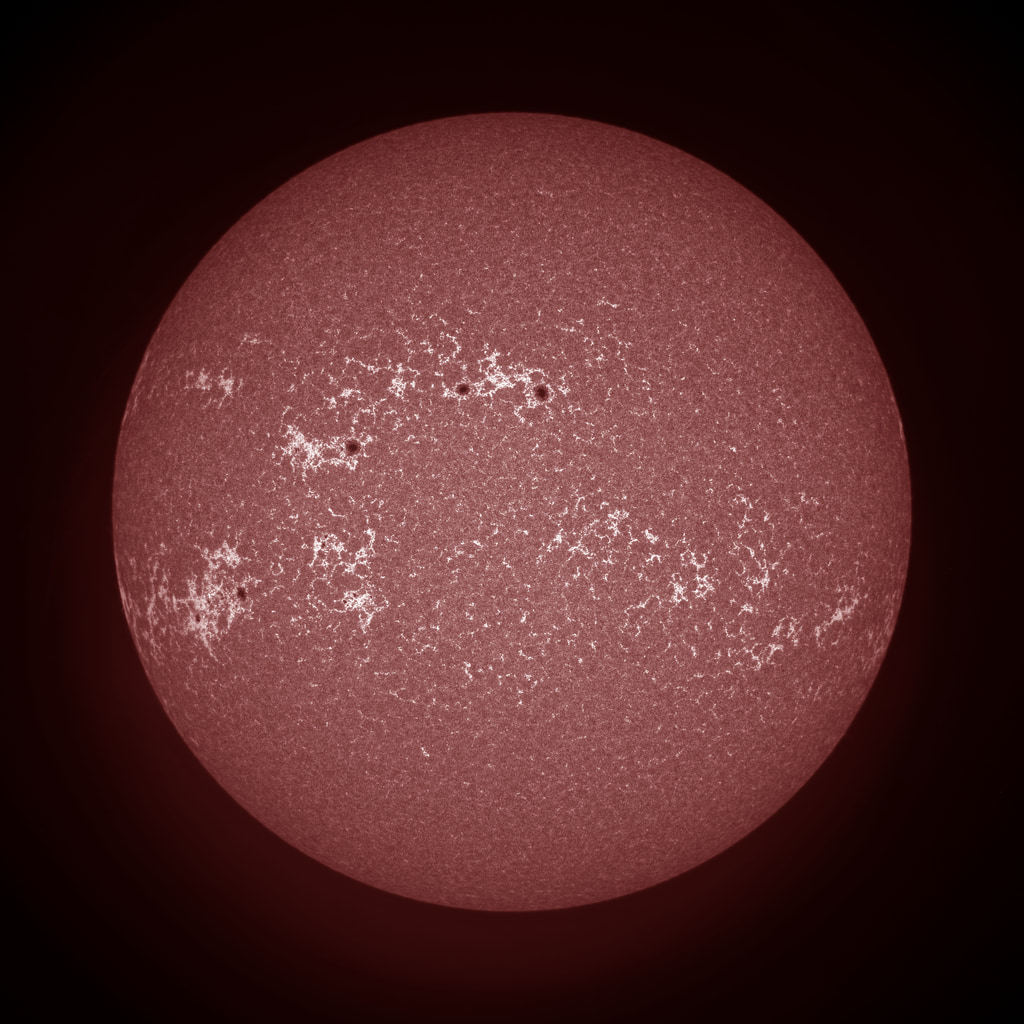
Bright patches best seen near the solar limb where the viewing angle reveals hot walls of magnetic flux tubes. They often surround sunspot groups and can persist long after the spots have faded. Easier to spot when sunspots are nearby for reference.
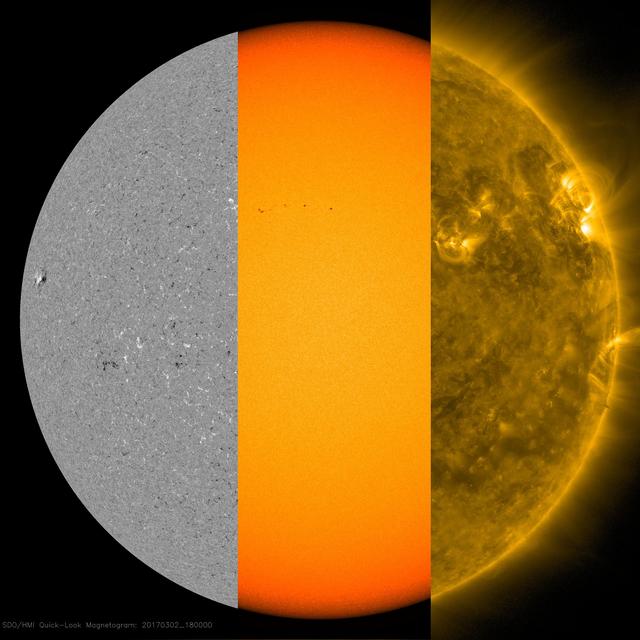
The relative sunspot number R = 10×g + s (g = groups, s = individual spots) lets you track the ~11-year solar cycle. Compare your count with the daily SILSO index. During solar maximum, expect dozens of spots; at minimum, the disk may be blank for weeks.
Images: NASA/SDO (HMI Continuum), JAXA/NASA Hinode (SOT), Sacramento Peak Observatory
Equipment
White-light solar observation requires only a telescope and a certified solar filter that fits over the front of the tube. Both glass (e.g. Thousand Oaks, Baader ND 5.0) and film filters (Baader AstroSolar™ film) work well.
- Full-aperture glass filter — pre-mounted, durable, consistent ND 5.0 density. Screw or friction fit.
- AstroSolar film (ND 5.0) — inexpensive, lightweight. Mount in a rigid cell over the aperture.
- Herschel wedge (prism) — premium option. Reflects 95% of light out the side; delivers the sharpest, most neutral-color image. Refractors only.
For the best detail, use a green or continuum filter (~540 nm) in the eyepiece to reduce atmospheric dispersion and sharpen the image. Magnifications of 80–150× suit most conditions; higher powers demand excellent seeing.
Safety
Never look at the Sun through any telescope, binoculars, or finder scope without a proper solar filter securely fitted over the front of the instrument. Eyepiece solar filters (screw-on dark glass) are dangerous — they can crack from heat concentration. Always inspect your filter for pinholes or damage before each session. Cap or remove finder scopes that lack their own filter.
Sun in H-Alpha
The H-alpha line (656.28 nm) reveals the chromosphere — the dynamic layer just above the photosphere visible in white light. While SDO’s AIA 304 channel (30.4 nm, extreme UV) images similar structures from space, a dedicated H-alpha telescope lets you observe them live at the eyepiece: prominences rising off the limb, dark filaments snaking across the disk, and bright flare ribbons in active regions.
What to Look For
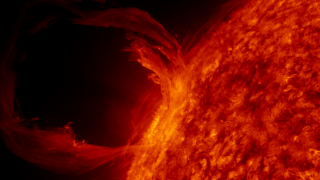
Bright arcs and loops of plasma extending beyond the solar limb. Best seen at the edge of the disk — look for slow changes over minutes to hours.
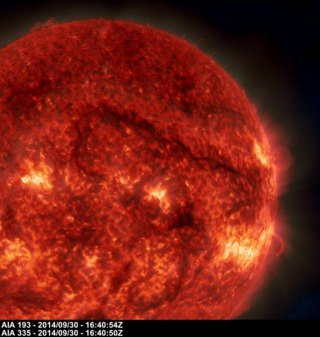
The same structures as prominences, but seen against the bright disk where they appear as dark, winding ribbons. Track them to the limb and watch them become prominences.
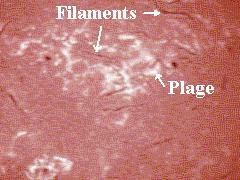
Bright, irregular patches surrounding active regions (sunspot groups). They mark areas of strong magnetic field and often persist after sunspots fade.
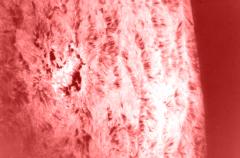
Fine, hair-like jets visible at the limb, giving it a “burning prairie” appearance. Requires good seeing and a narrow-bandwidth scope (<0.7 Å).
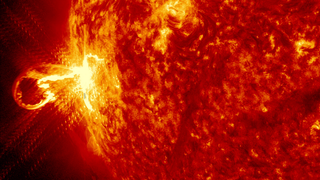
Sudden, intense brightenings in active regions — rare but spectacular. An M- or X-class flare can visibly brighten a region in seconds. Check Space Weather below for current activity.
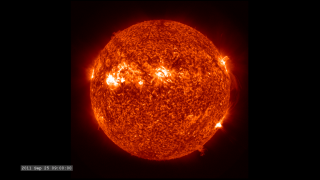
Complex areas combining plage, filaments, and dark fibrils around sunspot groups. Compare with the white-light view to correlate chromospheric and photospheric activity.
Images: NASA/SDO (AIA 304), NASA/MSFC Solar Physics
Equipment
H-alpha observation requires a dedicated solar telescope with an integrated etalon filter (e.g. Lunt, Coronado/Meade SolarMax, DayStar Quark). These instruments pass only a very narrow band around 656.28 nm.
- <1.0 Å — prominences and large-scale features
- <0.7 Å — surface detail (filaments, plage, fibrils)
- <0.5 Å — ideal for fine detail (spicules, flare structure)
Use the tuning mechanism (pressure or tilt) to shift the passband slightly across the H-alpha line. Tuning off-center toward the blue or red wing reveals Doppler-shifted material and can dramatically change what you see.
Safety
H-alpha solar telescopes include a complete filter stack: an energy rejection filter (ERF), a Fabry-Pérot etalon, and a blocking filter. Never use an H-alpha interference filter alone on a regular telescope — it blocks only one narrow wavelength while passing dangerous infrared and ultraviolet radiation. If any filter component is damaged, cracked, or missing, do not observe.
Sun Times
Today's Sun
Twilight
ISS Solar Transits
Astronomical Clocks
What are these times?
Apparent Solar Time is true “sundial time” — the hour angle of the real Sun plus 12 h. It drifts up to ±16 minutes from clock time during the year.
Mean Solar Time is your local clock time based on longitude alone (UTC + longitude correction), ignoring the Equation of Time.
Equation of Time is the difference between apparent and mean solar time, caused by Earth's orbital eccentricity and axial tilt.
Sidereal Time (LMST) measures the hour angle of the vernal equinox — it tells you which right ascension is currently on your meridian.
Julian Date is a continuous day count used in astronomy since 4713 BC, avoiding calendar complications.
Sun Hour Angle is the Sun's angular distance from your local meridian. 0° means the Sun is due south (transit), negative = east (morning), positive = west (afternoon).
Stellar Properties
Physical Properties
Identifiers & Classification
Spectral Type Decoder
Hertzsprung–Russell Diagram
Size Comparison
Stellar Lifecycle
Blackbody Spectrum
Stellar Absorption Spectrum
Simulated absorption spectrum based on spectral type. Hover over lines to identify elements.
