
When general relativity landed in late 1915, almost nobody in Britain wanted to hear it. It was a German theory during a war with Germany. British observatories were run by men who had grown up on Newton. Few in Cambridge could even read the mathematics.
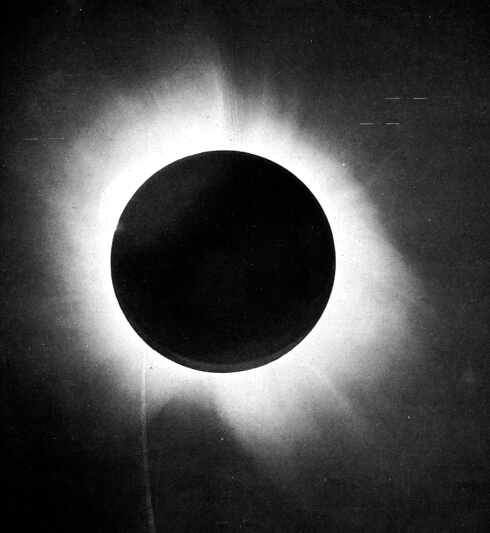
Eddington could. The Chief Assistant at the Royal Observatory, a former Senior Wrangler at Trinity, he had the mathematical horsepower and — as a Quaker — a stubborn belief that science shouldn't care which side of the Channel it came from. He persuaded the Astronomer Royal, Frank Dyson, to plan an expedition around a total solar eclipse predicted for 29 May 1919. The eclipse would sweep across the Atlantic, and a few minutes of totality would let them photograph stars in the Hyades cluster right beside the darkened Sun.
Einstein's prediction was specific: a light ray grazing the Sun's limb should bend by 1.75 arcseconds — exactly twice what a naive Newtonian analysis of light-as-particle gave. The Hyades stars, if photographed against an eclipsed Sun, should appear displaced outward compared to the same stars photographed at night, months earlier.
What Einstein actually predicted
In general relativity, mass doesn't pull on light — it warps the spacetime light has to travel through. A ray grazing the Sun follows a slightly curved path the way a marble follows the lip of a funnel. Eddington's job was to photograph that curvature.
Eddington sailed to Príncipe, a volcanic island off Africa's west coast. Andrew Crommelin led a parallel team to Sobral, in northern Brazil — two sites to insure against weather. On eclipse day, clouds smothered Príncipe until the final minutes; Eddington snapped sixteen plates and only two proved usable. They were enough.

Six months later, at a joint meeting of the Royal Society and the Royal Astronomical Society in Piccadilly, Dyson announced the verdict: the starlight had bent by an amount consistent with general relativity, not with Newton. The New York Times ran it on the front page under a six-deck headline: LIGHTS ALL ASKEW IN THE HEAVENS. Einstein, almost unknown outside physics, became overnight the most famous scientist on Earth. Eddington's cloud-rescued plate — the Dyson, Eddington, and Davidson photograph — remains one of the great confirmations in the history of science.



.jpg)