Menu

The Bortle Scale: Reading Your Sky's Darkness

A single number summarises how dark your sky really is — and whether the galaxy you're hunting tonight has any chance of showing up.

11 min read Matthias Wüllenweber

Key Takeaways

  1. 1

    The Bortle scale, introduced by amateur astronomer John Bortle in 2001, classifies night skies on a 9-point scale from 1 (truly dark) to 9 (inner city).

  2. 2

    Each class is anchored to both a naked-eye limiting magnitude (NELM, the faintest star you can see overhead) and a sky quality meter reading in magnitudes per square arcsecond.

  3. 3

    The scale is the Y-axis of every difficulty estimate — Nightbase's Difficulty Matrix asks for your Bortle class and scopes your targets accordingly.

  4. 4

    Light pollution is growing about 2% globally every year — doubling every generation. What was dark for your grandparents isn't dark now.

  5. 5

    You can't cure your sky — but you can find a darker one. A one-hour drive from a Bortle 7 city to a Bortle 4 rural site gains you 3 magnitudes and multiplies the number of visible stars by ten. Nightbase's Light Pollution Map shows where to drive.

Why Bortle Matters

You set up on the balcony of your suburban apartment, point your 8-inch scope at the Pinwheel Galaxy M101, and see… nothing. Not a smudge. Meanwhile, your friend with a 4-inch scope at a state park one valley over is sketching M101's spiral arms. What happened?

The answer is not the telescope. It is the sky behind the telescope. A galaxy shines at a certain surface brightness — usually between 22 and 25 magnitudes per square arcsecond. Under a truly dark sky (SQM ≈ 22), the galaxy stands out against the background by a fraction of a magnitude, and your eye catches the contrast. Under a suburban sky (SQM ≈ 19), the background itself is 20× brighter than the galaxy's surface — the galaxy is drowning in noise, and no aperture will save it.

Aperture does not fix light pollution

A bigger scope gathers more light from the target — but it also gathers more light from the polluted sky. On diffuse objects (nebulae, galaxies) the ratio stays roughly the same. That is why a small scope under dark skies out-performs a huge scope in a city for every faint target. For point sources (stars, double stars, bright planetary nebulae) aperture still wins. For diffuse targets, transparent darkness wins.

A Tour of the Nine Classes

John Bortle's 2001 scale reads like a tour from Wyoming to Manhattan. Each rung has its own character:

1 2 3 4 5 6 7 8 9 Excellent Rural Suburban Transition City NELM 7.8 6.8 5.8 4.8 < 4.0
The Bortle scale as a sky-brightness gradient. Class 1 skies (left) are nearly pure black; class 9 (right) are the gray-on-orange of a city ceiling.
  • Class 1 — Excellent dark-sky site. SQM 21.8–22.0, NELM 7.6–8.0. The Milky Way casts a shadow on the ground. Jupiter and Venus wreck your dark adaptation. The zodiacal light spans the whole sky. M33 is an unmistakable naked-eye smudge. Rare as hen's teeth — a handful of U.S. national parks, deep rural Australia, the Atacama.
  • Class 2 — Truly dark. SQM 21.6–21.8, NELM 7.1–7.5. Summer Milky Way shows highly structured detail; zodiacal light casts a visible glow at dawn and dusk. The Lagoon Nebula is a bright naked-eye patch in Sagittarius. This is the bar most amateurs call "truly dark."
  • Class 3 — Rural sky. SQM 21.3–21.6, NELM 6.6–7.0. Light pollution visible on one horizon, zenith is black. The Milky Way shows complex structure overhead. M31 (Andromeda) is obvious to the naked eye. Most serious amateur deep-sky work is done at Bortle 3 or better.
  • Class 4 — Rural/suburban transition. SQM 20.8–21.3, NELM 6.3–6.5. Milky Way visible but with dimmed detail. Light-pollution glow on multiple horizons. Faint nebulae need filters. The best skies within a one-hour drive of most European cities.
  • Class 5 — Suburban sky. SQM 19.3–20.8, NELM 5.6–6.0. Milky Way pale and washed out overhead, invisible lower down. Light pollution noticeable in most directions. M31 is still easy; M33 becomes a fight.
  • Class 6 — Bright suburban. SQM 18.5–19.3, NELM 5.1–5.5. Sky glows gray-white near the horizon; only bright constellations are intact. Milky Way visible only near zenith and then faintly. Andromeda's core is visible but the disk shrinks to a small bright oval.
  • Class 7 — Suburban/urban transition. SQM 18.0–18.5, NELM 4.6–5.0. Whole sky glows grayish. Milky Way nearly invisible. Only the brightest Messier clusters punch through with optical aid. Typical inner-ring suburbs of major cities.
  • Class 8 — City sky. SQM < 18.0, NELM 4.1–4.5. Sky glows orange or gray. Only 10–20 brightest stars form the constellations; the rest is drowned. Orion and the Big Dipper remain recognisable; much else is gone.
  • Class 9 — Inner city. NELM ≤ 4.0. Sky is actively bright. Only the Moon, planets, and a few first-magnitude stars visible naked-eye. Even telescope observing is mostly limited to the Moon, double stars, and bright planetary nebulae.

Bortle's original source

John Bortle published his scale in Sky & Telescope in February 2001 as a practical rubric for amateur astronomers after decades of hearing people describe "dark skies" they had not actually experienced. His framing has become universal because it is anchored in observables: you can check your class tonight without a meter.

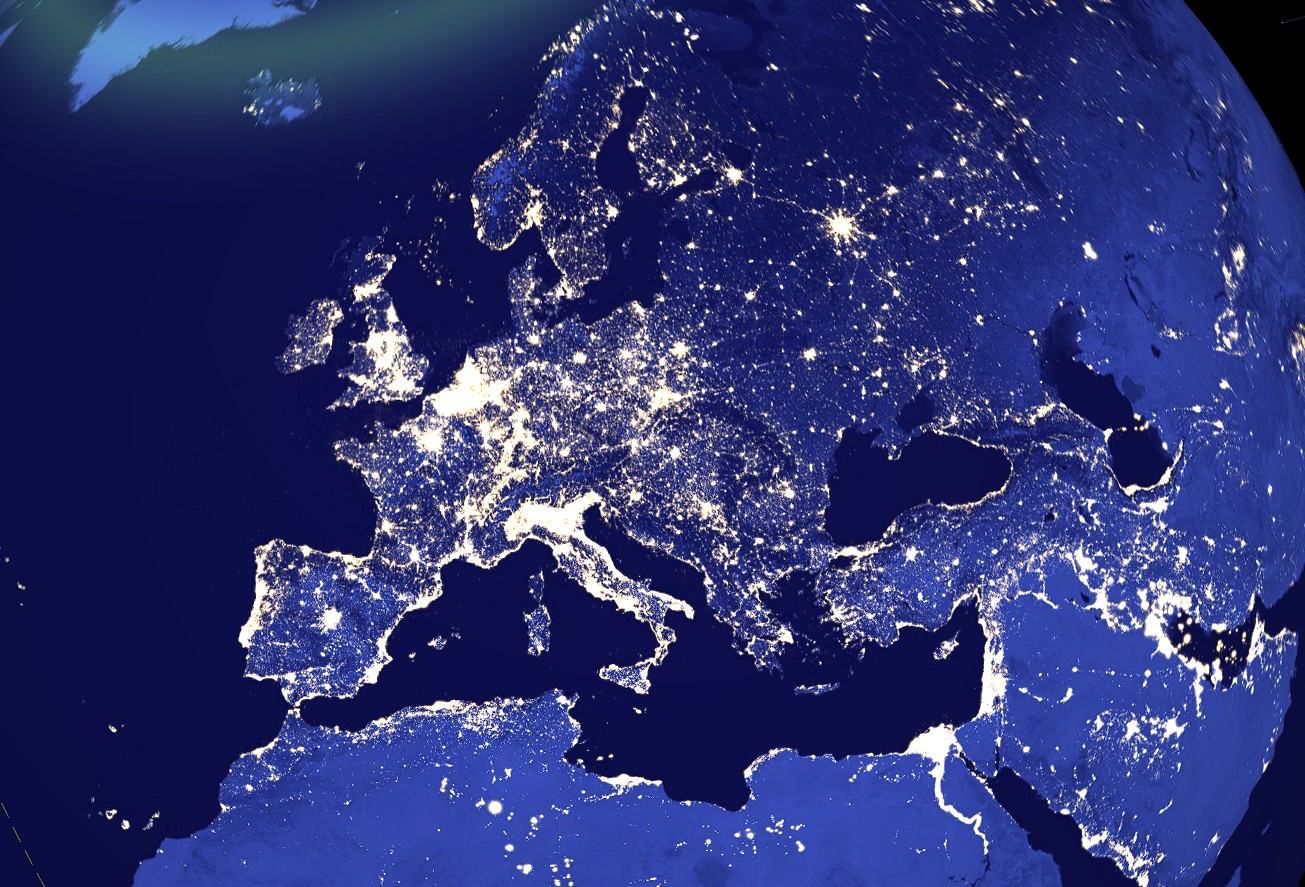
Night-side view of Earth over Europe, showing city lights as a web of glowing dots across the continent
Europe at night, rendered on Nightbase's interactive 3D Earth. Every bright patch is a Bortle 7–9 sky; every dark patch is where amateur astronomers drive to. Drag the globe to find yours. Night-lights imagery courtesy NASA Earth Observatory / VIIRS.

Measuring Your Own Sky

Bortle class is not a guess. Three ways to pin it down:

1. Count stars in the Little Dipper. The best free method. On a moonless night, fully dark-adapted, count the stars inside the bowl of Ursa Minor (between Polaris and the two "guard stars" at the dipper's mouth). Match your count to the scale below — this gives you NELM to about half a magnitude.

2stars · NELM ~4 · Class 8–9
4stars · NELM ~5 · Class 6–7
6stars · NELM ~6 · Class 4–5
8+stars · NELM ~7 · Class 2–3

2. Use a Sky Quality Meter. The Unihedron SQM-L is a handheld photometer, about the size of a TV remote, that points at the zenith and reads sky brightness in magnitudes per square arcsecond. Around $140. Much more precise than star-counting and removes the guesswork about your own vision. Values around 22.0 are pristine; around 17 is downtown.

3. Use Nightbase's Light Pollution Map. Built from the VIIRS nighttime dataset and overlaid on an interactive world map. Pan to your home, click to read the Bortle class and SQM estimate for that spot, then search outward for the nearest dark site. Accurate to about one class and lets you plan observing trips without ever going outside.

The "one star per hour" test

Pick any moonless night. Start with the naked-eye sky. Count how many stars you see inside the Little Dipper bowl. Twenty minutes later, count again. And again twenty minutes after that. Most people find their count goes up by 2–3 stars as dark adaptation matures — meaning your first count underestimated your Bortle class by one step. The lesson: give your eyes half an hour before you claim to know your sky.

Where the Light Comes From

Light pollution has four components — and only some are amateur observers' enemies:

  • Sky glow — the diffuse hemisphere of scattered light above a city. The main component; this is what the Bortle scale measures.
  • Glare — direct light from unshielded fixtures that strikes the eye. Destroys dark adaptation instantly.
  • Light trespass — light crossing property lines (your neighbour's unshielded security light pouring onto your scope).
  • Clutter — excessive, grouped light sources (commercial strips) that overwhelm.

The technology is changing fast — and not always for the better. The transition from orange sodium-vapour streetlights to blue-white LEDs after 2010 made cities modestly more energy-efficient and dramatically brighter across the blue end of the spectrum, where the sky scatters most effectively (Rayleigh scattering scales as 1/λ⁴). Astronomers noticed — the nearly-universal rollout has increased sky glow at short wavelengths by factors of two to three in many regions, even where the total lumens stayed flat.

A generation of galaxies, lost

Satellite data show that global light pollution is growing at about 2% per year — roughly 10% per five years, or a factor of two per human generation. The sky your grandparents observed from a suburb is now a sky you must drive hours to find. Within the remaining century of amateur astronomy as we know it, naked-eye stars will vanish from vast swathes of the inhabited world unless the trend is reversed.

What You Can Still See

Even from a bright suburb (Bortle 6), the sky is not empty. Nightbase's difficulty matrix reflects this honestly: target categories degrade differently under light pollution.

What survives city skies (Bortle 7–9):

  • The Moon. Immune to light pollution.
  • Planets. Jupiter's belts, Saturn's rings, Mars's polar caps — all unaffected.
  • Double stars. Point-source contrast is mostly preserved; Albireo's gold-and-blue is as beautiful from downtown as from a mountaintop.
  • Bright open clusters. The Pleiades, the Beehive, the Double Cluster.
  • Compact planetary nebulae. NGC 6543 (Cat's Eye), NGC 7009 (Saturn), M57 (Ring). Small, bright, and an OIII filter eats sky glow.

What survives suburbs (Bortle 4–6): All of the above, plus:

  • Bright galaxies with compact cores. M31, M81, M104.
  • Globular clusters. M13, M22, ω Cen all show at least partial resolution.
  • Bright nebulae with filters. Orion (M42), Lagoon (M8), Omega (M17), Dumbbell (M27).

What needs darker skies (Bortle 3 or better):

  • Low-surface-brightness galaxies. M33, M101, M74, most Messier galaxies beyond the Virgo Cluster.
  • Emission nebulae beyond the brightest. Veil, California, Heart & Soul.
  • The Milky Way itself as a structured band with dark rifts and bright patches.

Finding Darker Skies

There is only one way to observe galaxies from a bright suburb: drive away from it. The math is simple and brutal — sky brightness falls off roughly with the inverse square of distance from the nearest urban core. Thirty kilometers out can give you half a magnitude of improvement; sixty can give you a full magnitude; a hundred can put you in genuinely dark territory.

Useful resources for planning:

  • Nightbase's Light Pollution Map. Pan anywhere in the world, read off the Bortle class for any point, and find the nearest darker site by eye. The fastest way to scope out a new observing location.
  • Nightbase's user location field. Set your regular observing site once and the difficulty matrix auto-populates with your Bortle class for every catalog page. See Observing Workflow.
  • Clear Outside or similar weather apps. Many now display Bortle class for your location automatically.
  • DarkSky Places. The non-profit DarkSky International certifies parks, reserves, and communities worldwide as light-pollution-controlled. Over 200 sites globally, including dozens in the U.S., Europe, and Oceania.

A one-night trip from a Bortle 7 home base to a Bortle 4 site an hour away will show you more in four hours than a week of evenings at home. Plan around the Moon: two weeks per month around new Moon give you the dark hours that make the drive worth it.

The 10° rule

Avoid observing objects closer than 10° above the horizon in polluted skies. The extra air column mass at low altitudes amplifies every bit of city glow along that sightline. An object barely visible at altitude 25° becomes invisible at altitude 10°. Plan your observing list around transit times so targets are high when you attack them.

Test Yourself

Q1 You move from a Bortle 7 suburban backyard to a Bortle 4 state park an hour away. Roughly how many more naked-eye stars are available to you?

Going from Bortle 7 (NELM ≈ 4.8) to Bortle 4 (NELM ≈ 6.4) gains you about 1.6 magnitudes. Each magnitude you gain multiplies the number of visible stars by roughly 2.5 — two magnitudes multiplies by about 6. The improvement from Bortle 7 to Bortle 4 makes roughly 5× more stars naked-eye-visible in the same area of sky. On the full sky, the count rises from a few hundred stars to a few thousand.

Q2 Why is aperture not the answer to light pollution for diffuse objects like galaxies?

A bigger telescope gathers more photons from the target, but the background sky is also part of the image — and a bigger aperture gathers more sky-glow light too. The signal-to-noise ratio (target / sky) stays roughly constant for extended objects. For point sources (stars, double stars) the target concentrates into a tiny spot on the retina while the sky spreads across a larger area, so aperture still helps — but for extended diffuse objects, darker skies beat bigger scopes.

Q3 An OIII filter helps with planetary nebulae and emission nebulae but not with galaxies or star clusters. Why?

OIII filters are narrowband — they transmit only a narrow range around the doubly-ionized oxygen emission line at 501 nm and block everything else, including most sky-glow wavelengths. Emission nebulae and planetary nebulae emit most of their light in that OIII line, so their signal passes through nearly undiminished while the sky background is cut dramatically. Galaxies and star clusters emit a broadband continuum across all visible wavelengths, so the filter blocks most of their light along with the sky glow — net zero improvement.

Q4 Your friend insists their suburban backyard is "Bortle 3 quality." Without a meter, how do you check?

Count the stars in the bowl of the Little Dipper, dark-adapted, on a moonless night. Bortle 3 (NELM ~6.8) should show seven or more stars inside the bowl and clearly expose the Milky Way as a structured band overhead. If only five stars are visible and the Milky Way is a faint haze, the sky is probably Bortle 4 or 5. Sky Quality Meter readings of 21.3+ confirm Bortle 3. Most backyards in any urbanised region are at least one class poorer than their owners believe — the exercise is humbling.

bortle light-pollution observing sky-quality dark-sky