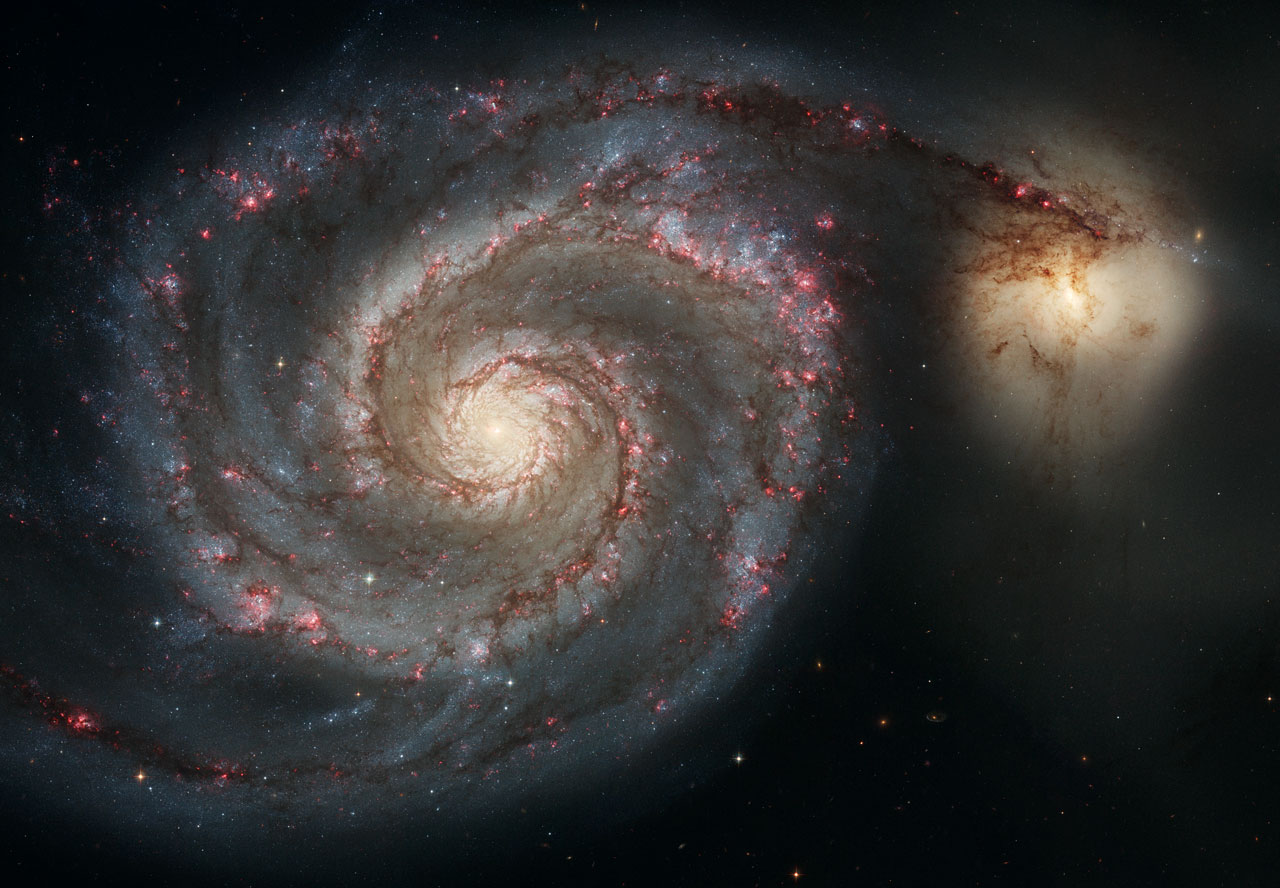
Pick up a catalog and you will read that the Triangulum Galaxy, M33, shines at magnitude 5.7 — a naked-eye object. Go outside and try to see it and you will fail from anywhere short of a truly dark site. What went wrong?
Stellar magnitudes describe a point source — all of the light crammed into a single pixel on your retina. A galaxy spreads the same amount of light over a patch of sky as large as the Moon. The figure that actually matters is surface brightness — how much light reaches each square arcsecond. M33's surface brightness is about 14 magnitudes per square arcsecond, which is darker than many night skies. You are not looking for a bright thing; you are looking for something fractionally brighter than the blackness next to it.
Two galaxies, same magnitude, different fate
M81 (Bode's Galaxy) and M101 (the Pinwheel) both sit at around magnitude 7.9 in the catalog. M81 is easy in 10×50 binoculars; M101 is a notorious urban-sky failure. M81's light is concentrated into a small, dense oval — high surface brightness. M101 is face-on, huge, and diffuse — its photons are spread so thin they drown in the sky. Never trust magnitude alone.