Menu

Galaxies — A Guide for Observers

A galaxy at the eyepiece is not a photo. It is a whisper of grey against a black field — and learning to hear that whisper is one of the deepest pleasures amateur astronomy offers.

12 min read Matthias Wüllenweber

Key Takeaways

  1. 1

    Total magnitude lies. A galaxy's light is spread over many square arcminutes; what your eye actually cares about is surface brightness. The Andromeda Galaxy at magnitude 3.4 is harder to see than any star of magnitude 6.

  2. 2

    The Hubble sequence — ellipticals, spirals, barred spirals, irregulars — predicts what you will see visually. Ellipticals are featureless fuzzballs; spirals can show arms and dust lanes under good skies.

  3. 3

    Galaxies come in groups. Leo, Virgo, Coma, Fornax, and the Local Group are clusters of worlds to spend a whole evening on, not individual targets.

  4. 4

    Technique matters more than aperture. Averted vision, low magnification, a dark site, and patience will coax arms out of M51 in a 4-inch scope.

  5. 5

    Start with the top ten. Andromeda, the Whirlpool, Bode's and the Cigar, the Pinwheel, the Sombrero, and the Leo Triplet will teach you nearly every visual trick galaxies have.

Why Galaxies Fool You

Pick up a catalog and you will read that the Triangulum Galaxy, M33, shines at magnitude 5.7 — a naked-eye object. Go outside and try to see it and you will fail from anywhere short of a truly dark site. What went wrong?

Stellar magnitudes describe a point source — all of the light crammed into a single pixel on your retina. A galaxy spreads the same amount of light over a patch of sky as large as the Moon. The figure that actually matters is surface brightness — how much light reaches each square arcsecond. M33's surface brightness is about 14 magnitudes per square arcsecond, which is darker than many night skies. You are not looking for a bright thing; you are looking for something fractionally brighter than the blackness next to it.

3.4M31 integrated magnitude
13.5M31 surface brightness (mag / arcsec²)
M31 apparent length — 6 × the Moon

Two galaxies, same magnitude, different fate

M81 (Bode's Galaxy) and M101 (the Pinwheel) both sit at around magnitude 7.9 in the catalog. M81 is easy in 10×50 binoculars; M101 is a notorious urban-sky failure. M81's light is concentrated into a small, dense oval — high surface brightness. M101 is face-on, huge, and diffuse — its photons are spread so thin they drown in the sky. Never trust magnitude alone.

What You're Actually Seeing

A galaxy in an amateur telescope is not a Hubble image. Forget the arms, forget the color, forget the dust lanes at first. The first thing your eye will register is a faint oval of uniform grey — the galaxy's bulge and inner disk, lit by a hundred billion G-, K-, and M-dwarfs blurring together at vast distance. Only when conditions, equipment, and technique align do the extras appear:

  • The core. Almost every spiral's nucleus is the bright centre — a spherical cloud of old stars. It is the last thing to fade when clouds roll in and the first to appear when they clear.
  • The disk. A broader glow around the core, often elongated, showing the galaxy's inclination to our line of sight.
  • Dust lanes. Dark cuts through the disk where dense interstellar dust absorbs the light of stars behind it. Seen best in edge-on spirals like NGC 4565 and the Sombrero.
  • Spiral arms. The hardest feature. Need dark skies, 6-inch or larger aperture, and practice. M51 and M101 are the two targets where amateurs first see arms rather than imagine them.
  • Companions. Many big galaxies come with smaller siblings. M31 has M32 and M110 flanking it; M51 has NGC 5195 grappled to one arm.
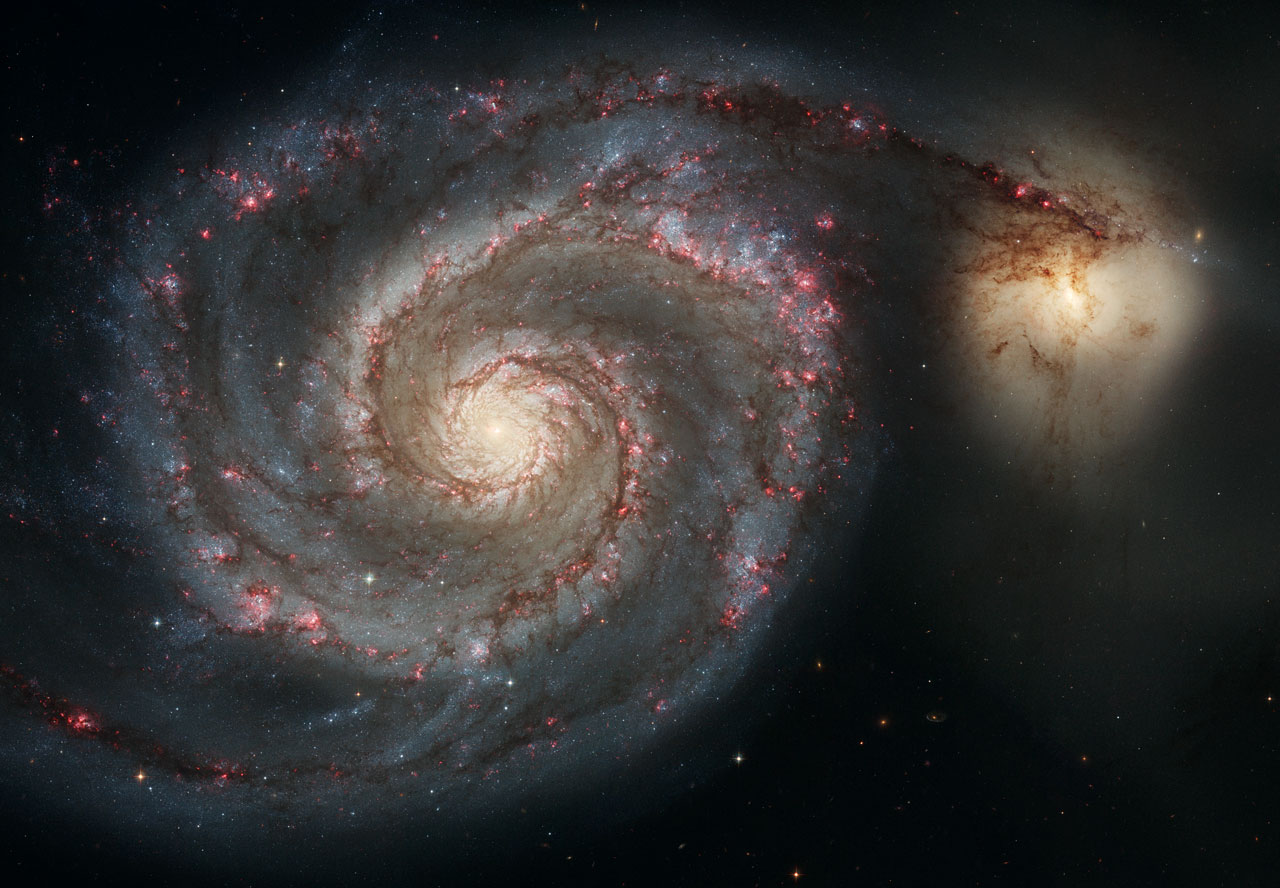
Hubble Space Telescope image of the Whirlpool Galaxy M51 showing its grand spiral arms and the companion NGC 5195
The Whirlpool Galaxy M51 with its companion NGC 5195, as Hubble sees it. An 8-inch telescope under dark skies shows the core, the bridge between them, and — with practice — the two main spiral arms. Credit: NASA, ESA, S. Beckwith (STScI) & The Hubble Heritage Team (STScI/AURA).

The Hubble Sequence at the Eyepiece

Edwin Hubble's 1926 tuning-fork classification still works as a predictor of what you will see. Four families, four visual fingerprints:

  • Ellipticals (E0–E7): featureless glowing eggs. No arms, no dust, no structure. Old stars only. Brightest cluster members — M49, M87, M110 — are usually ellipticals. Verdict: easy to find, nothing to draw.
  • Lenticulars (S0): a disk with no arms. The transitional class — flattened but smooth. NGC 5128 / Centaurus A is a famous example, complicated by a dramatic dust lane from a recent merger. Verdict: hunt for the lane.
  • Spirals (Sa–Sc): the classical arms-around-a-bulge galaxies. Sa have tight arms and a dominant bulge; Sc have loose arms and a small bulge. M31 is Sb; M33 is Sc.
  • Barred spirals (SBa–SBc): a straight bar of stars cuts the nucleus before the arms start. The Milky Way is one. M83 and NGC 1365 are showpieces.
  • Irregulars (Irr): shapeless. Often the victims or perpetrators of recent collisions. M82 is the most famous — a cigar-shaped starburst torn open by gravitational interaction with its neighbour M81.

Spirals glow blue; ellipticals glow red

Spirals still form stars, so they contain hot, bright, short-lived O and B stars. Ellipticals finished forming stars billions of years ago and contain only cool long-lived dwarfs. Color cameras show this clearly. Your eye is not sensitive enough to see the difference directly, but it is why ellipticals in images always look yellow-white and spirals always show a blue tint along their arms.

Finding Galaxies: Groups and Clusters

Galaxies are social. The sky has a handful of dense galaxy-group regions where you can sweep for hours and never run out of targets. Pick one per season and spend a whole evening there — you will finish knowing the region better than any list could teach you.

  • The Local Group (autumn / winter in the north). M31 plus M32 and M110, then M33 in Triangulum. All three are within 3 million light-years.
  • Leo I group (spring). The Leo TripletM65, M66, and NGC 3628 — fits in one low-power eyepiece field at 35 million light-years.
  • The Virgo Cluster (spring). Over 1,000 galaxies; the densely-packed heart contains a dozen within one binocular field. Start at M84 and M86 and sweep east along Markarian's Chain. Bring a detailed chart — you will lose count.
  • The Coma–Virgo supercluster (spring). Extends north from Virgo through Coma Berenices. M64 (Black Eye), NGC 4565 (Needle), and the Coma Cluster itself.
  • The Fornax Cluster (autumn, southern skies). NGC 1365, NGC 1316, and a dozen more in a few degrees.
  • Ursa Major galaxies (spring). Not a cluster but a rich observing region: M81/M82, M101, M108, M109.

Ten Galaxies Every Observer Should Know

Learn these first. They cover every major visual type and teach you how galaxies behave at the eyepiece.

  1. Andromeda Galaxy (M31) — mag 3.4, Sb, 2.5 million ly. Huge, oval, with a stellar-like core. Three degrees of length at a dark site. Bring the widest eyepiece you own.
  2. Triangulum (M33) — mag 5.7, Sc, 2.7 million ly. The most notorious "surface-brightness" target. Trivial in 10×50 binoculars under Bortle 3; invisible in Bortle 7.
  3. Bode's Galaxy (M81) — mag 6.9, Sb, 12 million ly. Easy, compact, bright core. The best "proof of principle" galaxy for beginners.
  4. Cigar Galaxy (M82) — mag 8.4, Irr, 12 million ly. In the same low-power field as M81 — a dramatic contrast. Edge-on, cigar-shaped, with visible dark mottling from a starburst.
  5. Whirlpool (M51) — mag 8.4, Sbc + companion, 23 million ly. The classical grand-design spiral. Arms visible with patience in 6-inch aperture under Bortle 4 or darker.
  6. Pinwheel (M101) — mag 7.9, Sc, 21 million ly. Face-on, enormous, very low surface brightness. A dark-sky test target.
  7. Sombrero (M104) — mag 8.0, Sa, 29 million ly. A bright oval bisected by a sharp dust lane. Unmistakable at medium power.
  8. Sculptor (NGC 253) — mag 7.1, SBc, 11 million ly. Southern-hemisphere showpiece. Large, elongated, mottled.
  9. Centaurus A (NGC 5128) — mag 7.0, S0 merger remnant, 13 million ly. A bright lenticular cut in half by a dramatic dust lane; the most structurally striking galaxy in the southern sky.
  10. Leo Triplet (M65 + M66 + NGC 3628) — three spirals, different orientations, one eyepiece field.

Technique: Seeing the Faint Ones

The single biggest improvement most beginners make on galaxies is not buying a bigger scope — it is learning to use the eyes and scope they already have.

  • Dark-adapt. Thirty full minutes in real darkness. The difference between 20 minutes and 30 is perceptible, especially on low-surface-brightness targets.
  • Use averted vision. Look slightly off to one side of the galaxy; rods dominate the retina outside the fovea. Many galaxies that are invisible when stared at directly snap into view when looked away from. See our forthcoming article on averted vision for the physiology.
  • Low magnification first. A galaxy's light competes with the sky background. Spreading it across a wide field of stars lowers contrast; concentrating it with just enough magnification to darken the background without losing surface detail is the sweet spot — typically 50× to 100× on spirals, higher on compact ellipticals.
  • Tap the telescope. A brief jiggle puts the image in motion for half a second; the eye's motion-detection circuitry is far more sensitive than its still-frame circuitry. Arms on M51, the dust lane on the Sombrero, the ring structure of NGC 253 — all show up better briefly after a tap.
  • Sketch what you see. Writing down or drawing the features forces you to look systematically, and a week later you will have caught details you missed in real time. See Sketching Astronomical Objects.
  • Check the Difficulty Matrix on the galaxy's detail page. Nightbase rates each galaxy against your telescope and Bortle class; low-surface-brightness galaxies drop rapidly in score from Bortle 4 to Bortle 5, and the number will tell you whether to drive for a dark site.

The Andromeda averted-vision test

On the first clear night M31 is up, find the bright fuzzy oval with the naked eye. Stare straight at it and note how long it extends — usually about a degree either side of the core. Now slightly to the east of the galaxy and use averted vision. The disk will stretch out — sometimes by a factor of three. People trained in averted vision regularly report M31 at 3° from end to end; untrained eyes see one degree.

Interacting and Weird Galaxies

Some of the most memorable galaxies are the ones in the middle of a gravitational car crash. Tidal forces during close passes pull out long tails of stars, trigger bursts of star formation, and distort both partners.

  • M51 + NGC 5195. The classic. Look for the bridge of stars between them — a tidal arm tugged out by the smaller galaxy's passage 500 million years ago.
  • The Antennae (NGC 4038 / NGC 4039). Two spirals colliding in Corvus. Mag 10.5; appears as a pair of merged Cs in amateur scopes. Hubble has photographed the quarter-million-light-year tails of stars trailing behind — the "antennae" of the name.
  • The Mice (NGC 4676). In Coma. Two tangled spirals with two long stellar tails. Too faint for visual at mag 14, but worth knowing about when you're in the area.
  • Arp's galaxies. Halton Arp cataloged 338 "peculiar" galaxies in 1966. Many are accessible: Arp 273, Arp 188 (the Tadpole), Arp 220 (merger at visual mag 13). An advanced project.

Every spiral you see was a collision site

The Milky Way is currently digesting the Sagittarius Dwarf and the Canis Major overdensity. Andromeda contains multiple tidal streams from meals taken billions of years ago. M31 and the Milky Way will merge in ~4.5 billion years, producing a gigantic elliptical. The galaxy shapes you are drawing tonight are not steady — they are pause-frames in a slow, violent history.

Test Yourself

Q1 Why can M33 be catalogued as a naked-eye object (magnitude 5.7) and yet be invisible from most cities?

The magnitude is the total integrated light. M33 spreads that light over more than a square degree, giving a surface brightness of about 14 mag/arcsec² — darker than a suburban sky, which typically runs 18–19 mag/arcsec² brighter than natural. When the background sky is brighter than the galaxy's surface brightness, the contrast vanishes. A dark-site visit flips the equation and M33 becomes a large naked-eye fuzzy patch.

Q2 Two galaxies are both listed as magnitude 8.0. One shows up in 10×50 binoculars from your yard; the other needs 8 inches from a dark site. What explains the difference?

Surface brightness, driven by angular size. The first galaxy is compact — all its light crammed into a small angular area, high contrast against the sky. The second is extended — the same total light smeared across a large area, drowning in the sky background. The Difficulty Matrix on Nightbase uses total magnitude and surface brightness (for galaxies, via the ConcentrationIndex) for exactly this reason.

Q3 Why do edge-on spiral galaxies (NGC 4565, the Sombrero) show such prominent dust lanes while face-on spirals (M101) don't?

Geometry. In an edge-on spiral you look through the entire thickness of the disk, and the dust layer — which is thin but concentrated in the disk plane — absorbs light from stars behind it along a long sightline. In a face-on spiral the dust sits between you and a thin sheet of stars; it still absorbs light, but the effect is spread everywhere instead of concentrated in a sharp silhouetted lane. Face-on spirals do have dust, but it's subtler — you see it as mottling along the arms, not as a hard dark stripe.

Q4 Why is M82 so irregular compared to its companion M81?

The two galaxies are gravitationally interacting. They passed close to each other about 300 million years ago, and the encounter disrupted M82 — its gas compressed, triggered a massive burst of star formation that still fills the galaxy with hot young stars and supernova-driven outflows. M81, much more massive, held its spiral shape. Starburst activity and the superwinds from it give M82 the mottled, torn, cigar-shaped appearance that is so distinctive at the eyepiece. You are watching the aftermath of a galactic collision in slow motion.

galaxies deep-sky observing hubble-sequence