Eunomia — Asteroid in Virgo
About Eunomia
Description
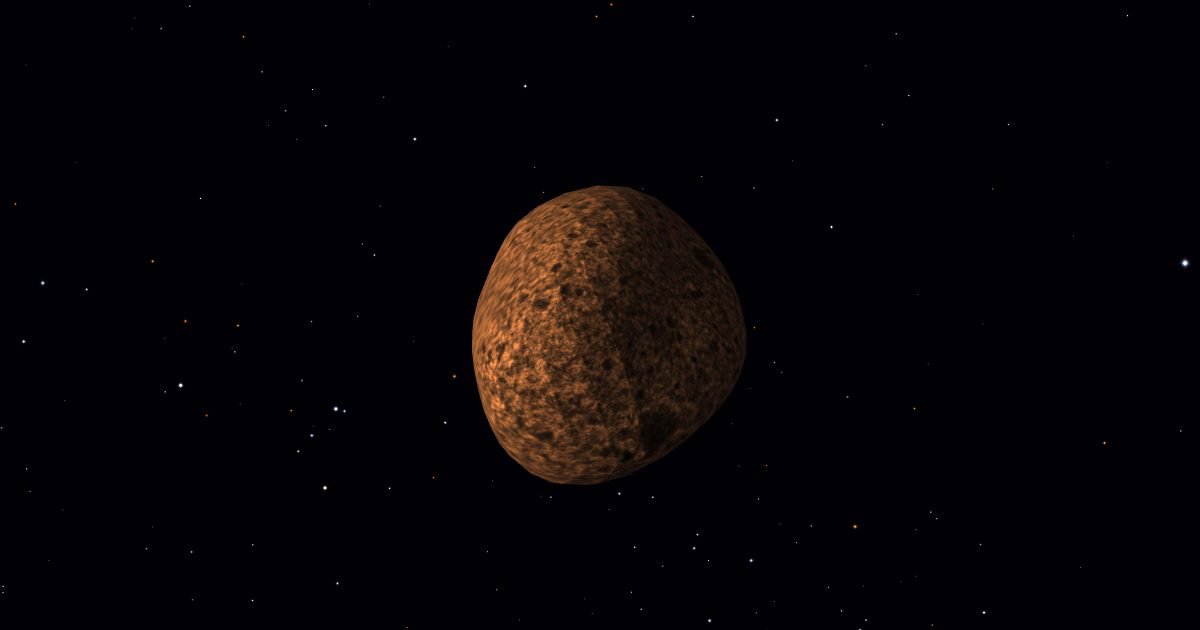
Eunomia is the largest S-type asteroid in the solar system with a diameter of 270 km, orbiting at 2.64 AU in the middle of the asteroid belt. It is the parent body of the Eunomia asteroid family, one of the most prominent families in the intermediate belt. Eunomia's surface is composed of silicates, nickel-iron, calcium-rich pyroxenes, and olivine — indicating it is a partially differentiated body that experienced internal heating early in its history. The current asteroid is thought to be the central remnant of a larger parent body that was shattered by a catastrophic collision, with the Eunomia family members being the scattered fragments. Eunomia has an elongated shape and shows significant brightness variations as it rotates.
Observing Tips
At opposition, Eunomia reaches about magnitude 7.9, requiring binoculars or a small telescope. Its brightness ranges from magnitude 8 to 10 depending on its position in orbit. Eunomia's elongated shape causes noticeable brightness variations during its 6-hour rotation — advanced observers can detect these with careful photometric measurements. Best viewed from September through November around opposition, which occurs roughly every 16 months. Its middle-belt position gives it a moderate apparent speed against the star field. Use an ephemeris to track its position and identify it through nightly motion.
History
Eunomia was discovered on July 29, 1851 by Italian astronomer Annibale de Gasparis at the Capodimonte Observatory in Naples — the same astronomer who had discovered Hygiea two years earlier. It was the fifteenth asteroid discovered and was named after Eunomia, one of the Horae (Hours) in Greek mythology, a goddess representing order and lawful conduct. De Gasparis was a remarkably successful asteroid hunter, discovering nine asteroids between 1849 and 1865. No spacecraft has visited Eunomia.
Fun Facts
Eunomia is so elongated that its brightness changes by a full magnitude during each rotation — one of the largest lightcurve amplitudes of any large asteroid, making it appear to 'blink' over its 6-hour spin. As the largest S-type asteroid, it offers the best laboratory for studying stony asteroid composition from Earth. The Eunomia family contains hundreds of known members, all fragments from the violent breakup of the original parent body.
Properties
Position & Identifiers
Physical Properties
Orbital Properties
Brightness Forecast (next 12 months)
Apparent magnitude as Earth–asteroid distance changes through the year. The peak marks the brightest moment in the window — usually around opposition, when the asteroid is closest and fully illuminated.
Computed from JPL orbital elements via m = H + 5·log10(r·Δ). Phase-function correction is omitted, so curves trace distance variation only — accurate within a few tenths for main-belt asteroids; coarse for fast-moving NEOs near Earth.
Observing Tips
Discovery
Current Ephemeris
How easy to spot?
| Telescope | Bortle 3 | Bortle 4 | Bortle 5 |
|---|---|---|---|
| 80 mm refractor 80mm refr. | Easy | Easy | Medium+ |
| 150 mm Newton 150mm Newt. | Easy | Easy | Easy |
| Celestron C8 (203 mm SCT) C8 203mm | Easy | Easy | Easy |
Bortle 3 = rural · 4 = outer suburbs · 5 = suburbs
Visibility
Set a location in User Settings to see visibility data.
Community Photos (1)
Rendered preview of Eunomia from the Nightbase orrery, lit from the current Sun direction with the terminator visible.
Credit: Nightbase orrery render.
Skybred Apr 27, 2026
Explore Nightbase
Related knowledge, tools, and stories — no observation planning required.
