Flora — Asteroid in Sagittarius
About Flora
Description
Flora is an S-type asteroid with a diameter of 146 km, orbiting at 2.20 AU in the inner asteroid belt. It is the parent body and largest member of the Flora family — one of the largest asteroid families, containing thousands of fragments from ancient collisions. Flora's surface is composed of silicate rock and nickel-iron metal, and the family may be a significant source of L chondrite meteorites. Flora orbits close to the 2:1 mean-motion resonance with Mars and near the ν₆ secular resonance, which can gradually push fragments from the Flora family onto Earth-crossing orbits — making the Flora family a possible source of near-Earth asteroids and potentially linked to the Chicxulub impactor that caused the dinosaur extinction.
Observing Tips
Flora reaches about magnitude 8.1 at favorable oppositions, requiring binoculars or a small telescope. Its brightness typically ranges from magnitude 8 to 10. Being in the inner asteroid belt, Flora moves relatively quickly against background stars, making motion detection easier over consecutive nights. Best observed in the months around opposition, which occurs roughly every 14 months. Its position near the ecliptic means it transits through familiar zodiacal constellations. Use a planetarium app or ephemeris service to identify its current position.
History
Flora was discovered on October 18, 1847 by English astronomer John Russell Hind at the George Bishop Observatory in London — the same year and observatory where he also discovered Iris. Flora was the eighth asteroid discovered and was named after the Roman goddess of flowers and spring. The Flora asteroid family was among the first dynamical families recognized by Japanese astronomer Kiyotsugu Hirayama in 1918, making it important in understanding how asteroid families form through collisional disruption.
Fun Facts
The Flora family may be responsible for the extinction of the dinosaurs. Computer simulations suggest that the Chicxulub impactor — the 10 km asteroid that struck Earth 66 million years ago — may have been a Flora family fragment nudged into an Earth-crossing orbit by gravitational resonances. Flora rotates slowly, taking nearly 13 hours per rotation, and shows moderate brightness variations indicating an irregular shape.
Properties
Position & Identifiers
Physical Properties
Orbital Properties
Brightness Forecast (next 12 months)
Apparent magnitude as Earth–asteroid distance changes through the year. The peak marks the brightest moment in the window — usually around opposition, when the asteroid is closest and fully illuminated.
Computed from JPL orbital elements via m = H + 5·log10(r·Δ). Phase-function correction is omitted, so curves trace distance variation only — accurate within a few tenths for main-belt asteroids; coarse for fast-moving NEOs near Earth.
Observing Tips
Discovery
Current Ephemeris
How easy to spot?
| Telescope | Bortle 3 | Bortle 4 | Bortle 5 |
|---|---|---|---|
| 80 mm refractor 80mm refr. | Easy | Easy | Medium+ |
| 150 mm Newton 150mm Newt. | Easy | Easy | Easy |
| Celestron C8 (203 mm SCT) C8 203mm | Easy | Easy | Easy |
Bortle 3 = rural · 4 = outer suburbs · 5 = suburbs
Visibility
Set a location in User Settings to see visibility data.
Community Photos (1)
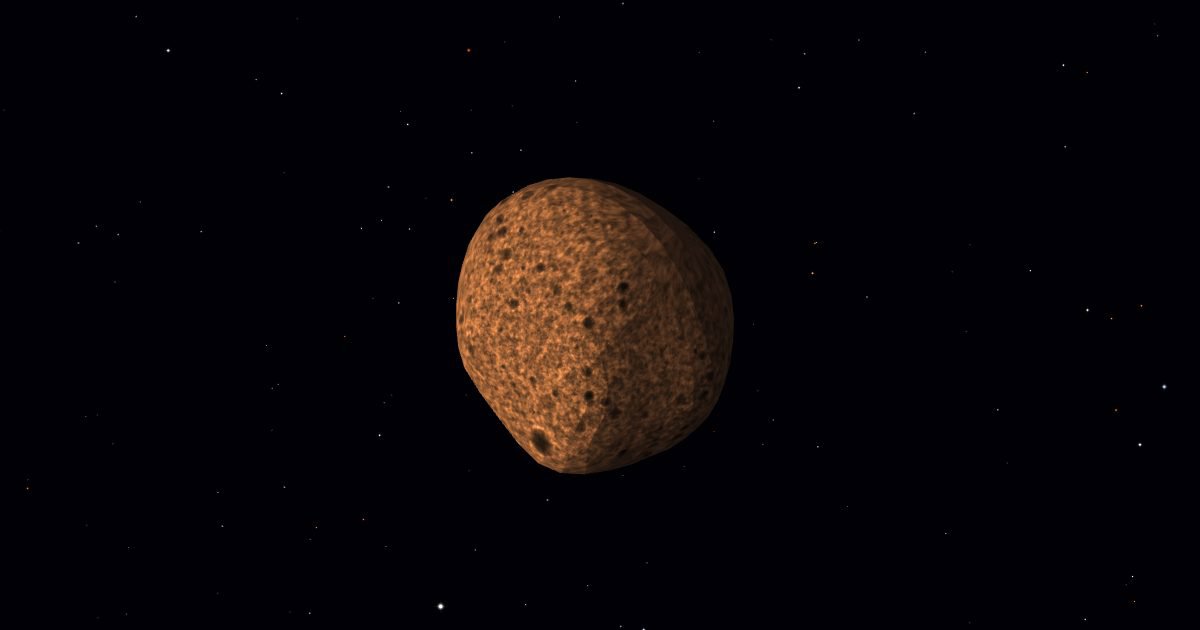
Rendered preview of Flora from the Nightbase orrery, lit from the current Sun direction with the terminator visible.
Credit: Nightbase orrery render.
Skybred Apr 27, 2026
Explore Nightbase
Related knowledge, tools, and stories — no observation planning required.
