Hygiea — Asteroid in Gemini

About Hygiea
Description
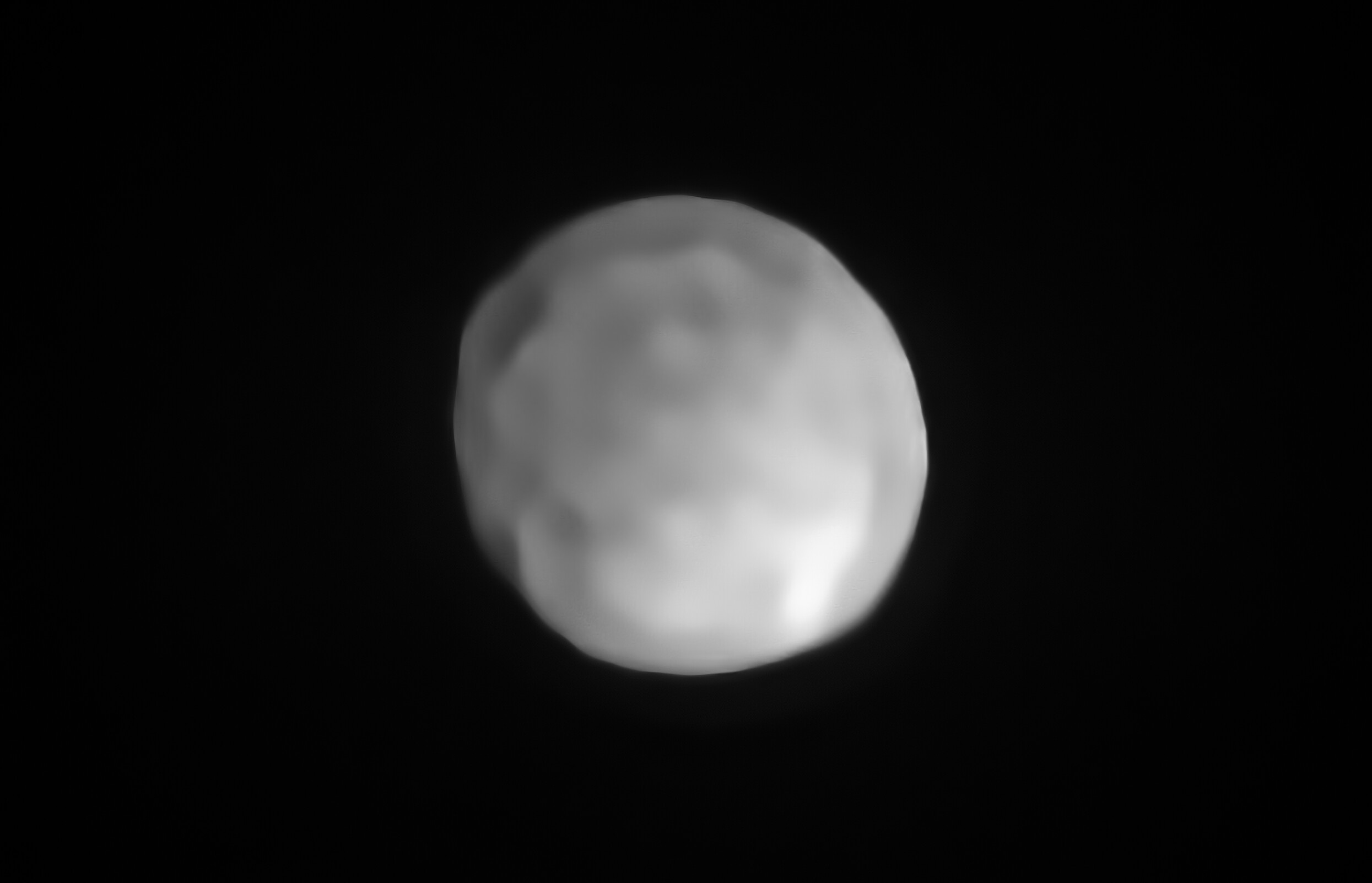
Hygiea is the fourth-largest object in the asteroid belt with a diameter of 433 km, orbiting at 3.14 AU. It is the largest member of the carbonaceous C-type asteroids and the parent body of the Hygiea asteroid family — the most populous family in the outer main belt. Hygiea's surface is very dark (albedo 0.063) and composed of hydrated and ammoniated silicate minerals, carbonates, and water ice, making it one of the most primitive bodies in the solar system. Recent observations with the VLT's SPHERE instrument revealed that Hygiea is surprisingly spherical for its size, leading to discussions about whether it should be reclassified as a dwarf planet — which would make it the smallest in the solar system.
Observing Tips
Hygiea is a faint target at magnitude 9.0 at best, requiring at least a 3-inch (75 mm) telescope to spot. It appears as a dim star-like point and is best identified by its motion over consecutive nights using a detailed finder chart. Because of its distance from the Sun (3.14 AU), Hygiea moves more slowly against the background stars than inner belt asteroids — patience is needed when tracking it. Oppositions occur roughly every 15 months. A computerized go-to mount is very helpful for locating this dim object, as it can easily be lost among similarly faint background stars.
History
Hygiea was discovered on April 12, 1849 by Italian astronomer Annibale de Gasparis at the Observatory of Capodimonte in Naples. It was named after Hygieia, the Greek goddess of health and hygiene — a fitting choice, as the modern words 'hygiene' and 'hygienic' derive from her name. Hygiea has never been visited by a spacecraft. In 2019, high-resolution images from the European Southern Observatory's Very Large Telescope revealed its nearly spherical shape, reigniting the debate about its potential dwarf planet status under the IAU definition.
Fun Facts
If classified as a dwarf planet, Hygiea would be the smallest known, with a diameter less than half that of Ceres. Computer simulations suggest that the entire Hygiea family — thousands of asteroids — was created by a single catastrophic impact that shattered the original parent body and allowed it to reassemble into its current nearly round shape. Its extremely dark surface reflects less light than charcoal.
Properties
Physical Properties
Orbital Properties
Brightness Forecast (next 12 months)
Apparent magnitude as Earth–asteroid distance changes through the year. The peak marks the brightest moment in the window — usually around opposition, when the asteroid is closest and fully illuminated.
Computed from JPL orbital elements via m = H + 5·log10(r·Δ). Phase-function correction is omitted, so curves trace distance variation only — accurate within a few tenths for main-belt asteroids; coarse for fast-moving NEOs near Earth.
Observing Tips
Discovery
Current Ephemeris
How easy to spot?
| Telescope | Bortle 3 | Bortle 4 | Bortle 5 |
|---|---|---|---|
| 80 mm refractor 80mm refr. | Medium+ | Medium+ | Medium |
| 150 mm Newton 150mm Newt. | Easy | Easy | Easy |
| Celestron C8 (203 mm SCT) C8 203mm | Easy | Easy | Easy |
Bortle 3 = rural · 4 = outer suburbs · 5 = suburbs
Visibility
Set a location in User Settings to see visibility data.
Community Photos (1)
Credit: ESO/P. Vernazza et al./MISTRAL algorithm (ONERA/CNRS). License: CC BY 4.0. (Wikimedia Commons)
Skybred Feb 28, 2026
Explore Nightbase
Related knowledge, tools, and stories — no observation planning required.
