Metis — Asteroid in Aquarius
About Metis
Description
Metis is an S-type asteroid with a diameter of 173 km, orbiting at 2.39 AU in the asteroid belt. It is composed of silicates and metallic nickel-iron, and may be the exposed core remnant of a larger asteroid that was destroyed by a catastrophic collision early in the solar system's history. Metis has a moderately dark surface (albedo 0.18) and shows spectral similarities with asteroid 113 Amalthea, suggesting they may be remnants of the same ancient parent body — fragments of an old dynamical family. Metis contains under 0.5% of the asteroid belt's total mass and has a relatively fast rotation period of just over 5 hours.
Observing Tips
Metis can reach magnitude 6.3 at the most favorable oppositions, making it one of the brighter asteroids and visible in binoculars. More typically it shines between magnitude 7 and 9. Its inner-belt orbit means it moves at a moderate pace against the star background. Track its nightly motion over two to three nights using a finder chart to confirm its identity. Metis passes through the zodiacal constellations and is best viewed around opposition months, typically March through May. A go-to telescope makes locating it straightforward, though it is bright enough for manual star-hopping.
History
Metis was discovered on April 25, 1848 by Irish astronomer Andrew Graham at Markree Observatory in County Sligo, Ireland — the only asteroid ever discovered from Irish soil. It was the ninth asteroid discovered and was named after Metis, the Titaness of wisdom and cunning in Greek mythology, who was the first wife of Zeus. Markree Observatory was one of the most well-equipped private observatories of the 19th century. No spacecraft has visited Metis, and most of what we know comes from ground-based photometry and spectroscopy.
Fun Facts
Metis holds the distinction of being the only asteroid discovered from Ireland. Its fast 5-hour rotation rate is unusual for its size — most asteroids this large rotate more slowly. If Metis is indeed an exposed metallic core, it provides a rare opportunity to study the interior composition of a differentiated body without needing to dig hundreds of kilometers beneath a rocky crust, as one would have to do on Earth.
Properties
Physical Properties
Orbital Properties
Brightness Forecast (next 12 months)
Apparent magnitude as Earth–asteroid distance changes through the year. The peak marks the brightest moment in the window — usually around opposition, when the asteroid is closest and fully illuminated.
Computed from JPL orbital elements via m = H + 5·log10(r·Δ). Phase-function correction is omitted, so curves trace distance variation only — accurate within a few tenths for main-belt asteroids; coarse for fast-moving NEOs near Earth.
Observing Tips
Discovery
Current Ephemeris
How easy to spot?
| Telescope | Bortle 3 | Bortle 4 | Bortle 5 |
|---|---|---|---|
| 80 mm refractor 80mm refr. | Easy | Easy | Easy |
| 150 mm Newton 150mm Newt. | Easy | Easy | Easy |
| Celestron C8 (203 mm SCT) C8 203mm | Easy | Easy | Easy |
Bortle 3 = rural · 4 = outer suburbs · 5 = suburbs
Visibility
Set a location in User Settings to see visibility data.
Community Photos (1)
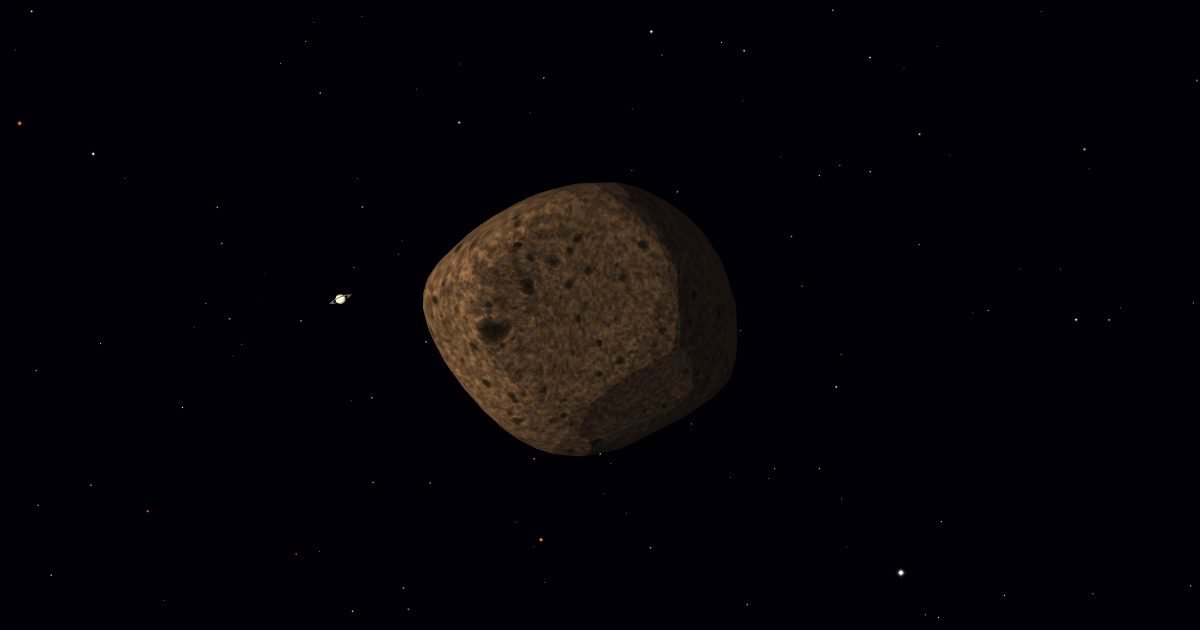
Rendered preview of Metis from the Nightbase orrery, lit from the current Sun direction with the terminator visible.
Credit: Nightbase orrery render.
Skybred Apr 27, 2026
Explore Nightbase
Related knowledge, tools, and stories — no observation planning required.
