Pallas — Asteroid in Cetus

About Pallas
Description
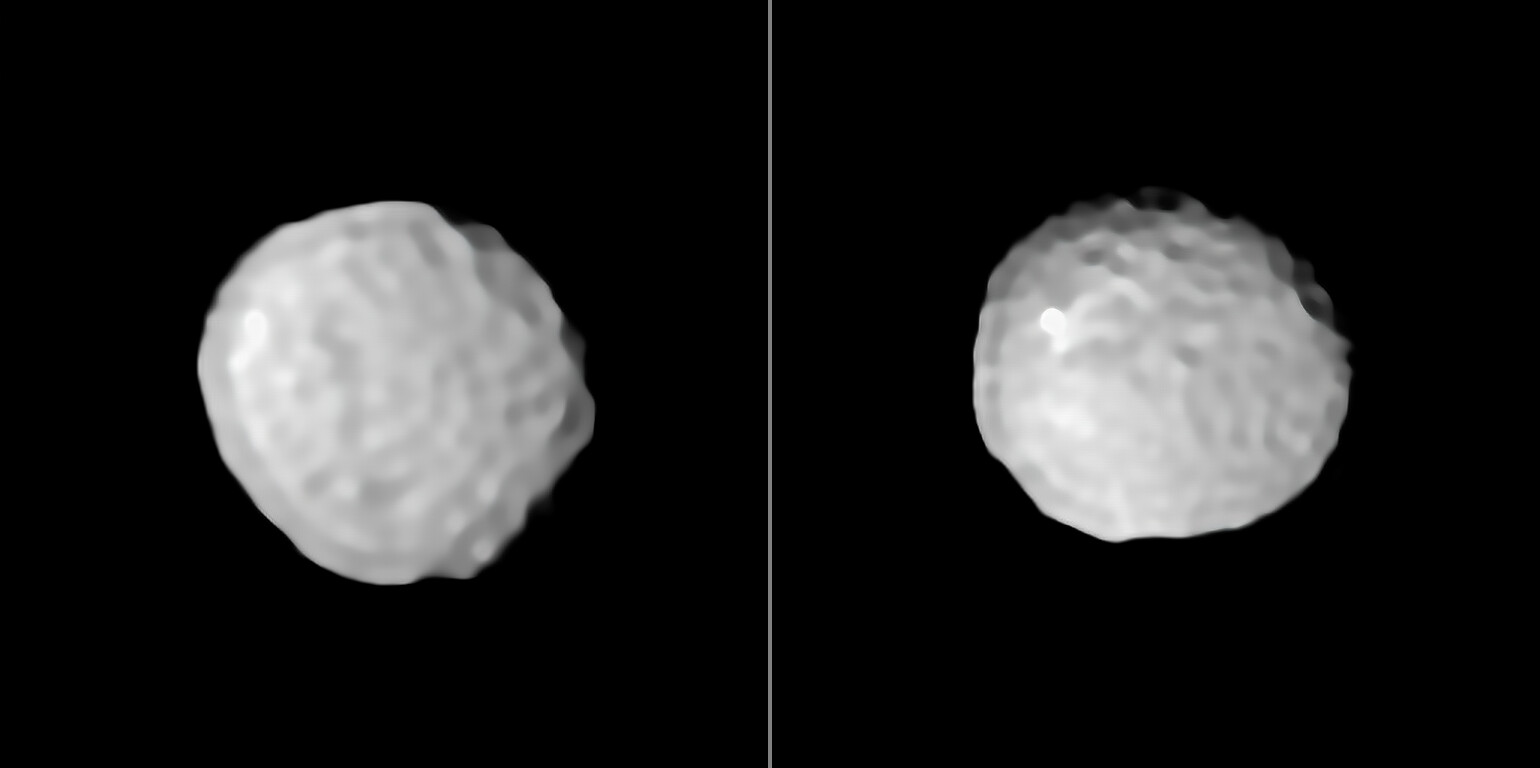
Pallas is the second-largest asteroid in the solar system with a diameter of 544 km, orbiting at 2.77 AU in the asteroid belt. Despite its size, Pallas is far less well understood than Vesta or Ceres because its highly inclined orbit (34.8°) makes it difficult for spacecraft to reach. Pallas has an irregular, somewhat elongated shape and a relatively dark surface (albedo 0.16) composed of carbonaceous material similar to CM chondrite meteorites. Its surface appears heavily cratered and possibly contains hydrated silicate minerals, suggesting it has retained some water-bearing compounds since the early solar system. Pallas accounts for about 7% of the total mass of the asteroid belt.
Observing Tips
At favorable oppositions, Pallas reaches about magnitude 6.7 — visible in binoculars but not to the naked eye. It typically appears between magnitude 7 and 9, requiring binoculars or a small telescope. Its highly inclined orbit means Pallas can appear far from the ecliptic, sometimes wandering into northern constellations like Ursa Major or southern ones well below the zodiac. This unusual sky position can actually help with identification, as few asteroids travel so far from the ecliptic plane. Track its nightly motion against background stars over two to three nights to confirm identity. Oppositions occur roughly every 16 months.
History
Pallas was discovered on March 28, 1802 by Heinrich Olbers while he was searching for Ceres, which had been found the previous year. It was the second asteroid ever discovered and was initially considered a planet. The name honors Pallas Athena, the Greek goddess of wisdom. Its discovery was pivotal in establishing that a new class of small bodies existed between Mars and Jupiter. No spacecraft has ever visited Pallas, largely because its extreme orbital inclination would require enormous fuel to match — making it the largest unexplored object in the inner solar system.
Fun Facts
Pallas has the most tilted orbit of any large asteroid at 34.8° — almost perpendicular to the main plane of the asteroid belt. If a spacecraft were to orbit Pallas, it would need more fuel for the orbital plane change than the Dawn mission used to visit both Vesta and Ceres combined. Despite being slightly larger than Vesta, Pallas is much fainter because of its darker surface.
Properties
Position & Identifiers
Physical Properties
Orbital Properties
Brightness Forecast (next 12 months)
Apparent magnitude as Earth–asteroid distance changes through the year. The peak marks the brightest moment in the window — usually around opposition, when the asteroid is closest and fully illuminated.
Computed from JPL orbital elements via m = H + 5·log10(r·Δ). Phase-function correction is omitted, so curves trace distance variation only — accurate within a few tenths for main-belt asteroids; coarse for fast-moving NEOs near Earth.
Observing Tips
Discovery
Current Ephemeris
How easy to spot?
| Telescope | Bortle 3 | Bortle 4 | Bortle 5 |
|---|---|---|---|
| 80 mm refractor 80mm refr. | Medium+ | Medium+ | Medium+ |
| 150 mm Newton 150mm Newt. | Medium+ | Medium+ | Medium+ |
| Celestron C8 (203 mm SCT) C8 203mm | Medium+ | Medium+ | Medium+ |
Bortle 3 = rural · 4 = outer suburbs · 5 = suburbs
Visibility
Set a location in User Settings to see visibility data.
Community Photos (1)
Credit: Credit: ESO/Vernazza et al.. License: CC BY 4.0. (Wikimedia Commons)
Skybred Feb 28, 2026
Explore Nightbase
Related knowledge, tools, and stories — no observation planning required.
