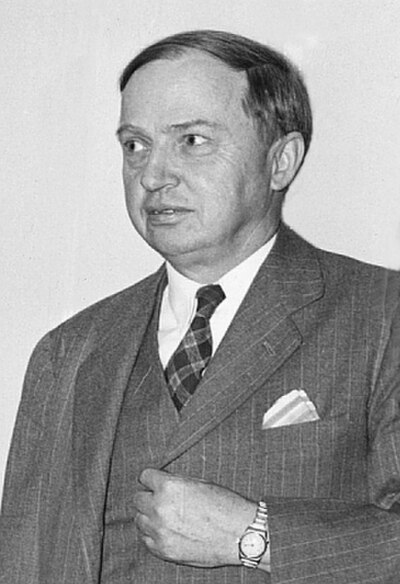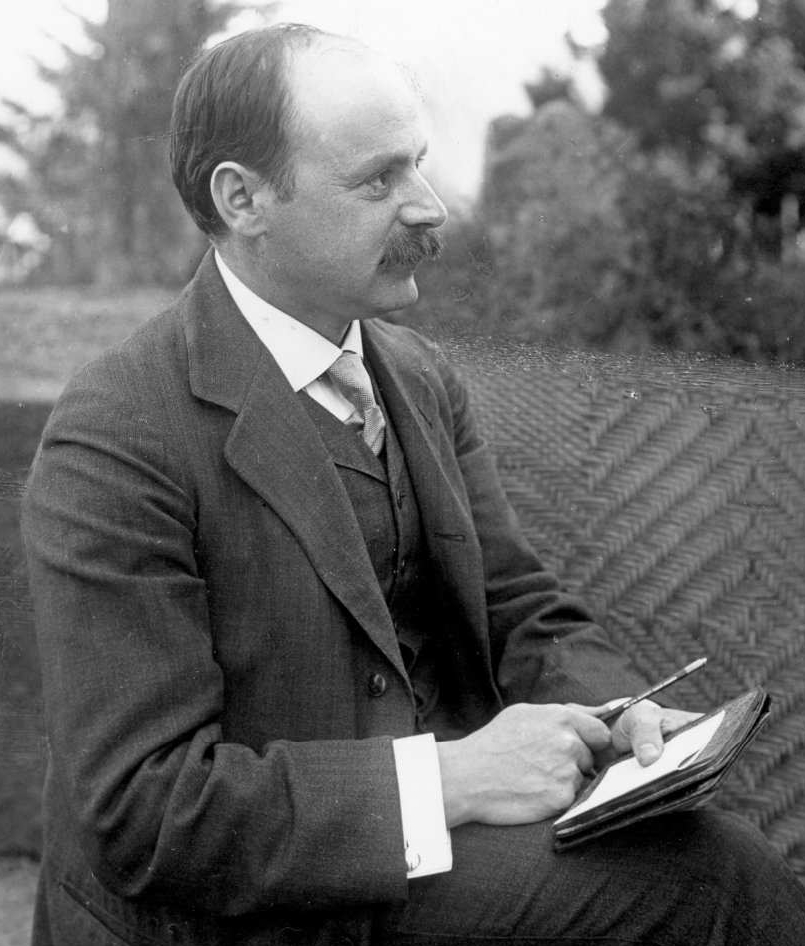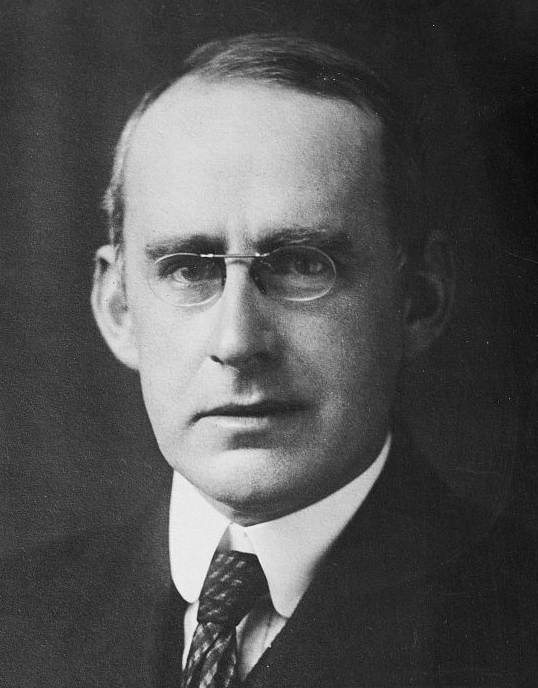
Library of Congress, George Grantham Bain Collection, public domain
Arthur Eddington
1882 – 1944
British
20th Century
1919 eclipse expedition confirming general relativity; first theory of stellar interiors; the Eddington limit
Biography
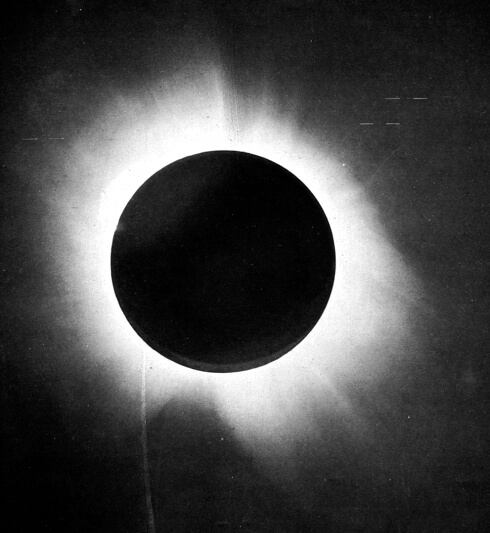
Eddington's 1919 eclipse plate — stars near the Sun's darkened limb whose positions confirmed general relativity.
Dyson, Eddington & Davidson (1919), via Wikimedia Commons, public domain
Arthur Stanley Eddington (1882–1944) was a British astrophysicist and Quaker pacifist whose career reshaped both the public understanding and the internal machinery of 20th-century astronomy. As Chief Assistant at the Royal Observatory during the First World War, he was one of the very few British scientists able to read Einstein's general relativity in its native mathematical form.
In 1919 he led the eclipse expedition to Príncipe, a volcanic island off West Africa, to photograph stars in the Hyades during totality. A parallel team travelled to Sobral in Brazil. Comparing the plates with night-time photographs of the same stars, they found that starlight grazing the Sun had bent by about 1.75 arcseconds — twice what Newtonian physics predicted, and exactly what Einstein's theory required. The announcement in November 1919 made Einstein world-famous overnight and established general relativity as empirical physics rather than speculation.
Eddington then turned to stellar structure. Before his work, the interior of a star was speculation; spectra gave the surface only. In The Internal Constitution of the Stars (1926) he showed that a star is a ball of gas held against gravity by a combination of gas pressure and radiation pressure, and he derived the mass-luminosity relation still taught today — a 10-solar-mass star radiates about 10,000 times the Sun, not 10.
From the same framework came the Eddington limit: the maximum luminosity a stable object of given mass can sustain before its own radiation pressure blows the outer layers off. The limit defines the upper envelope of massive stars (luminous blue variables live at it), and it sets the maximum accretion rate of black holes. Quasar luminosities are still quoted as fractions of their Eddington rate.
Eddington also argued, long before the mechanism was understood, that stars must be powered by subatomic processes — four hydrogens fusing into one helium would liberate the missing energy. When critics objected that the Sun was not hot enough, he famously replied: 'We do not argue with the critic who urges that the stars are not hot enough for this process; we tell him to go and find a hotter place.' Hans Bethe worked out the fusion details in 1938.
His least flattering moment came in 1935, when he publicly ridiculed the nineteen-year-old Subrahmanyan Chandrasekhar's correct derivation of a maximum white-dwarf mass, delaying the acceptance of black holes by a generation. Chandrasekhar received the Nobel Prize for that work in 1983.
Eddington was also the most successful popular-science writer of his era. Stars and Atoms, The Nature of the Physical World, and The Expanding Universe together sold over a million copies between the wars. He coined the phrase 'arrow of time'. When asked whether only three people in the world understood general relativity, he replied, 'I am trying to think who the third person is.'
Key Discoveries
Confirmation of general relativity through the 1919 solar eclipse expedition to Príncipe, measuring starlight deflection of 1.75 arcseconds near the Sun — the first empirical proof of Einstein's theory; First quantitative theory of stellar interiors and derivation of the mass-luminosity relation; The Eddington limit, setting the maximum stable luminosity for stars and accretion disks; Early proposal that stars are powered by hydrogen-to-helium fusion (1920), anticipating Bethe's 1938 CNO cycle by nearly two decades; Coined the phrase 'arrow of time' in discussing thermodynamic irreversibility (1927); Author of landmark popular-science books (Stars and Atoms, The Nature of the Physical World, The Expanding Universe) that shaped public understanding of modern physics between the wars