Everything you need to walk outside tonight, point at something, and know what you're looking at.
24 min readMatthias Wüllenweber
Key Takeaways
1
Start with the Moon, then Jupiter, then Saturn. These three alone will convert anyone into an amateur astronomer. Get comfortable finding and focusing on them before you chase anything faint.
2
The magnitude scale runs backward. A bright star is magnitude 0, a faint one is magnitude 6, and the Moon is magnitude −13. Lower numbers win. It's the only score in life where you want to be below zero.
3
Planets live on a single line across the sky — the ecliptic. If you know where the Sun rose and set, you know where to look for every planet all night long.
4
Your eyes need 20 minutes in the dark to wake up. One glance at a phone screen resets the clock. Install a red flashlight app before you leave the house, not after.
5
The biggest upgrade to your first year of observing isn't a bigger telescope — it's a darker sky. Driving 30 minutes out of town will show you more than spending another $1000 on gear.
Stand outside tonight, face south, and raise your arms like you're holding up an invisible dome. That dome is the celestial sphere — or rather, the half of it you can see. The other half is under your feet, hidden by the Earth.
Ancient astronomers weren't being naive when they drew the sky as a sphere. They knew the stars weren't stuck to a shell. They drew a sphere because, from where we stand, it looks like one. And every useful sky coordinate — every catalog, every telescope mount, every star-hopping route — still uses that ancient imaginary dome as its frame of reference.
Earth's axial tilt and the ecliptic plane — the sky's built-in geometry.
Four features of that dome are worth memorising, because you'll meet them every night:
The celestial poles
The two points directly above Earth's geographic poles. The north celestial pole sits within a thumb's width of Polaris — which is why Polaris appears not to move while every other star wheels around it over the course of a night.
The celestial equator
Earth's equator, projected outward onto the sky. From mid-northern latitudes it arcs across the southern sky. Stars on the equator rise due east and set due west.
The ecliptic — a scar from the solar system's birth
The ecliptic is the Sun's yearly path across the stars. Every planet and the Moon sticks close to it — because the solar system is flat. Billions of years ago, a collapsing cloud of gas spun itself into a thin disk, and tonight you're still seeing the fossil of that disk painted across the sky. Every planet you find will lie on a single curving line, as if threaded on a string.
The meridian
An imaginary line from due north, up over your head, and down to due south. When an object crosses it, astronomers say it transits. That's when it's highest in the sky — and highest is always best, because you're looking through less atmosphere.
See the sphere come alive
Open Nightbase's interactive Star Map — it shows the celestial equator, the ecliptic, and the meridian overlaid on the sky from your exact location. Watch objects rise, transit, and set in real time.
Celestial Coordinates
Every star has an address. The postman who delivers starlight uses two numbers — and once you know what they mean, you can find any object in any catalog on any night.
Right Ascension and Declination — sky longitude and latitude.
RA and Dec — longitude and latitude for the sky
Right Ascension (RA) is sky longitude, measured in hours rather than degrees — from 0h to 24h, because Earth makes one full turn in 24 hours. If a star is at RA 6h, it's highest when the Earth has rotated six hours past the zero line — handy for planning when to observe.
Declination (Dec) is sky latitude, in degrees north (+) or south (−) of the celestial equator. +90° is the north celestial pole, −90° is the south. A helpful trick: an object with a declination equal to your latitude passes straight overhead. From Munich at 48° N, a star at Dec +48° clears your zenith; a star at Dec −42° never rises above the horizon.
The Orion Nebula lives at RA 5h 35m, Dec −5° 23′. Punch those two numbers into any telescope on Earth and it'll point at the same cloud of gas.
Alt and Az — where to point, right now
There's a second system for telling a scope where to aim right this second: altitude (degrees above the horizon, 0°–90°) and azimuth (compass direction, N = 0°, E = 90°, S = 180°, W = 270°). Unlike RA and Dec, these change every minute as the Earth turns. They're perfect for "move the mount 40° up, 120° right" and useless for catalogs.
One screen, both systems
Click any object on the Star Map — Nightbase shows its RA/Dec (permanent address) and its current Alt/Az (where to point right now) side by side.
The Magnitude System
Brighter stars have lower numbers. It's the only scale where you want a bad score.
This is entirely the fault of a Greek named Hipparchus. Around 150 BC he sorted the brightest stars into "first magnitude", the next tier into "second", and so on down to "sixth" — the faintest his unaided eye could catch. That ordering stuck, and when astronomers later made it precise, they kept the backward direction out of tradition. Learn to love it; you'll never escape it.
Apparent magnitude — what brightness actually looks like at each step.
Each full magnitude step is about 2.5× brighter. Five magnitudes is exactly 100× brighter (5 × log(2.512) = 2). So a mag 1 star is a hundred times brighter than a mag 6 star — the faintest you can just barely glimpse from a dark site.
−13Full Moon
−4.6Venus at its best
−1.5Sirius
+2.0Polaris
+6.0Naked-eye limit (dark sky)
+1050mm binoculars
+148″ telescope, visually
You are catching million-year-old photons
The photon that triggers a rod cell in your retina when you look at the Andromeda Galaxy tonight left its home star two and a half million years ago — when our ancestors were Homo erectus, still learning to use fire. Your eye is the first thing it's hit in all that time. At magnitude 3.4 it's bright enough to see without optical aid, and close enough that those photons haven't yet dispersed beyond the sensitivity of a human eyeball. That's the magnitude scale in action, and it's a touch of the divine.
The galaxy trap
A magnitude 9 star is easy in a small scope. A magnitude 9 galaxy can be invisible from the same scope, in the same sky. The galaxy's light is spread over an area of sky the size of a dime held at arm's length — diluted until it blends into the background glow. This is called surface brightness, and it's why the Andromeda Galaxy, a naked-eye target in theory, becomes a forgettable smudge in suburbia. Dark skies matter more than aperture for extended objects.
Deep-Sky Objects
The most beautiful things in the sky are also the faintest. Beyond the planets and the Moon, beyond the bright stars you can name, lies a universe of deep-sky objects — star clusters, nebulae, galaxies. These are what you'll spend most nights chasing. And each type has its own personality.
The Orion Nebula (M42) — a stellar nursery 1,344 light-years away. Credit: NASA/Hubble.
Star clusters
Open clusters are loose gangs of young stars, born together from the same cloud of gas. The Pleiades (M45) is the showstopper — a sapphire handful you can see with your naked eye, with blue reflection nebulosity glowing around the brightest members. Best in binoculars or at low magnification.
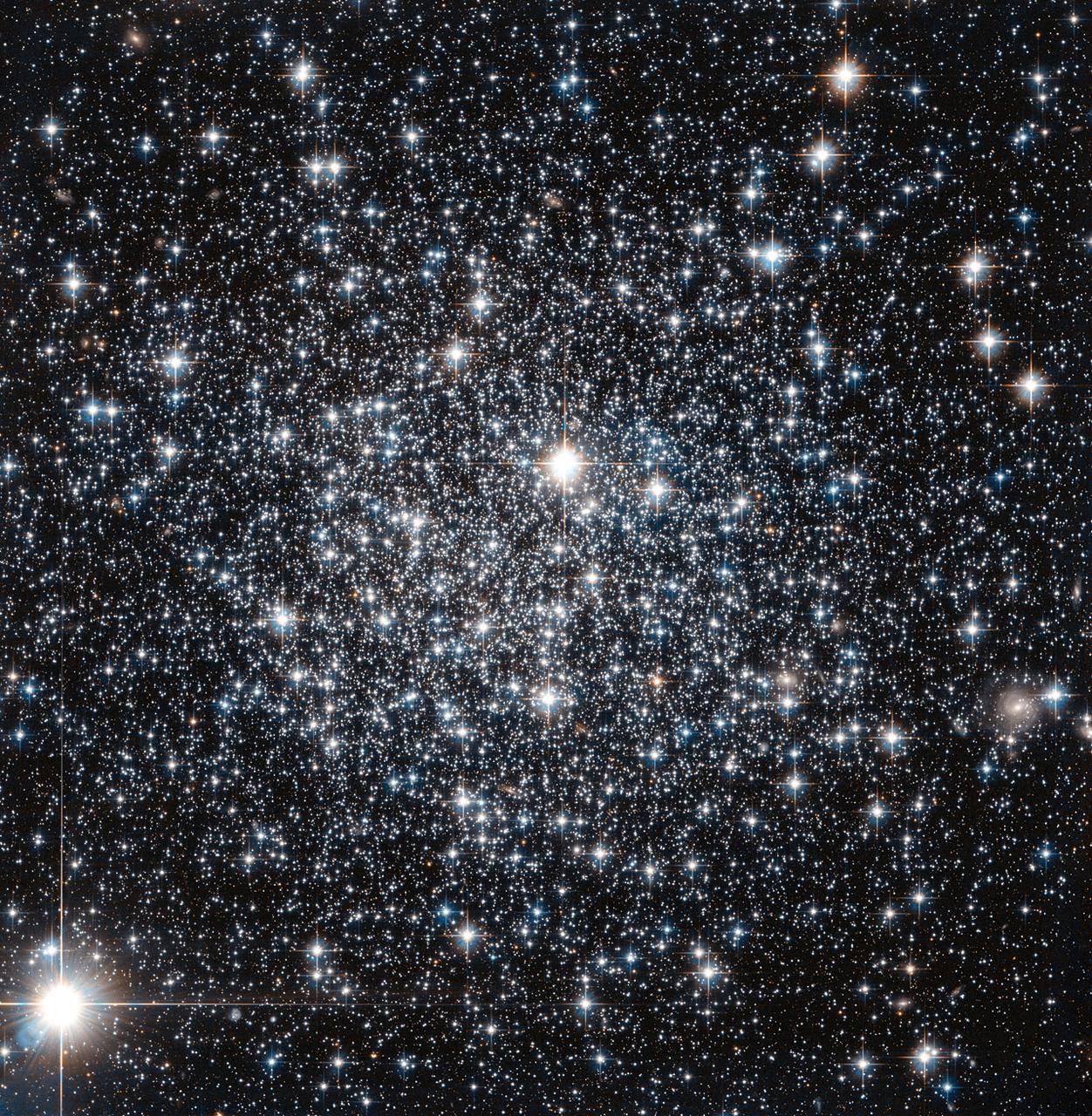
Globular clusters are the opposite: ancient, tight-packed balls containing hundreds of thousands of stars, as old as the galaxy itself. Point an 8″ scope at M13 — the Great Hercules Cluster under dark skies and push the magnification. The edges of the ball resolve into glittering pinpoints. It's one of the finest sights in amateur astronomy.
Nebulae — and why filters matter
Emission nebulae glow because hot nearby stars light them up — their gas re-radiates at very specific wavelengths, mostly a green-blue line from ionised oxygen and a red line from hydrogen. That narrow-band behaviour is what makes O-III and UHC filters so dramatic: they block almost everything except those wavelengths. Light pollution disappears; the nebula pops out of a grey sky.
Reflection nebulae just bounce starlight off dust, like blue smoke in a car headlight. Filters don't help — you need dark skies and patience.
Planetary nebulae are the discarded shells of dying stars. Most are tiny; many reward high magnification, up to 200× or more. The Ring Nebula (M57) really does look like a ghostly smoke ring in the eyepiece — hard to forget the first time you see one.
You're watching stars being born — right now
When you look at M42 through a telescope, you're not just seeing gas. You're seeing a stellar nursery where new suns are condensing out of collapsing clouds at this moment. The four Trapezium stars at the nebula's heart are infants only a few hundred thousand years old — barely out of the cradle by cosmic standards. The light reaching your eye tonight left them 1,344 years ago. A young star's first baby photo, delivered to your retina.
Galaxies
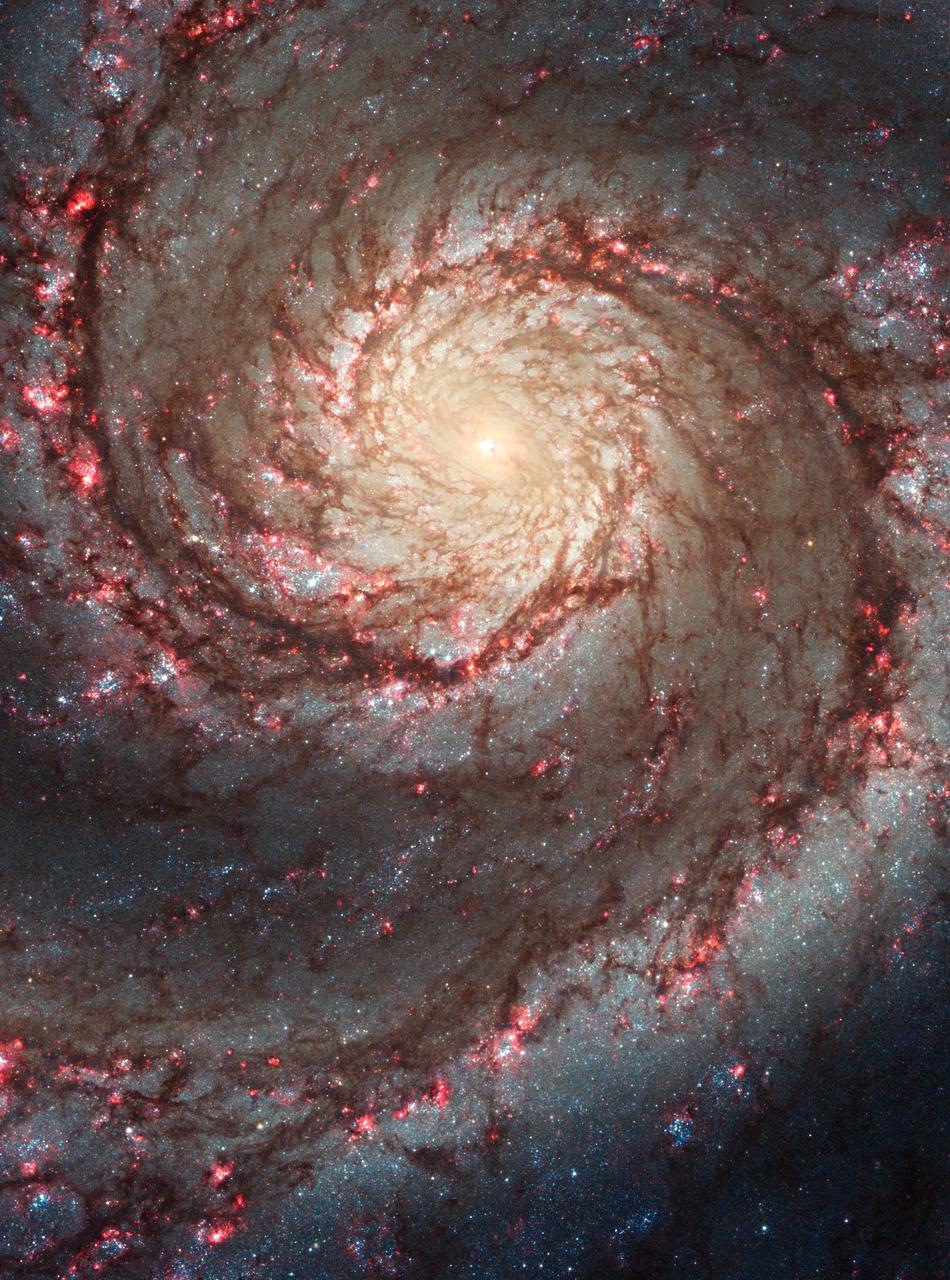
Vast cities of hundreds of billions of stars, seen from so far away that the whole structure shrinks to a faint smudge. Most galaxies look like gentle cotton-ball glows at first. Patience, a larger aperture, and dark skies slowly bring out more — spiral arms, dust lanes, the gravitational dance of interacting pairs.
The Whirlpool Galaxy (M51) — a face-on spiral with a companion caught in its gravity. Credit: NASA/Hubble.
Pairs of stars, side by side. Some are gravitationally bound and slowly orbiting each other over centuries; others are just line-of-sight accidents. The best doubles show striking colour contrast. Point any telescope at Albireo at the foot of Cygnus and you'll see why it's the most photographed double in the sky — a gold giant next to a sapphire companion, like a little jewellery setting in the eyepiece. If you show a non-astronomer just one object, make it Albireo.
Variable stars
Some stars change brightness over days, weeks, or months. Tracking them is a gentle, lifetime project — and one of the few areas where amateur observers still contribute real science by reporting magnitudes to the AAVSO. Algol dims every 2.87 days as its companion eclipses it; Mira swells and fades by a factor of a thousand over 332 days.
A typical globular cluster — hundreds of thousands of stars older than the Milky Way's disk. Credit: NASA/Hubble.
Browse the whole universe of targets
Nightbase's catalog lets you filter 22,000+ deep-sky objects by type, constellation, magnitude, and what's actually visible from your location tonight.
The Solar System
There is no substitute for watching Jupiter's moons dance over three nights, or catching Saturn's rings when they're tipped wide open. Planets change position from week to week — and they all live on one line across the sky: the ecliptic, that fossil of the solar system's birth.
Saturn at equinox — rings tilted almost edge-on. Credit: NASA/Cassini.
Where are the planets tonight?
Watch the Sun set. The ecliptic starts exactly where the Sun went down and arcs up across the southern sky. Every planet you can see tonight is somewhere on that arc. Nightbase's Solar System page shows their current positions.
The planets you'll come back to again and again:
Venus — Dazzling at mag −4.6 and low enough to see at dusk or dawn. A telescope reveals a tiny crescent that waxes and wanes exactly like the Moon. Only ever visible near sunrise or sunset.
Mars — That distinctive ember-orange point. Every 26 months it reaches opposition, swelling to a disk where a good scope shows polar ice caps and dark surface markings. Between oppositions it's a bland dot. Timing matters.
Jupiter — The starter pack for every new observer. At 50× magnification you see cloud bands and four bright moons that shift position from night to night — sometimes all four on one side, sometimes split 2-and-2, sometimes one missing entirely because it's behind the planet. The Great Red Spot comes round every ten hours.
Saturn — The moment the rings lock into focus at 30× is the single most common conversion point for amateur astronomers. "Is that real?" "Yes." And Titan is right there beside it.
Uranus & Neptune — Uranus is a pale blue-green dot at mag 5.7, Neptune a darker blue one at mag 7.8. You'll need a chart to tell them from stars, and a steady night to see they're not quite pointlike.
The terminator — where the Moon really lives
Skip the full Moon. It's flat, glaring, and washes out the whole sky. The time to observe the Moon is along the terminator — the day/night boundary — where low sunlight throws craters and mountains into knife-sharp relief. Different craters catch the light each night. The Moon is a different target every time.
Opposition is the golden window
When a planet is at opposition — opposite the Sun in our sky — it rises at sunset, is closest to Earth, biggest, brightest, and visible all night. For the outer planets (Mars, Jupiter, Saturn, Uranus, Neptune), opposition is the observing window of the year. Check current planet positions →
Catalogs & Designations
The same glowing smudge in your eyepiece might have half a dozen names. Because astronomers have been cataloging objects for 250 years, every object tends to live in multiple lists — and knowing which list is which saves confusion.
The Crab Nebula. Same object, three names: M1 = NGC 1952 = Taurus A. Credit: NASA/Hubble.
The four you'll bump into constantly:
Messier (M) — 110 objects catalogued by Charles Messier in the 1770s as things to avoid while hunting comets. He never guessed his list of "annoying smudges" would become the beginner's greatest-hits tour. M1–M110 are all bright, all visible in small scopes, and all gorgeous. Most observers work through the list at some point. It's the best single "to-do" in amateur astronomy.
NGC / IC — The New General Catalogue (~7,840 objects) and Index Catalogue (~5,380 more), compiled in the late 1800s. Together they cover almost everything a visual amateur could ever want.
Caldwell (C) — Sir Patrick Moore's 109-object supplement to Messier, published in 1995. Includes southern-sky gems Messier never saw.
Bayer letters — Greek letters attached to bright stars, constellation by constellation, roughly brightest to faintest. α Cyg = Deneb. β Ori = Rigel. α Ori = Betelgeuse. You'll see these on every star chart.
Same object, different names
When a catalog entry lists something like "M1 / NGC 1952 / Taurus A / SN 1054 remnant", don't panic — they're all the Crab Nebula. Browse Nightbase's catalog to see cross-references for every object.
Constellations
The sky is divided into 88 official constellations — not just the familiar stick figures, but precisely bounded territories agreed on by the International Astronomical Union in 1930. Every point in the sky belongs to exactly one constellation. "This galaxy is in Leo" doesn't mean it's near the lion's stars — it means it's within the legal boundaries of Leo's region of sky.
Orion — the most recognisable constellation in the northern sky.
The three flavours of sky pattern
Circumpolar — your year-round anchors
Constellations that never dip below the horizon from your latitude. From mid-northern latitudes that's Ursa Major, Ursa Minor, Cassiopeia, Cepheus, Draco. They circle Polaris all night, every night. Learn them first; they'll be with you forever.
Seasonal — the turning wheel
Most constellations are visible for only part of the year. Orion rules winter evenings; Scorpius dominates summer; the Great Square of Pegasus marks autumn. The sky drifts about 1° per night as Earth orbits the Sun — so a star rises four minutes earlier each evening, and tonight's midnight sky matches tomorrow's 11:56 PM sky.
Asterisms — the folk patterns
Shapes that aren't official constellations but everyone recognises anyway. The Big Dipper is a subset of Ursa Major. The Summer Triangle links Vega, Deneb, and Altair across three constellations. The Teapot is the central body of Sagittarius. Asterisms are the folk-song versions of the official classical music.
See Navigating the Night Sky for a season-by-season tour of the constellations from mid-northern latitudes.
Observing Conditions
Your success under the stars depends more on the air above you than on the glass in your telescope. Four conditions make or break a session — and learning to read them takes only a few nights.
The Milky Way from a Bortle 2 site. Most city dwellers have never seen this.
Seeing — is the air steady?
Seeing measures atmospheric turbulence. Stars twinkling wildly = bad seeing; rock-steady points = good seeing. On bad nights, planets blur above 100× magnification and double stars refuse to split. On great nights, you can push past 300× and catch fine lunar detail. If tonight's seeing is poor, stick to clusters and wide-field targets where turbulence doesn't matter.
Transparency — is the air clear?
How deep the sky goes. High humidity, haze, and thin cirrus all drop it. Check the faintest star you can see naked-eye at the zenith — your NELM (naked-eye limiting magnitude). Mag 6 = pristine; mag 4 = decent suburban; mag 3 = forget DSOs. Counterintuitively, the best transparency often comes with the worst seeing, and vice versa. Cold fronts clear the air but stir it up.
Light pollution — the Bortle scale
A 1–9 ladder. Bortle 1 is a truly remote desert site where the Milky Way casts shadows. Bortle 5 is suburban backyard. Bortle 8–9 is downtown. The leap from Bortle 5 to Bortle 3 — typically a 30-minute drive — reveals more objects than tripling your telescope's aperture. Driving out beats spending up.
Moon phase matters more than you think
A full Moon obliterates faint DSOs across most of the sky. For deep-sky hunting, plan sessions in the week before or after new moon, or observe after moonset. The Moon itself, planets, double stars, and bright clusters are all unaffected — they stay beautiful regardless. Check current Moon phase and rise/set.
Altitude — the horizon is the enemy
At 10° above the horizon you look through 5.6× more atmosphere than straight up. That thick slab of air dims, blurs, and reddens anything near the horizon. Wait for your target to climb — and if it never rises above 20° from your latitude, consider choosing another one.
Check before you leave
Nightbase's Weather page pulls cloud cover, seeing, and transparency forecasts for your location. See Seeing and Transparency for a deeper guide.
Practical Observing Tips
The difference between a frustrating night and a magical one almost always comes down to preparation and technique, not equipment. These are the habits every experienced observer internalises.
Star trails — proof that the Earth turns.
Protect your night vision
Your eye has two kinds of photoreceptors. Cones sit in the centre of your retina and give you colour and sharpness in daylight. Rods line the outer retina and are vastly more sensitive to dim light — but they take about 20–30 minutes in darkness to reach full sensitivity. A single flash of white light resets the process to zero.
Use a dim red flashlight or night-mode red screen — red light barely disturbs the rods.
Arrive at your site early and set up in twilight so your eyes adapt as the sky darkens.
If you must check a phone, cover one eye first to preserve partial adaptation.
Nightbase has a built-in red night mode — toggle it before you head out.
Use averted vision — the trick that changes everything
Here's the counterintuitive move: to see a faint object, don't look directly at it. Look slightly to one side. The centre of your retina (the fovea) is packed with cones, which are worthless for faint light. Your rods live around the fovea. When you look directly at something dim, you're aiming it at your eye's one blind spot for dim light.
Shift your gaze 10–20° off the target and the faint nebula or galaxy you couldn't see will suddenly shimmer into view — often 1–2 magnitudes fainter than direct vision allows. It takes practice on easy targets first, but once you learn it, your telescope effectively gets bigger.
Plan the session
A little preparation triples what you'll see:
Check weather, Moon phase, and moonset time.
Make a target list of 5–10 objects — more than you think you can get through.
Note which objects transit (peak) early in the night vs late.
Observe setting objects first, then work east across the sky — otherwise the night rolls on and your early targets slide below the horizon before you get to them.
Nightbase's Tonight page lists what's well placed right now.
Choosing magnification
Bigger magnification is not better. Each target has a sweet spot:
Target
Magnification
Why
Open clusters, Milky Way fields
25–50×
Wide field captures the sprawl
Galaxies, large nebulae
50–100×
Enough detail, still bright
Globular clusters
100–200×
Resolves the outer stars
Planetary nebulae
100–250×
Small targets need magnification
Planets
100–250×
As much as seeing allows
Double stars
100–300×
Splits tight pairs
Moon detail
100–300×
Craters, rilles, shadow edges
Your scope's useful maximum is roughly 2× its aperture in mm (a 200mm scope tops out around 400×, but most nights it's capped by seeing at 250×). The Optics Simulator lets you preview how objects look at different magnifications in your scope.
Nebula filters — narrow beats wide
A good O-III filter can turn an invisible emission nebula into an obvious bright arc. These filters work by blocking nearly all light pollution and passing only the specific wavelengths that emission nebulae glow at.
O-III — The most dramatic. Essential for planetary nebulae and supernova remnants like the [Veil](/object/NGC 6992).
UHC — A broader all-rounder; works on most emission nebulae.
H-β — Specialised; needed for the Horsehead and the California Nebula and not much else.
None of them help on galaxies, reflection nebulae, or clusters — those emit across the full spectrum.
Comfort at the eyepiece
You'll see more if you're comfortable. Fatigue steals detail.
Dress warmer than you think. Standing still loses heat fast.
Get an adjustable observing chair — your neck will thank you two hours in.
A dew shield or dew heater saves the night when optics start fogging.
Warm drinks, snacks, and breaks are not optional on long sessions.
Keep an observing log
Writing down what you see makes you a better observer — logging forces you to actually look. A rushed glance gives you nothing to write; so you keep looking, and the details emerge. Log the date, time, conditions, equipment, magnification, and a short description. Sketching, even crude sketches, trains your eye more than any other habit. Nightbase is designed exactly for this: start a session, dictate quick voice notes at the eyepiece, and everything syncs to your log.
Your First Targets
New to observing? These eight objects are bright, easy to find, and impressive in any telescope. Work through them before you chase anything tricky. Between them they'll teach you every skill you need for the rest.
The Moon — Your training ground. Focus the scope, learn the terminator trick, push to 150×, and explore craters at the day/night line. Different features every night.
Jupiter — Cloud bands and four moons visible at 50×. The moons change positions from hour to hour. Catch the Great Red Spot when it faces us.
Saturn — The moment the rings sharpen into focus is a memory you'll keep. Try 100× or more. Titan sits nearby as an obvious point of light.
Pleiades (M45) — A shimmering blue handful. Use low power or binoculars; higher magnification kills the effect. Best in winter evenings.
Orion Nebula (M42) — Below Orion's belt, visible with the naked eye. A glowing gas cloud around the four Trapezium infant stars. Stunning in any instrument.
M13 Hercules Cluster — Summer's showpiece globular. At 100–150× the edges resolve into individual stars. A favourite for life.
Ring Nebula (M57) — Between the two lower stars of Lyra. A tiny ghost donut at 100×. The first planetary nebula most people ever see.
Albireo (β Cygni) — Gold and sapphire. Easy at any magnification. The most giftable object in the sky.
Your first month of observing
Don't try to see all eight in one night. Spread them over several sessions so each gets real attention. Watch Jupiter's moons shift over three consecutive clear nights. Sketch M42 and look at the sketch a year later. Slow, deliberate observing beats frantic target-bagging — every time.
What's up tonight?
Check Tonight's Targets to see which of these (and hundreds more) are well placed right now. When you've bagged all eight, move on to the Messier catalog — 110 objects designed to be achievable, and a lifetime project many observers take on. See Your First Telescope if you're still choosing gear, and The Life of Stars to understand what you're actually looking at.
Test Yourself
Q1You see a star listed at RA 20h, Dec +45°. Roughly when (which season and time of night) and from what latitude is it best placed for observing?
An RA of 20h transits (is highest) around midnight in August, because the Sun is roughly opposite that RA in summer. A Dec of +45° means the star passes overhead from latitude 45° N — so observers in northern France, southern Germany, or the US Midwest see it at the zenith. That's Deneb's neighbourhood, right in the heart of the Summer Triangle.
Q2A friend sees "M 9" listed as magnitude 8 for a globular cluster and "NGC 6205" (M13) listed as magnitude 5.8. Why is M13 not just "about three times brighter" visually — it's vastly more impressive?
Two reasons. First, magnitude is logarithmic: a 2.2-magnitude difference is about 7.6× more total light, not 3×. Second, both are globular clusters of similar physical size, but M13 is closer and appears larger, so its total light is spread over a bigger patch of sky in a way that still leaves plenty of surface brightness for individual stars to resolve. M13's magnitude gap is bigger than it looks and its structure rewards magnification.
Q3Why can't an O-III filter save your view of a dim galaxy?
O-III filters pass only a narrow green-blue wavelength where ionised oxygen emits. Emission nebulae and planetary nebulae glow mostly at that one wavelength, so a filter blocks light pollution while letting the nebula through — huge contrast gain. Galaxies are made of stars, which emit across the full spectrum. An O-III filter blocks most of a galaxy's light along with the light pollution, and you end up with nothing. Galaxies need dark skies, not narrow-band filters.
Q4You look straight at a faint nebula and can barely see it. You shift your gaze slightly off to one side — and suddenly there it is, obvious. What just happened inside your eye?
You moved the image off your fovea (packed with colour-sensitive cones, poor in dim light) onto the peripheral retina (dense with rods, which are up to 100× more sensitive in dim light but not at the centre of vision). This is averted vision. It routinely reveals objects 1–2 magnitudes fainter than direct vision can detect — effectively giving your telescope a free aperture upgrade.
Q5Your observing friend says Jupiter will be at opposition next month. What does that mean for your observing plans, and why is it a big deal?
Opposition means Jupiter sits opposite the Sun in our sky — so it rises at sunset, transits around midnight, and sets at sunrise. You can observe it all night. Just as importantly, Earth is passing Jupiter on the inside track of its orbit, so the planet is closest to us and therefore biggest and brightest of the whole year. For outer planets, opposition is the single best observing window of the year. Plan the session, wait for a night of steady seeing, and don't waste it.