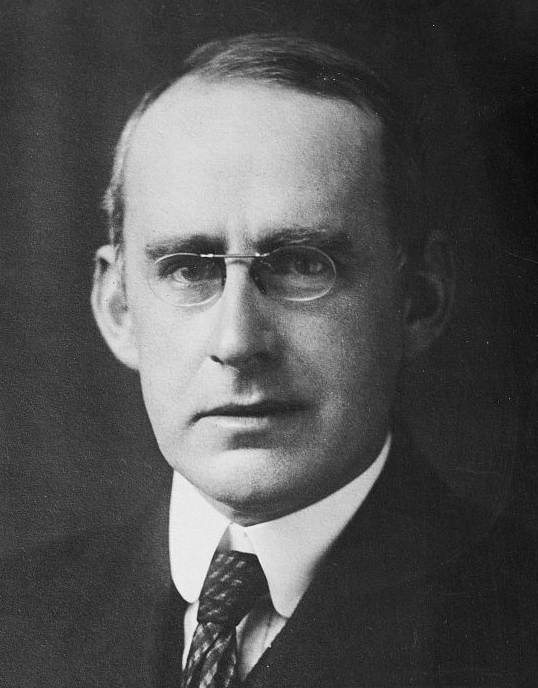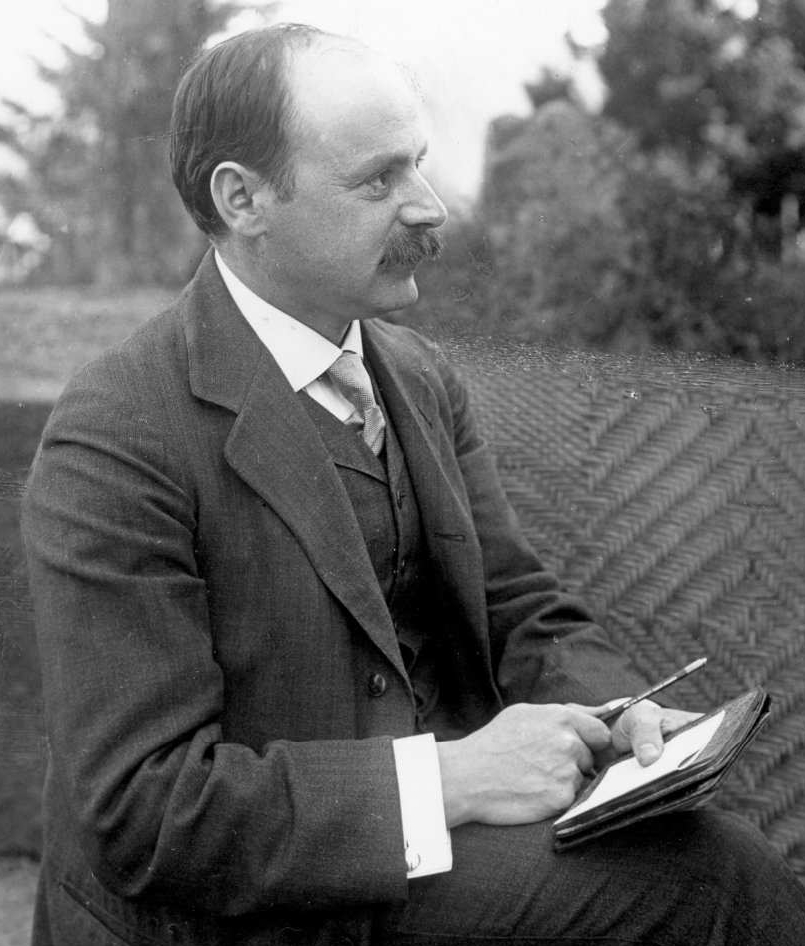
Photograph, pre-1930, via Wikimedia Commons, public domain
Karl Schwarzschild
1873 – 1916
German
20th Century
First exact solution to Einstein's field equations; the Schwarzschild radius and the geometry around a non-rotating black hole
Biography
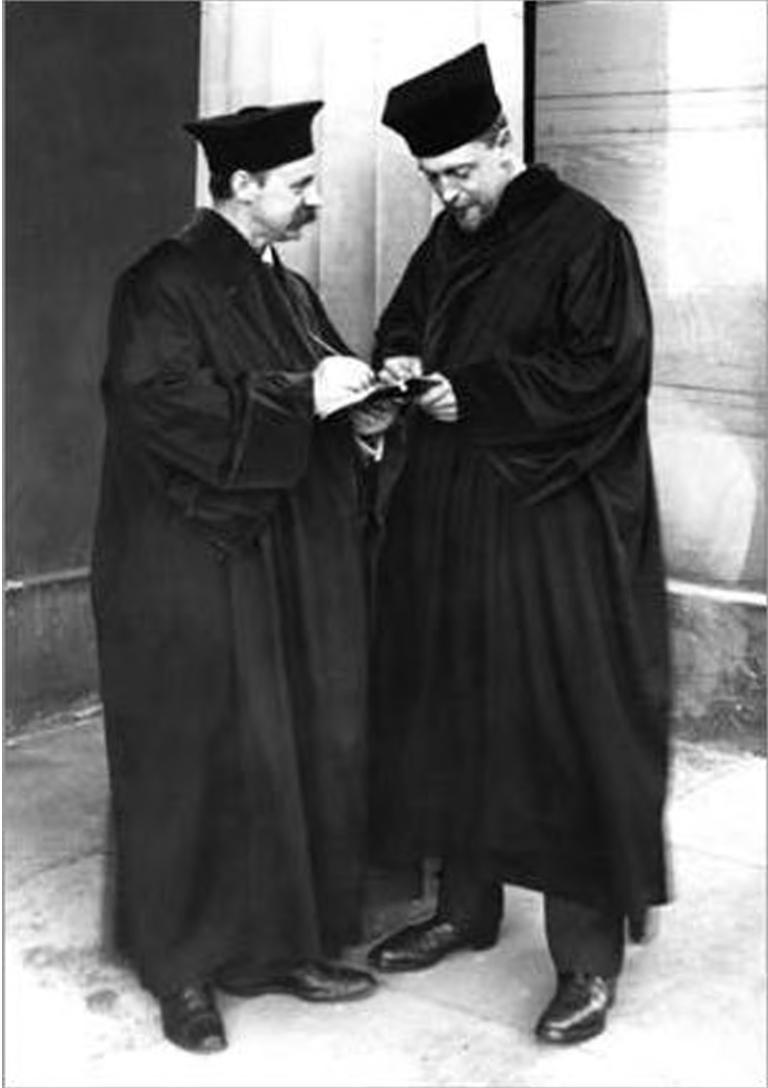
Karl Schwarzschild (left) with his doctoral student Ejnar Hertzsprung in professorial gowns at the Göttingen Observatory, 1909.
Göttingen Observatory archive, via Wikimedia Commons, public domain
Karl Schwarzschild (1873–1916) was a German physicist and astronomer whose seven-year burst of productivity at the end of his short life established the mathematical foundations of black-hole physics and the modern theory of stellar atmospheres. He died at forty-two from an autoimmune disease contracted on the Russian front of the First World War — six months after writing down, in a field hospital, the first exact solution to the equations of Einstein's general relativity.
Schwarzschild was a prodigy. Born in Frankfurt into a Jewish family, he published two papers on celestial mechanics at sixteen and earned a doctorate from Munich at twenty-three. He ran the Kuffner Observatory in Vienna and then, from 1901, the observatory at Göttingen, where he supervised a young Danish doctoral student named Ejnar Hertzsprung. In 1909 he moved to Potsdam to direct the Astrophysical Observatory, the most prestigious such post in Germany.
Before the war he did first-rate work on stellar photometry — his 1899 law of reciprocity failure in photographic emulsions is still named after him — and on radiative transfer in stellar atmospheres. The <span>Schwarzschild criterion</span> for convective stability, distinguishing radiative from convective zones inside a star, came from this period and remains standard textbook material. He also reformulated the Hamilton–Jacobi equations of classical mechanics in a form that would later be recognised as the geometric framework general relativity would need.
In 1914, at forty-one and already internationally famous, he volunteered for the German army. He served at the Belgian and French fronts computing artillery trajectories, then shipped east to Russia. It was there, in late 1915, that he read Einstein's newly published paper on general relativity. Between calculating shell-fall tables he worked out the spherically symmetric vacuum solution of the Einstein field equations — the metric that now bears his name — and mailed it to Einstein in January 1916. Einstein, astonished, read it to the Prussian Academy and wrote back: "I had not expected that one could formulate the exact solution of the problem in such a simple way."
A second paper followed within weeks, solving the interior of a uniform-density star. Both papers predicted what today we call the event horizon: a critical radius, R_s = 2GM/c², below which light itself cannot escape. In 1916 the phrase "black hole" did not yet exist, and Schwarzschild himself viewed the singularity at R_s as a mathematical artefact. It would take half a century, and the work of [Subrahmanyan Chandrasekhar](/FamousAstronomers/subrahmanyan-chandrasekhar), Oppenheimer, Penrose, and [Stephen Hawking](/FamousAstronomers/stephen-hawking), to realise that the geometry he had written down was the real shape of spacetime around a collapsed star.
By the time his papers were read in Berlin, Schwarzschild was dying. He had contracted pemphigus, a rare autoimmune disease that destroys the skin; there was no treatment in 1916. He was invalided home in March and died in Potsdam on 11 May, at age 42. His son Martin, born in 1912, became one of the great stellar astrophysicists of the twentieth century and worked out much of the theory of stellar evolution that grew out of his father's criterion.
Key Discoveries
First exact solution to the Einstein field equations (Schwarzschild metric, 1916), the foundational geometry for non-rotating black holes and the basis of classical tests of general relativity; Derivation of the Schwarzschild radius R_s = 2GM/c² — the event horizon beyond which no signal can escape — which sets the scale of black-hole physics from M-sigma to gravitational-wave signals; Interior Schwarzschild solution for a uniform-density sphere, the first exact relativistic model of a stellar interior; Schwarzschild criterion for convective versus radiative transport in stellar atmospheres (1906), still taught as the standard test; Schwarzschild law of reciprocity failure in photographic astronomy (1899), a cornerstone of photographic photometry in the pre-CCD era; Pioneering work on radiative transfer in stellar atmospheres that laid the groundwork for modern quantitative spectroscopy; Reformulation of the Hamilton–Jacobi formalism in a geometric form that anticipated the mathematical style of general relativity