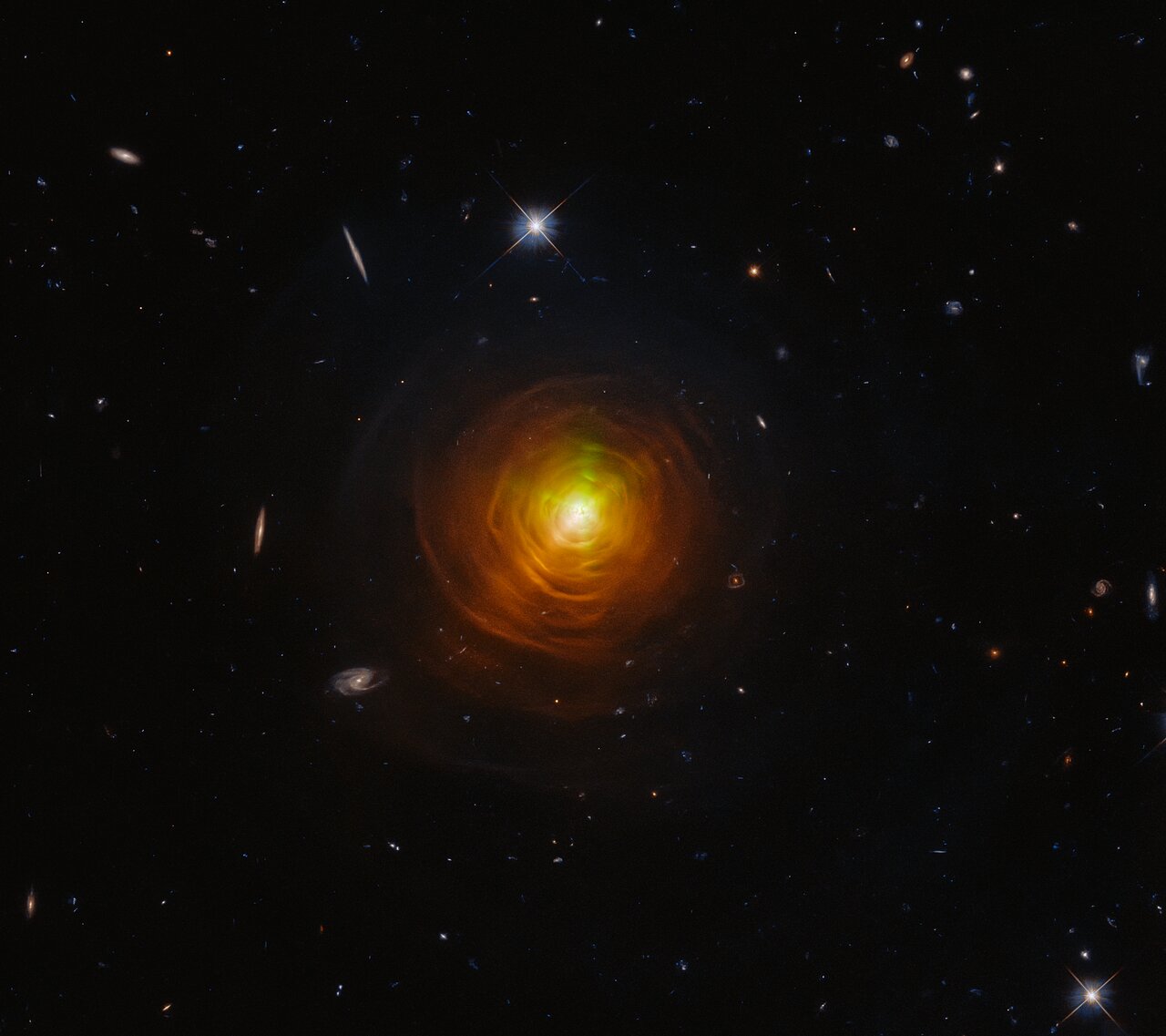
Three rules for getting the most out of them at the eyepiece:
- Let your eyes dark-adapt first. Carbon-star color is a high-saturation, low-brightness effect; a fully dark-adapted eye reads the red more vividly.
- Defocus slightly and then refocus. A carbon star viewed slightly soft, then snapped to focus, looks more red than one viewed steadily — the contrast with the white field stars spikes.
- Compare side-by-side with a nearby hot star. Color is relational, not absolute. A mag-5 B-type star a few arcminutes away turns the carbon star from "reddish" to garnet.
La Superba — Y Canum Venaticorum (mag 4.86–5.88, period 158 days) is the one to start with. It sits high under the Big Dipper's handle and holds steady around mag 5, visible in binoculars on a dark night and stunning in any telescope. Its B−V of 2.54 makes it one of the reddest naked-eye stars anywhere. Father Angelo Secchi named it La Superba — "The Superb" — when he first saw its spectrum.
R Leporis — Hind's Crimson Star (mag 5.5–11.7, Mira-type, 427-day period) is the legend. British astronomer John Russell Hind wrote in 1845 that it looked "like a drop of blood on the black background of the sky." At maximum it is an easy small-scope target under Orion's feet; near minimum it vanishes for binoculars and you need an 8-inch. Catch it near maximum for the full effect.
Other strong northern targets: U Hydrae (mag 4.8–5.4, SRB, 450 d), UU Aurigae (5.1–6.6, SRB, 234 d), and W Orionis (5.5–6.9, SRB, 212 d) — all cool N-types that drift in brightness over months rather than weeks.
The color-match test
Next clear night, put a carbon star and a nearby hot blue-white star in the same low-power field. Pick a neutral object in the room — a red LED, a glowing stove burner, a ripe strawberry — and ask yourself: which of these does the star match? People who do this once never forget how red a carbon star really is.