Venus Transits — How a Black Dot Measured the Solar System
For three centuries, an event that lasts six hours and happens twice in a lifetime was the most ambitious scientific undertaking on Earth. Nations built ships, astronomers crossed oceans, one man waited eleven years for a single afternoon — all to time the moment a small black dot touched the limb of the Sun.
20 min readMatthias Wüllenweber
Key Takeaways
1
A transit of Venus is the rare alignment when Venus passes directly between Earth and the Sun, appearing as a tiny dark disc crossing the solar face. Pairs of transits come eight years apart, then nothing for over a century.
2
Edmond Halley realised in 1716 that timing the transit from widely separated points on Earth would let astronomers solve the one number Kepler's laws couldn't give them: the absolute size of the solar system.
3
Eighteenth-century expeditions — Cook to Tahiti, Le Gentil to India, Mason and Dixon to South Africa — were among the first truly global scientific projects in history.
4
The 1874 and 1882 photographic transits, refined by Simon Newcomb's analysis, fixed the Astronomical Unit to within 0.2% of its modern value: 149.6 million kilometres.
5
The same geometric principle — a planet briefly dimming its star — is how the Kepler space telescope discovered thousands of exoplanets. Venus was the dress rehearsal.
6
The next transit of Venus is on 11 December 2117. Nobody alive today will see it.
7
Every historical transit in this article links into the Nightbase orrery so you can pause the simulation at the moment Halley, Cook, Lomonosov, or Newcomb were watching, and see the geometry from behind Earth's limb.
By 1700, astronomers knew almost everything about the solar system — except how big it was.
Johannes Kepler had given them the shape. His third law (1619) related a planet's orbital period to its distance from the Sun: square the years, and you get the cube of the distance — but only in units of Earth's distance. Mars was 1.524 times as far from the Sun as Earth. Jupiter was 5.20 times. Saturn 9.54. Beautiful, exact, and useless without one anchor: how far is Earth from the Sun in honest kilometres?
That anchor is what astronomers call the Astronomical Unit — the AU. Without it, the solar system was a perfect scale model with no scale bar. Distances to stars, masses of planets, the size of the Sun itself — every absolute number in astronomy descends from this one.
Did you know?
The best estimate of the AU in 1700 came from Giovanni Cassini, who in 1672 had used a Mars opposition to triangulate the planet's distance — and got 140 million km for the Sun, only 7% short of the modern 149.6 million km. Impressive, but his contemporaries didn't trust the number to better than ±20%. The solar system's size was uncertain by an entire Mars orbit.
The trouble was triangulation. To measure the distance to anything in the sky, you observe it from two places far apart on Earth and measure the tiny angle by which it appears to shift against the background — its parallax. Closer object, bigger shift. The Moon shifts by almost two degrees from one side of Earth to the other. Mars at opposition shifts by about 25 arcseconds. The Sun's parallax — the prize — is less than 9 arcseconds. That is the angular size of a one-cent coin seen from four kilometres away. In 1700, no instrument could measure it directly.
Halley saw a way around the problem. You don't have to measure the Sun's parallax at all. You can measure Venus's parallax instead — and Venus, when it transits, is projected onto a perfect ruler: the Sun itself.
Halley's Posthumous Plan
Edmond Halley — designed the experiment a century in advance.
In 1716, Halley was sixty years old and knew with certainty he would not see the next transit of Venus. The transits come in pairs eight years apart, then a gap of either 105.5 or 121.5 years; the next pair, he calculated, would be in 1761 and 1769. He published a paper that year in the Philosophical Transactions of the Royal Society titled A new Method of determining the Parallax of the Sun — the most influential research proposal ever written by a man who knew he wouldn't live to read its results.
The idea was elegant. Two observers, one in the far north and one in the far south, would each see Venus traverse the Sun's disc — but along slightly different chords. The northern observer sees Venus take a path slightly south of where the southerner sees it, by an angle equal to Venus's parallax across the baseline of the two latitudes. Because Venus moves at a known speed, the offset translates into a difference in transit duration of perhaps ten or twenty minutes. That is something a careful observer with a pendulum clock can measure.
The northern observer sees Venus follow the blue chord; the southerner sees the orange chord. The chord separation, projected back through the geometry, yields the Earth–Sun distance.
The geometry has a beautiful lever: because the Sun is much farther away than Venus, the small parallax of Venus across the Earth's diameter is magnified when projected onto the Sun's disc. Halley estimated that timing the transit to within two seconds at two well-chosen sites would pin down the AU to better than 0.2%. In 1716, that would be the most precise measurement in the history of astronomy.
He closed his paper with a direct appeal to the next century: he urged "young astronomers" to undertake the observations, and warned them not to leave it to chance — the alignments would not return for another century if the 1761 and 1769 transits were missed.
A scientific will
Halley wrote his 1716 paper as a kind of last will and testament to a profession. He died in 1742, nineteen years before the 1761 transit. When astronomers across Europe organised the largest scientific expedition in history that year, they were carrying out the instructions of a dead man.
Horrocks Got There First
Halley designed the useful observation. But he was not the first to see a transit of Venus. That honour belongs to a 20-year-old English curate named Jeremiah Horrocks, working alone in the Lancashire village of Much Hoole.
In 1639, Kepler's tables predicted a near-miss for that November — the geometry would just barely fail. Horrocks redid the calculation and got a different answer: Venus would cross the Sun, on Sunday 24 November (Old Style; 4 December in the modern calendar). He had no transit pair to wait for, no royal expedition, no funding. He set up a small telescope to project the Sun's image onto a sheet of paper, drew a circle six inches across to represent the solar disc, and watched.
He had to interrupt the observation to perform Sunday afternoon services at his church. When he returned, the transit had begun. He drew Venus's position on his paper at three carefully timed moments before sunset — the only data ever taken of the 1639 transit. From the apparent size of Venus's disc he derived a solar parallax of 14 arcseconds, far too generous, but the smallest serious estimate published until then. The corresponding Earth–Sun distance: roughly 95 million km. Wrong by about a third — but in the right order of magnitude, and obtained by a single observer with a wooden telescope and a sheet of paper.
See the 1639 Horrocks transit in the orrery → (the view "behind Earth's limb" lines Venus up directly across the Sun's disc — exactly what Horrocks was projecting onto his sheet of paper)
Horrocks died at 22, before he could publish. His manuscript circulated quietly for two decades before Hevelius brought it into print.
The 1761 Expedition: Lomonosov's Glow and Le Gentil's Heartbreak
When the long-awaited 1761 transit came on 6 June, Europe sent astronomers to every continent it could reach. Britain dispatched Charles Mason and Jeremiah Dixon (yes, the same pair who would later survey the line between Pennsylvania and Maryland) to the Cape of Good Hope. France sent observers to Tobolsk, Pondicherry, Vienna, and the island of Rodrigues. Russia mounted observations from Saint Petersburg. In all, more than 120 astronomers at 60-some sites watched the same six-hour event from across the planet.
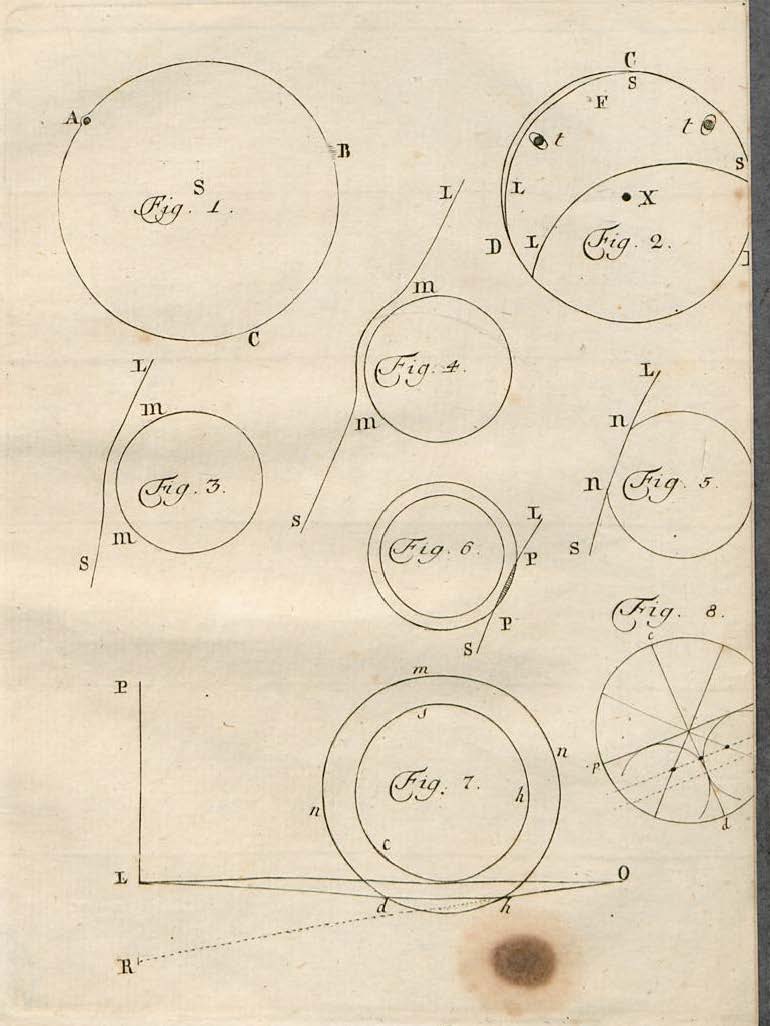
Mikhail Lomonosov's own figure from his 1761 publication — the luminous arc he saw clinging to Venus's edge as the planet entered and left the Sun's disc. He concluded, correctly, that Venus has an atmosphere refracting sunlight from behind it. Public domain (Commons).
The headline scientific result of 1761 was not, in fact, the AU — those measurements were ambiguous and disputed for years. The discovery that lasted was made by Mikhail Lomonosov in Saint Petersburg. As Venus crossed onto the Sun's edge, Lomonosov saw a thin glowing arc surrounding the planet's dark silhouette — sunlight refracted through Venus's atmosphere from behind. He wrote a short paper concluding that Venus has "an air-like envelope similar to that which surrounds our terrestrial globe, if not greater." It was the first detection of an atmosphere on another planet.
A side discovery worth a primary one
Lomonosov's atmosphere was real. Venus's atmosphere is in fact ninety times the mass of Earth's, dense enough to crush the Soviet Venera landers in the 1970s after only a few minutes on the surface. He had detected, with a 4-inch refractor and good eyes, a 480 km thick CO₂ shroud at 92 atmospheres pressure. Not bad for a side observation in a project aimed at measuring the AU.
The story of 1761 also has a tragic protagonist. The French astronomer Guillaume Le Gentil had set out a year earlier for Pondicherry, on the Indian coast, to observe from a French outpost. War with Britain made his ship divert; he was still at sea when the transit happened, watching the Sun from the heaving deck — useless for timing. Le Gentil decided to wait eight years in the East Indies for the 1769 transit rather than return home empty-handed.
See the 6 June 1761 transit in the orrery → (this is the moment when Lomonosov in Saint Petersburg, Mason and Dixon at the Cape, and Le Gentil's ship in the Indian Ocean were all watching the same point of light — pause and rotate the view to see who had the Sun above their horizon)
The 1769 Triumph: Tahiti, the Black Drop, and a Real Number
The 1769 transit was the most ambitious scientific project of the eighteenth century. The British Admiralty commissioned a converted coal ship, the Endeavour, and gave its command to a 40-year-old lieutenant named James Cook. His mission: take the astronomer Charles Green to a small island in the South Pacific that had only recently been mapped by Europeans, and time the transit. The island was Tahiti. The point Cook chose for the observation is still called Point Venus.
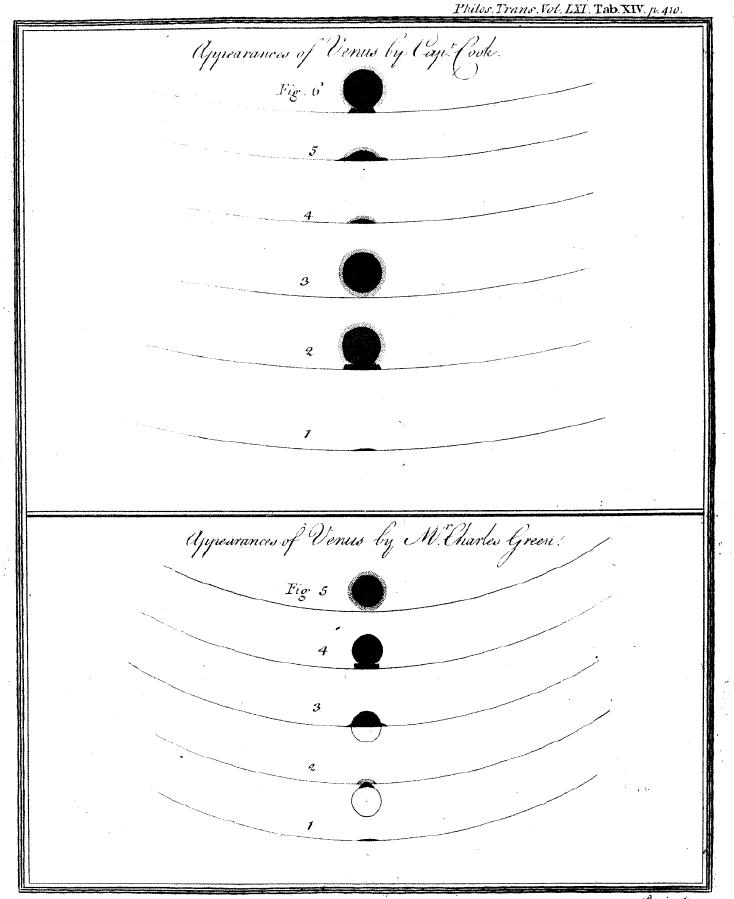
Captain Cook and Charles Green's drawings from Point Venus, Tahiti, on 3 June 1769. Each small disc is Venus a few seconds before or after touching the Sun's limb. Note how the black silhouette stretches into a teardrop just before separating — the infamous black-drop effect. Public domain (Commons).
Cook arrived at Tahiti two months ahead of the transit, set up a fortified observatory, and on 3 June 1769 had perfect weather. He, Green, and the expedition's astronomer Daniel Solander each timed the four "contacts" — the moments when Venus's edge first touched the Sun's outer limb (first contact), passed fully onto the disc (second contact), began to leave (third contact), and finally separated (fourth contact). The contacts are the timing markers Halley needed.
But they ran into a foe Halley had not anticipated. Just before second contact, instead of Venus pulling cleanly away from the Sun's edge, the planet's silhouette appeared to stretch into a teardrop and stick to the limb for a moment, like a drop of black ink. Then the connection snapped. Cook, Green, and Solander each timed the moment differently — by tens of seconds. Across all 1769 sites, the same effect ruined contact timing everywhere.
The black-drop effect
The black-drop is not a real physical bridge between Venus and the Sun. It is a combination of atmospheric seeing, optical diffraction at the planet's limb, and the way the eye perceives a sharp edge against a bright disc. Modern observations from space — where seeing and atmospheric refraction vanish — show the effect is much weaker but doesn't disappear entirely; the optical contribution is intrinsic. Eighteenth-century astronomers, blaming themselves and their instruments, never identified its true cause.
Despite the black drop, Le Gentil — who had now waited nine years in the East Indies — set up at Manila and then moved to Pondicherry for the 1769 transit. The morning of 4 June 1769 dawned crystal clear in Pondicherry. As the transit began, a single cloud drifted across the Sun and stayed there for the entire duration. He saw nothing. He returned to France in 1771 to discover that he had been declared legally dead, his estate distributed among relatives, and his seat at the Académie given to someone else.
Eleven years for nothing — almost
Le Gentil eventually got his seat back, remarried, and lived another twenty years. The story is a reminder of what science cost in the age before air travel and instant communication: a single missed observation could erase a decade of a life. It is also a reminder that redundancy across many sites is the only defence against weather. The 1769 expedition succeeded as a project precisely because no single observer was load-bearing.
When the 1761 and 1769 timings were finally combined and reconciled — a labour that took until 1771, with the German mathematician Johann Franz Encke producing the definitive analysis fifty years later in 1824 — the answer was 153.34 million km for the AU. The modern value is 149.60 million km. They had nailed the size of the solar system to about 2.5%, the most accurate cosmological measurement of the eighteenth century.
See the 3 June 1769 transit in the orrery → (Cook at Point Venus had the Sun nearly overhead at this moment; the orrery's "behind Earth's limb" view shows what he was sketching)
Visit every transit in the orrery
Each link below pauses the Nightbase orrery at the moment of greatest transit and lines up Venus directly between Earth and the Sun. Use the time controls to step forward and watch Venus drift off the disc, or rotate the camera to see Earth's day/night line at the historical moment.
4 December 1639 — Horrocks at Much Hoole (first observed transit)
6 June 1761 — Lomonosov, Mason–Dixon, the Le Gentil disaster
By the next pair of transits — December 1874 and December 1882 — astronomy had a new tool: photography. Where Cook had to time a flickering teardrop with a pendulum clock, the new generation could record the entire transit as a sequence of glass plates and measure positions later in the calm of a laboratory. Or so the theory went.
The American astronomer Simon Newcomb led the 1874–82 reduction effort. The U.S. expedition alone deployed eight teams across the Pacific, Indian, and Atlantic Oceans, returning thousands of photographic plates. Britain, France, Germany, Russia, Italy, and Mexico all sent their own. The black drop survived photography intact — but with so many independent timings and the new ability to measure Venus's position on the plates rather than the contact moments, the systematic errors averaged down.
Newcomb's final value, published in 1895: 149.59 ± 0.31 million km. He had pinned the AU to 0.2% — Halley's promise, fulfilled 179 years after he wrote it. Newcomb's value remained the international standard for the size of the solar system until radar bouncing off Venus in the 1960s did better.
The 1882 transit was the last time anyone needed Venus to measure the AU. By the early twentieth century, asteroid parallax (Eros, 1900–01) gave a better answer faster. By the 1960s, radar astronomy timed light bouncing off Venus's surface and got the AU to ten decimal places. The transit pairs of 2004 and 2012 had no role to play in measuring the solar system at all. They had become, in a beautiful reversal, historical re-enactments of the experiment that built modern astronomy.
June 2004 and June 2012: A Generation Witnesses History
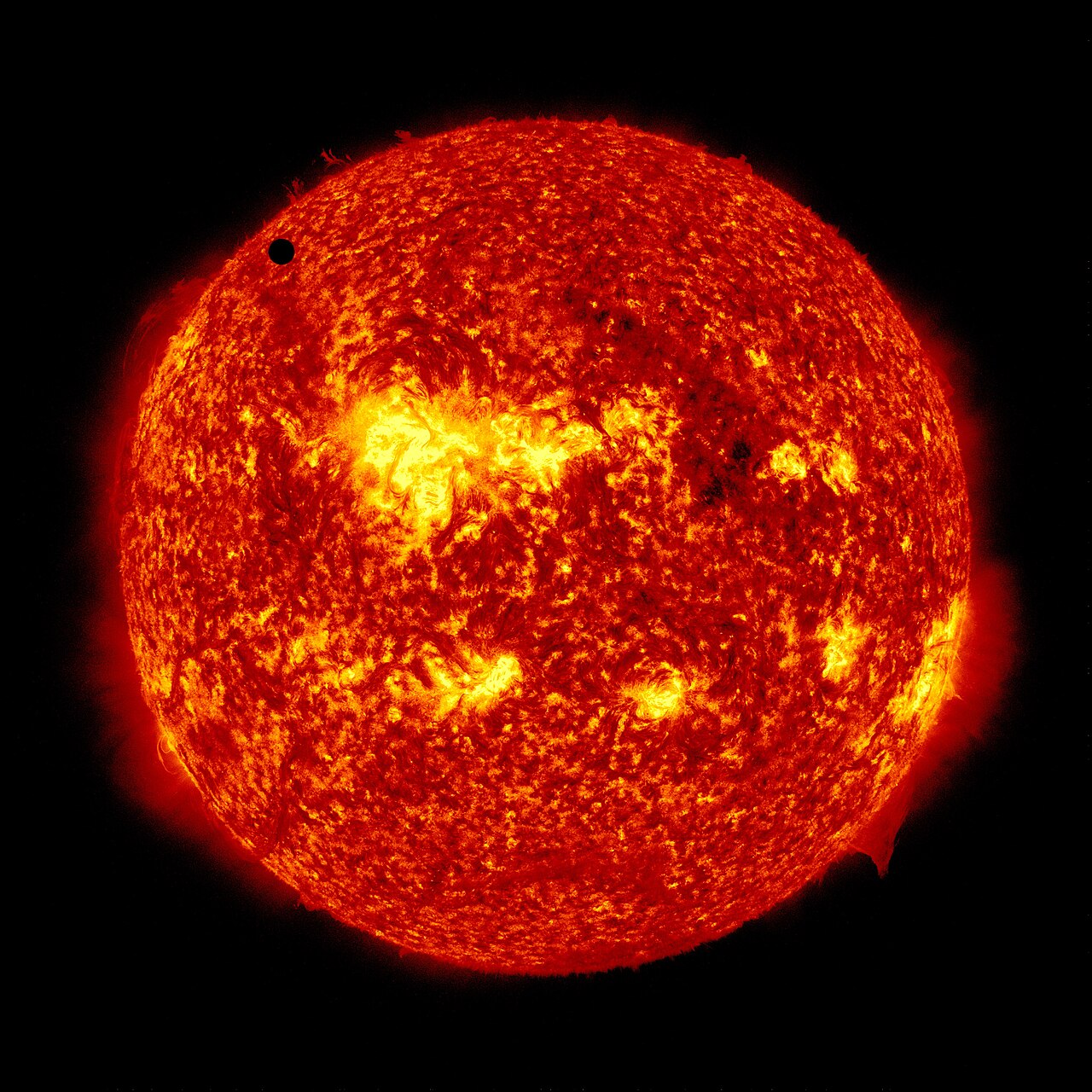
The pair of 8 June 2004 and 5–6 June 2012 was the first transit pair since the invention of the spacecraft. Hundreds of millions of people watched live online. Schools projected the Sun onto walls. Amateur astronomers across Europe put solar filters on their telescopes and saw, with their own eyes, the small black bead that had launched a century of expeditions.
The 2012 transit, photographed by NASA's Solar Dynamics Observatory in 304-Ångström ultraviolet. The chromosphere's textured surface fills the disc; Venus is the perfectly black sphere at top. Note how clean the planet's edge appears from space — no black drop. NASA/SDO, public domain.
The science returned was modest by historical standards but novel: spacecraft observations of the transit confirmed several predictions about the exoplanet transit method (see below), and the Hubble Space Telescope used reflected sunlight from the Moon during transit to test atmospheric retrieval techniques on a planet whose atmosphere we already knew. In essence, 2004 and 2012 were used to calibrate the method by which we now find planets around other stars.
If you missed both — and almost everyone alive today did
There will not be another transit of Venus until 11 December 2117, then a final one on 8 December 2125. Mercury, the inner planet, transits the Sun far more often — about 13 times per century. The next transit of Mercury is on 13 May 2032, and you can plan to observe it through a properly filtered telescope from anywhere in the world where the Sun is up. It is the closest experience an amateur astronomer alive today will have to what Cook saw at Tahiti.
From Venus to Exoplanets: The Transit Method's Modern Life
Halley's geometry has had a second life that he could not possibly have imagined.
When Venus transits the Sun, it blocks about 0.1% of the Sun's light — a dimming an exquisitely sensitive photometer could detect even if you couldn't actually see the transit. This is the principle behind the transit method for finding planets around other stars. A planet crossing in front of its host star produces a tiny, periodic dip in the star's brightness. Time the dip's depth and duration, and you recover the planet's size and orbital period.
NASA's Kepler Space Telescope (2009–2018) stared at a single patch of sky containing 150,000 stars and found over 2,600 confirmed exoplanets this way, plus thousands more candidates. Its successor TESS (2018–) is now scanning the entire sky for transits of nearby bright stars. Most of what we know about the population of small, rocky, potentially Earth-like planets in our galaxy comes from one technique: detecting black dots crossing distant suns.
Halley would have loved this
Halley's parallax method gave the absolute size of our solar system. The transit method, applied to other stars, gives the absolute size of their planets. Same geometry. Same black-dot-crossing-bright-disc principle. The 2012 transit of Venus was — among other things — a calibration target for the methods that have since revealed thousands of distant worlds. A 1716 paper still earning its keep three centuries later.
For Nightbase users curious about the modern method in detail, we have a deeper guide: Exoplanets: A Guide for Observers. For the broader story of how we measure cosmic distances at all, see Parallax: The Cosmic Tape Measure (if it exists in your reading queue) and the Kepler's Laws simulator for the orbital geometry that made transits predictable in the first place.
The next time you see a small black dot of Venus low in the western sky after sunset, remember: that planet has crossed the Sun seven times since Galileo first turned a telescope on it. Each crossing was a six-hour event that pulled scientists across oceans, ruined careers, made reputations, and pinned down a number we now calculate to ten decimal places without leaving our desks. The black dot did its work.
Test Yourself
Q1Why did Halley think transits of Venus could measure the AU when direct measurements of the Sun's parallax couldn't?
The Sun's parallax is too small (about 9 arcseconds) to measure directly with eighteenth-century instruments. Venus is much closer than the Sun, so its parallax across an Earth baseline is much larger. When Venus is projected onto the Sun's disc during a transit, two observers see Venus take slightly different chords across that disc. The chord offset is much easier to measure than a tiny parallax in empty sky, and converts back into the Earth–Sun distance through Kepler's known ratio of orbits.
Q2What is the black-drop effect, and why was it such a problem for the eighteenth-century expeditions?
It is the appearance, just before second contact and just after third contact, of a black "ligament" or teardrop connecting Venus's silhouette to the inner edge of the Sun's limb. Halley's method needed those contact moments timed to within a couple of seconds. The black drop blurred the contact by tens of seconds and varied between observers, introducing a systematic error that the 1761 and 1769 expeditions never fully overcame. It is partly an optical effect (diffraction at the planet's limb) and partly atmospheric — modern space-based observations show a much weaker version still occurs.
Q3What did Lomonosov discover during the 1761 transit, and how did he do it?
He saw a luminous arc surrounding Venus's silhouette during ingress and egress and correctly interpreted it as sunlight refracted through Venus's atmosphere. It was the first detection of an atmosphere on another planet. He used a small refractor and careful naked-eye perception of contrast — no spectroscopy, no photography. The conclusion held up: Venus's atmosphere is in fact dense and CO₂-rich, ninety times the mass of Earth's.
Q4When is the next transit of Venus, and why is the gap so long?
11 December 2117 — almost a century from now. Venus's orbit is tilted by 3.4° to Earth's, so most of the time when Venus passes between Earth and the Sun (which it does every 1.6 years at inferior conjunction) it passes either above or below the solar disc. Transits only happen when inferior conjunction occurs near one of the two points where Venus's orbit crosses Earth's orbital plane. The geometry repeats in pairs eight years apart, with gaps of either 105.5 or 121.5 years between pairs.
Q5The 2004 and 2012 transits returned almost no new astronomical information about the AU. So why were they observed at all?
Two reasons. First, historical and educational — they were the first transit pair widely visible to the public after the invention of mass communication, and millions of people experienced an event Halley had designed three centuries earlier. Second, scientific — they served as calibration targets for the exoplanet transit method, which uses the same geometry to detect black dots crossing distant stars. Spacecraft observations of Venus's transit refined techniques for measuring the atmospheres of transiting exoplanets via the way starlight is filtered as it grazes the planet's limb. Halley's experiment had become a benchmark for finding new worlds.




.jpg)