From the first wobble around 51 Pegasi to a planet circling our nearest stellar neighbor — a guide to the worlds we have found, how we found them, and where to look in your own sky.
14 min readMatthias Wüllenweber
Key Takeaways
1
Exoplanets are worlds orbiting other stars. We knew of eight planets for most of human history. The confirmed count is now over 5,800, rising every month.
2
Essentially every star in the galaxy hosts at least one planet. Kepler's statistics showed small rocky worlds are more common than gas giants. Planets are the rule, not the exception.
3
Almost all detections are indirect. You cannot see an exoplanet through a telescope — but you can absolutely see its host star, and some are naked-eye.
4
Five techniques do all the work: radial velocity (the Doppler wobble that found 51 Peg b), transits (the Kepler / TESS workhorse), direct imaging, microlensing, and astrometry.
5
The habitable zone is only a starting point. It's where liquid water is geometrically possible — not a guarantee of atmospheres, magnetospheres, or a temperate climate. Mars sits inside our own zone.
An exoplanet — short for "extrasolar planet" — is a planet that orbits a star other than the Sun. For most of human history we knew of only eight planets — the worlds of our own solar system. Today the count is over 5,800 confirmed, and rising every month.
That number is itself a wild understatement. NASA's Kepler space telescope — a planet-hunting mission that stared at one patch of the Milky Way from 2009 to 2018, watching ~150,000 stars for the periodic dimming caused by transiting planets — produced enough statistics to suggest that essentially every star in the galaxy hosts at least one planet, and that small rocky worlds are more common than gas giants. The Milky Way contains a few hundred billion stars. The implication is that planets are not rare cosmic accidents — they are the rule.
None of these worlds can be seen as a disk in any amateur telescope (or even most professional ones). Almost every confirmed exoplanet has been detected indirectly — through tiny effects it has on the light of its host star. The host stars themselves, however, are very much within reach. Some are bright enough to spot with the naked eye on a dark night.
5,800+Confirmed exoplanets
~100%Of stars with ≥ 1 planet
4.24 lyDistance to nearest (Proxima b)
A Brief History
For centuries the existence of other planets was a philosophical question. The first confirmed detections came only in the 1990s, and they came in an order nobody expected.
1992 — Pulsar planets
The very first confirmed exoplanets were found orbiting PSR B1257+12, a millisecond pulsar in Virgo. Aleksander Wolszczan and Dale Frail measured timing irregularities in the pulsar's beacon and showed they had to be caused by orbiting bodies. Two small planets were announced; a third followed in 1994. Pulsars are stellar corpses, so these were not worlds anyone had been hoping to find — but they proved planets existed elsewhere.
1995 — The first sun-like host
Michel Mayor and Didier Queloz announced a planet around 51 Pegasi (now officially named Helvetios), a perfectly ordinary G-type star 50 light-years away. The planet, 51 Pegasi b, is a Jupiter-mass world that whips around its star in just 4.2 days. Nothing in the textbooks predicted gas giants could exist that close to their stars; the discovery rewrote planet-formation theory overnight. Mayor and Queloz shared the 2019 Nobel Prize in Physics for the work.
2009–2018 — Kepler's flood
Pointed at a single patch of sky in Cygnus and Lyra, NASA's Kepler mission single-handedly multiplied the known exoplanet population by an order of magnitude and proved that small, Earth-sized worlds are common. TESS, Kepler's all-sky successor launched in 2018, has been adding nearby targets ever since.
2016 — A planet at our doorstep
The European Southern Observatory announced Proxima Centauri b — a roughly Earth-mass planet orbiting the red dwarf Proxima Centauri in its habitable zone. Proxima is the closest star to the Sun, just 4.24 light-years away. Suddenly the nearest known exoplanet was also a potentially temperate, rocky world. It is the most-studied exoplanet system we have, and the most plausible target for any future interstellar probe.
How We Find Them
A planet is millions or billions of times fainter than its star and sits inside its glare. Five techniques have produced almost every confirmed detection.
Radial Velocity (Doppler Wobble)
A planet and its star both orbit their shared center of mass. As the star moves toward us its light is slightly blue-shifted; as it moves away, slightly red-shifted. High-resolution spectrographs can measure these shifts down to ~1 m/s — a walking pace. This is how 51 Pegasi b was found and how Proxima b was confirmed. Best for massive, close-in planets.
Transit
If a planet's orbit is edge-on from our viewpoint it crosses in front of its star once per orbit, blocking a tiny fraction of the light — typically 0.01% to 1%. Repeated, periodic dips betray a planet. This is the workhorse method for Kepler and TESS, and it accounts for the majority of all known exoplanets. The geometry has to cooperate, so transits only catch a small fraction of existing planets, but the ones it catches are extremely well-characterized: we get the planet's radius, and follow-up radial-velocity measurements yield the mass and therefore the density.
Direct Imaging
The hardest method — literally photographing the planet. It requires a young, bright, self-luminous planet far from its star, plus heroic optics (coronagraphs, adaptive optics, starshades) to suppress the host's glare. The classic success is the four-planet system around HR 8799 — which you can also fly through in 3D here — where all four giants have been resolved and tracked along their orbits. Beta Pictoris b is another benchmark. The method also produces cautionary tales: the famous Hubble "image" of Fomalhaut b (2008) was later shown by Gáspár & Rieke (2020) to be an expanding dust cloud from a planetesimal collision, not a planet at all. Direct imaging gives us spectra of the planet's own atmosphere, which is otherwise extremely hard to obtain.
Gravitational Microlensing
When one star passes precisely in front of another, its gravity bends and magnifies the background star's light. A planet around the foreground star adds a brief secondary spike to that brightening. Microlensing is sensitive to planets at large orbital distances and even to free-floating rogue planets with no host star at all — a population estimated to rival the count of stars.
Astrometry & Pulsar Timing
Astrometry measures the tiny side-to-side wobble of a star against the sky — ESA's Gaia mission is expected to deliver thousands of detections this way. Pulsar timing watches the cadence of a pulsar's radio beam for orbit-induced delays; it is exquisitely precise but only works for the rare handful of stars that are pulsars.
Famous Host Stars You Can Observe
You cannot see the planets themselves, but you can absolutely see their suns. Pointing a telescope at a star you know hosts other worlds is a small, quiet pleasure that nothing else in observing quite matches.
Bright hosts — naked eye or binoculars
Pollux (Beta Geminorum) — mag 1.1, Gemini. An orange giant easily visible to the naked eye. Pollux b is a Jupiter-class planet on a 1.6-year orbit, discovered by radial velocity in 2006. (3D orrery)
Tau Ceti — mag 3.5, Cetus. The closest single sun-like star, just 11.9 light-years away. Multiple super-Earth candidates have been reported, two of them potentially in the habitable zone. A long-time staple of science fiction for good reason. (3D orrery)
Epsilon Eridani (Ran) — mag 3.7, Eridanus. A young K-type dwarf 10.5 light-years away with a known Jupiter-mass planet and at least two debris belts — a system that probably resembles our own solar system in its youth. (3D orrery)
Upsilon Andromedae (Titawin) — mag 4.1, Andromeda. In 1999 this became the first sun-like star confirmed to host multiple planets. At least four are now known. (3D orrery)
51 Pegasi (Helvetios) — mag 5.5, Pegasus. The headline name in exoplanet history — the first ordinary star ever confirmed to host a planet (1995). Visible to the naked eye under a dark sky and a comfortable binocular target from anywhere. (3D orrery)
Dim hosts — the red-dwarf telescope targets
Most of the galaxy's planets orbit M-dwarfs — small, cool, abundant red stars. Individually they are faint, but the closest ones are within reach of any decent telescope.
The closest known exoplanet host, full stop. A red dwarf 4.24 light-years away, gravitationally bound to the brilliant Alpha Centauri AB pair. Proxima b (2016) is roughly Earth-mass and orbits in the habitable zone; a second planet, Proxima c, was added in 2019. See the two worlds laid out in the 3D orrery. Alpha Cen A and B themselves have a long history of planet claims, including Alpha Cen Bb (announced 2012, retracted 2015) and an unconfirmed JWST mid-infrared candidate around Alpha Cen A (2021) — but no confirmed worlds yet. A challenging target from northern Europe (declination −62°) but a must-see from southern latitudes.
A nearby M-dwarf system that became famous in the 2000s as the first place habitable-zone super-Earths were claimed. Several of its planets are confirmed; others remain debated. A historically important system.
A four-planet M-dwarf system — the first multi-planet system found around a red dwarf, and the first to show clear evidence of orbital resonance between its giant planets.
Beyond amateur reach
Many more hosts — including Kepler and TRAPPIST-1 targets — lie below the magnitude limit of most amateur telescopes. The catalog at /exoplanets lists every confirmed planet alongside its host star.
What Kinds of Worlds Are Out There?
The single biggest surprise of the exoplanet era is how unfamiliar most of these worlds are. The solar system, it turns out, is not a representative sample.
Hot Jupiters — Gas giants the size of Jupiter or bigger, orbiting their star closer than Mercury orbits the Sun. Surface temperatures of 1,000 to 3,000 K. They are easy to detect and were the first kind of planet found around a sun-like star — 51 Pegasi b is the prototype.
Super-Earths and Mini-Neptunes — The most common planet types in the galaxy. Super-Earths are rocky worlds 1–2× Earth's radius; mini-Neptunes are slightly larger (2–4×) with thick gas envelopes. Nothing like them exists in our own solar system — the gap between Earth and Neptune is a peculiarity of the Sun's planetary system, not a universal pattern.
Ultra-short-period planets — Worlds whose entire year lasts a few hours. Some are so close to their stars that the surface is molten rock and the atmosphere, if any, is rock vapor.
Rogue planets — Free-floating worlds drifting through interstellar space without a host star. Microlensing surveys suggest they could be as numerous as stars themselves — an enormous, dark, scattered population.
Earth analogues — The grail. Roughly Earth-sized, roughly Earth-mass, orbiting in the habitable zone of a long-lived star. We have a handful of plausible candidates — Proxima b, the inner TRAPPIST-1 worlds, several Tau Ceti candidates — but no firm twin yet.
The Habitable Zone
The habitable zone is the band of orbital distances around a star where a rocky planet with the right kind of atmosphere could plausibly hold liquid water on its surface. Too close, and oceans boil away; too far, and they freeze.
For the Sun the zone runs roughly from inside Earth's orbit to past Mars. For a cool red dwarf like Proxima Centauri it sits much closer in — a few percent of Earth's distance from the Sun. That is why Proxima b, with an 11-day orbit, is still a habitable-zone candidate: its star is far cooler than ours.
"Habitable zone" does not mean "habitable"
It only means liquid water is geometrically possible. It does not guarantee an atmosphere, a magnetosphere, or anything like a temperate climate. Mars is technically inside the Sun's habitable zone, and yet here we are. Still, it is the right place to start looking.
The count of confirmed habitable-zone planets — visible at the top of the exoplanet catalog — is one of the most-watched numbers in the field.
Explore the Catalog
Nightbase mirrors the full NASA Exoplanet Archive: every confirmed exoplanet whose host star is in our catalog, along with its discovery method, orbit, and measured properties. The Exoplanet Explorer lets you browse by individual planet or by host system, and every system has a full-screen interactive 3D orrery.
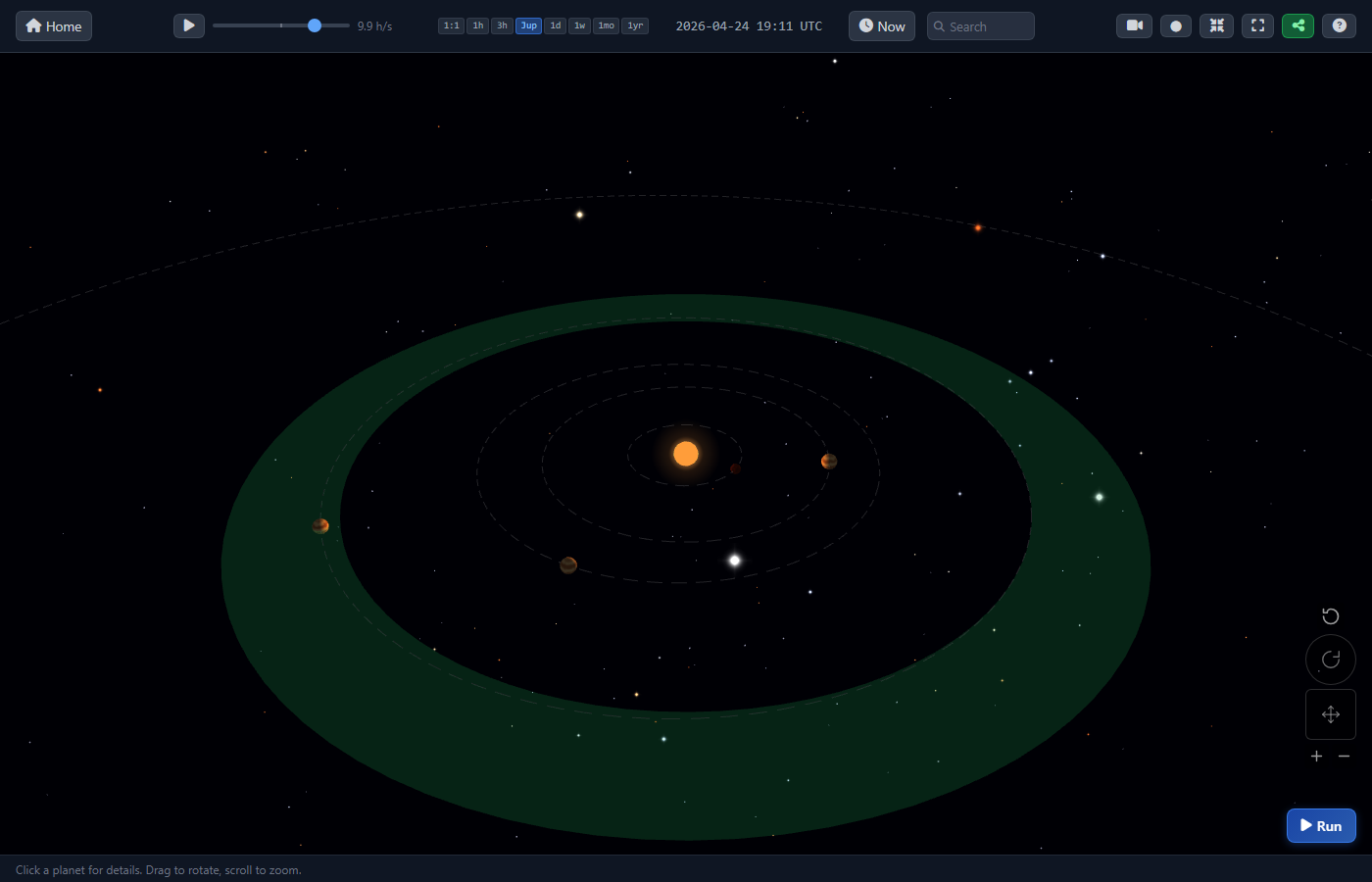
The 55 Cancri system in the 3D orrery — five confirmed planets, from the lava super-Earth 55 Cnc e (innermost) out to the Jupiter-class 55 Cnc d near the habitable zone (green band).
What's on the page
Discovery timeline — stacked bars of every confirmed detection, coloured by method, back to the 1992 pulsar-timing discoveries. Good for seeing how radial velocity, Kepler transits, and TESS each reshaped the field.
Famous Cases quick-reference — a dozen of the most important systems (51 Pegasi, Proxima Centauri, 55 Cancri, HR 8799, Upsilon Andromedae…) with a one-line historical or physical note for each. Useful when you just want to jump straight to a landmark rather than scroll through the full table.
Browse by Planet — the full table of ~5,000 linkable planets. Filter by discovery method, planet radius, or habitable-zone membership; sort by year, distance, period, or mass.
Browse by Host Star — a second tab that groups planets by system. Multi-planet hosts like 55 Cancri, HR 8799, and υ Andromedae surface at the top. Each row gives the star's spectral type, distance, planet count, and a direct link into the 3D orrery.
3D orrery for every system — click the cube icon on any row to open an interactive scene: star, planets, orbits to scale, and the habitable zone drawn as a green band. Drag to rotate, scroll to zoom, click a planet to follow it.
Start with the timeline, browse the Famous Cases grid, then pick a tab: planets for an individual-world view, or host stars for a per-system view. Any row with a cube icon links straight into the 3D orrery.
Test Yourself
Q1Why is radial velocity particularly good at finding massive, close-in planets?
The Doppler wobble is largest when the planet is heavy (so it tugs on the star hard) and close (so the orbital period is short and both bodies move fast). 51 Pegasi b — a Jupiter-mass planet on a 4-day orbit — was effectively the best-case scenario for the method, which is why it was one of the first planets found. Small planets on wide orbits produce tiny, slow wobbles that spectrographs only began measuring reliably in the 2010s.
Q2Why is Proxima Centauri b a habitable-zone planet if it orbits its star in just 11 days?
Proxima Centauri is a red dwarf, much cooler and dimmer than the Sun. Its habitable zone — where temperatures allow liquid water — sits very close in, at only a few percent of Earth's distance from the Sun. An 11-day orbit around a cool M-dwarf can deliver the same energy flux as Earth receives from the Sun in 365 days.
Q3If essentially every star hosts a planet, why do we "only" have ~5,800 confirmed?
We can only detect planets whose geometric configuration, mass, and orbital period happen to be favorable for one of our techniques. Transits require edge-on alignment (a few percent chance); radial velocity needs years of monitoring to catch a long-period planet; direct imaging only works on young, hot, widely-separated giants. Most planets in the galaxy are invisible to our current methods — we count only the lucky minority.
Q4Why was the 1995 discovery of 51 Pegasi b more surprising than the 1992 pulsar planets, even though it came later?
The 1992 pulsars already proved planets could exist elsewhere, but they orbit a stellar corpse — not a normal star. 51 Pegasi b was the first planet found around a sun-like star, and it was a Jupiter-mass gas giant orbiting in 4 days — something nobody had predicted. Models of planet formation at the time said gas giants couldn't form that close to their star. The discovery forced a complete rewrite of planet-formation theory ("hot Jupiters migrate inward after forming farther out") and earned Mayor and Queloz the 2019 Nobel.
Q5Rogue planets wander through interstellar space without a star. How do we detect them?
Gravitational microlensing. When a rogue planet passes precisely in front of a distant background star, its gravity briefly bends and magnifies the background star's light. The event is short (hours to days, versus weeks for stellar microlensing), one-off, and unpredictable — but surveys like OGLE and KMTNet watch millions of background stars simultaneously and catch them by statistics. The estimated population — possibly rivalling the number of stars — is almost entirely inferred this way.