Menu

The Fermi Paradox: Where Is Everybody?

A galaxy of 200 billion stars, four times older than the Earth, with rocky planets around most of them — and the only signal we have ever received from another civilization is a 72-second blip in 1977 we still cannot explain. The silence is the data.

16 min read Matthias Wüllenweber

Key Takeaways

  1. 1

    In summer 1950 at Los Alamos, Enrico Fermi interrupted a lunchtime conversation about flying saucers with one casual question — "Where is everybody?" — and accidentally named the deepest puzzle in modern astronomy.

  2. 2

    A self-replicating probe travelling at a modest 0.01 c could colonize the entire Milky Way in 5–50 million years — a blink against the galaxy's 13-billion-year age. Even one technological civilization predating us by a sliver of cosmic time should have left fingerprints everywhere.

  3. 3

    The Drake Equation isn't a calculation — it's a bookkeeping device. Every term except the first two is a guess, and small changes in any of them swing the answer from "billions of civilizations" to "we are alone".

  4. 4

    The Great Filter is the single most uncomfortable resolution: somewhere between a lifeless rock and a galaxy-spanning species, almost everything dies. The question is whether the filter is behind us (we're rare) or ahead of us (we're doomed).

  5. 5

    We are no longer just listening. Biosignatures in exoplanet atmospheres (JWST is reading them now) and technosignatures (Dyson spheres, megastructures, laser pulses) are giving us new ways to test the silence. The Nightbase Exoplanets dashboard tracks the ~5,000 confirmed worlds we're sifting for these signs.

  6. 6

    The night sky is enormous and our search has been laughably small — equivalent, in radio terms, to scooping a single glass of water from the ocean and concluding it has no fish.

The Lunchroom Question

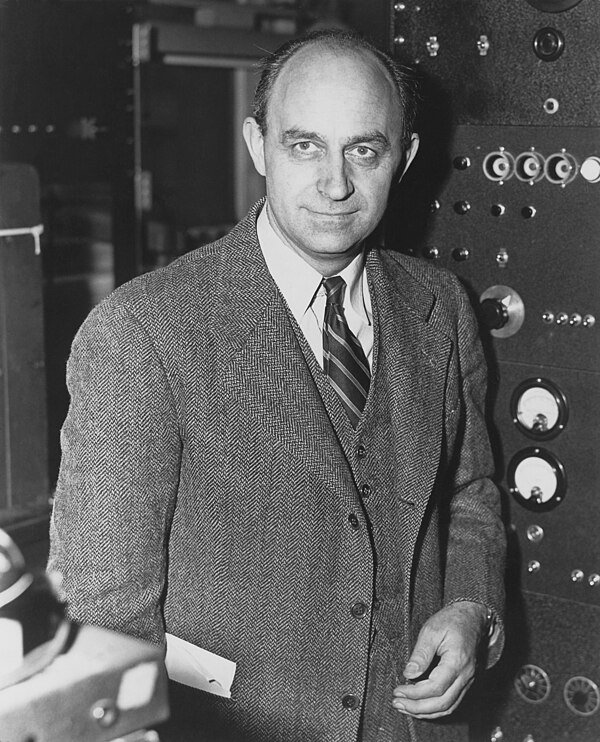
Portrait of Enrico Fermi at Los Alamos in the 1940s
Enrico Fermi (1901–1954), Los Alamos ID badge photo, c. 1943. U.S. Department of Energy, public domain.

It was the summer of 1950 at the Los Alamos National Laboratory. Enrico Fermi — Nobel laureate, architect of the first nuclear reactor, the kind of physicist whose mental arithmetic estimated bomb yields from scraps of paper drifting on the Trinity blast wave — was walking to lunch with Edward Teller, Emil Konopinski, and Herbert York. The conversation, sparked by a New Yorker cartoon about flying saucers stealing trash cans, drifted into faster-than-light travel and the plausibility of interstellar visitors.

The group sat down. Conversation moved on. Then, in the middle of an unrelated topic, Fermi said it out loud: "Where is everybody?"

Everyone at the table understood instantly. Fermi had done the silent arithmetic in his head — the age of the galaxy, the number of stars, the time required for a moderately motivated civilization to spread from one to all of them — and concluded that the sky should be teeming with evidence of other minds. Yet our radios were quiet, our telescopes saw nothing artificial, and no probe had ever landed in the cornfields of Iowa.

That single lunchtime question is now the Fermi Paradox. It isn't a riddle with one answer — it's a constraint on every theory of life in the universe. Whatever you believe about biology, intelligence, or technology, your model has to explain why the sky is empty.

Did you know?

The 1977 "Wow! signal" was a 72-second narrowband radio burst at 1420 MHz — the hydrogen line, the frequency every SETI textbook lists as the obvious channel for an interstellar greeting. Astronomer Jerry Ehman circled it on the printout and wrote "Wow!" in the margin. Despite hundreds of follow-up observations of that exact patch of sky in Sagittarius, it has never repeated. We have one anomaly, half a century old, and nothing to compare it to.

The Numbers Should Be Overwhelming

Three numbers set the stage for the paradox. Sit with them for a moment.

13.6 GyrAge of the Milky Way
~200 BStars in our galaxy
~50 BEarth-sized planets in habitable zones (best estimate)

The galaxy is three times older than Earth. If even one civilization arose a hundred million years before us — a rounding error on cosmic time — and decided to send out probes at one-hundredth the speed of light, the math is brutal.

A self-replicating probe (a so-called von Neumann machine) doesn't need to be fast. Send one to the nearest star. It mines the asteroids there for raw materials, builds two copies of itself, sends them onward. Each new probe does the same. The colonization wave grows exponentially. Conservative estimates put full galactic coverage at 5–50 million years — a deep breath compared to 13 billion. There has been time for this to happen thousands of times over.

So either:

  1. Civilizations capable of this never arise.
  2. Civilizations arise but never start the wave (or stop themselves before it goes far).
  3. The wave already happened and we somehow don't see it.

Each of those is its own essay.

The Drake Equation

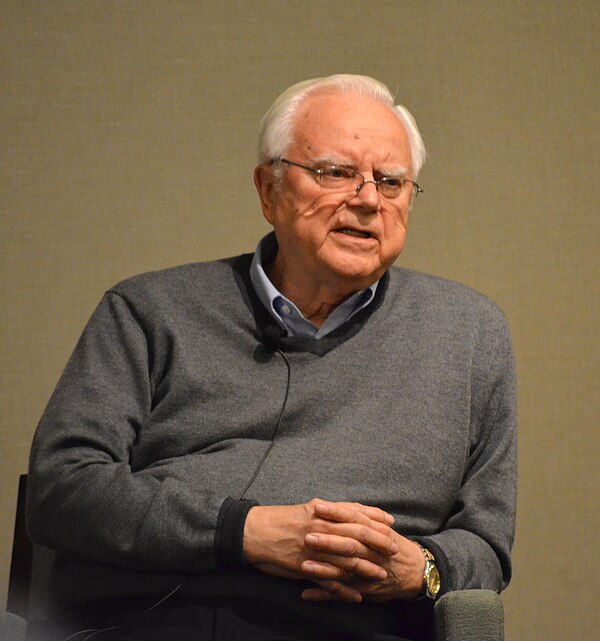
Portrait of Frank Drake, the SETI astronomer, photographed in 2012
Frank Drake (1930–2022), photographed in 2012. Photo by Raphael Perrino, CC BY 2.0.

In 1961, the radio astronomer Frank Drake was preparing for the first scientific meeting on extraterrestrial intelligence at Green Bank, West Virginia. He needed an agenda. He scribbled on the blackboard a string of factors, each a probability or rate, that together would estimate the number of communicating civilizations in our galaxy at any given moment.

That string is now the Drake Equation:

N = R★ × f_p × n_e × f_l × f_i × f_c × L

Term Meaning Modern best guess
R★ Star formation rate (stars/year) ~1.5–3
f_p Fraction of stars with planets ~1.0 (essentially all of them)
n_e Earth-like planets in the habitable zone per system ~0.4
f_l Fraction where life arises unknown — anywhere from 10⁻⁶ to ~1
f_i Fraction of life that becomes intelligent unknown
f_c Fraction of intelligent life that develops radio unknown
L Average lifetime of a communicating civilization (years) unknown — 100? 100 million?

The first three factors we now know. The exoplanet revolution since 1995 — see Exoplanets: A Guide for Observers and the live Exoplanets dashboard — turned f_p from "we have no idea" into "essentially every star has planets, and a third of them have rocky worlds in the habitable zone" (the orbital band where liquid water is stable on a planet's surface — neither too hot nor too cold).

The remaining four are pure conjecture. Plug in optimistic numbers and N comes out in the millions. Plug in pessimistic ones and N is much less than one — meaning we may be the only technological civilization the Milky Way has ever produced.

The Drake Equation as a probability cascade 200 B stars in galaxy × f_p ≈ 1 have planets × n_e ≈ 0.4 Earth-like × f_l ? life starts × f_i ? intelligence × f_c × L ? talks & lasts Pessimistic stack: N ≈ 0.0001 — we are alone Optimistic stack: N ≈ 10 million — galaxy is crowded Same equation. Same galaxy. The four unknown factors decide everything.
Figure 1 — The Drake Equation isn't a prediction; it's a way to organize what we don't know. The first three factors are pinned down by exoplanet science. The last four — the biology, the intelligence, the longevity — are wide open.

The equation's real value isn't its numerical answer. It's the way it forces you to point at which unknown factor your worldview depends on. Are you optimistic about chemistry, pessimistic about politics? Pessimistic about abiogenesis, optimistic about everything that follows? The Drake Equation makes you commit.

The Great Filter

In 1996, the economist Robin Hanson gave the Fermi Paradox its sharpest rephrasing. Imagine the path from "barren rock" to "galaxy-spanning civilization" as a series of stages. At each stage, almost everything fails to advance. Somewhere on that path is a step so improbable that almost nothing crosses it.

That step is the Great Filter.

The filter could lie anywhere along the path:

  • Abiogenesis — getting from chemistry to self-replicating life.
  • Eukaryotes — going from prokaryotic cells to nucleated, complex ones (took ~2 billion years on Earth, the longest single step).
  • Multicellular life — cooperation between cells.
  • Animal-like intelligence — central nervous systems, problem-solving.
  • Tool use, language, civilization.
  • Technological civilization that survives long enough to be detected.

The chilling logic: wherever the filter sits, it has to explain the silence. If the filter is behind us — if any of the steps to here is the rare one — then we are an extreme cosmic accident, and the galaxy is genuinely empty. If the filter is ahead of us — if the rare step is something every technological civilization fails to cross — then our future is short.

A grim corollary

This is why the discovery of independent life on Mars or Europa would be bad news, not good. If life arises easily — twice in a single solar system — then the Great Filter cannot be abiogenesis. It must lie further along the path. Most of it would lie ahead of us. Every additional discovery of life narrows where the filter can hide, and every narrowing pushes it closer to us.

The most reassuring possible news is that Earth life is utterly unique in our solar system.

Other Solutions to the Paradox

The Great Filter is one explanation. Dozens of others have been proposed — none of them comfortable.

  • Rare Earth. Earth is a one-in-a-galaxy fluke: stable star, plate tectonics, oversized Moon damping our axial wobble, Jupiter sweeping comets out of the inner system. Take any of those away and complex life never emerges. (See Rare Earth by Ward & Brownlee, 2000.)
  • The Zoo Hypothesis. They are out there, watching, and have agreed not to interfere. The galaxy is a nature reserve and Earth is the petting zoo.
  • The Dark Forest. Every advanced civilization that broadcasts gets destroyed by an older, paranoid one. The reasonable strategy is to listen, never transmit. The silence is the sound of everyone hiding. (Liu Cixin's novels popularized this; the underlying game-theory argument is older.)
  • The Berserker Hypothesis. Self-replicating war probes from a long-dead aggressor patrol the galaxy and snuff out emerging civilizations before they spread. We are still here only because we have not yet been noticed.
  • Transcension. Mature civilizations stop expanding outward and instead retreat into the high-energy-density physics of the very small — black-hole interiors, simulated worlds, postbiological substrates. They aren't out there because they are in there.
  • The Aestivation Hypothesis. Computation gets exponentially cheaper as the universe cools. The smart move for a galaxy-spanning AI is to sleep through the present hot era and wake up in 10²⁰ years when each erg of energy buys 10²⁰ times more thinking. We are the noisy children outside their bedroom door.
  • They are too alien. A signal from a methane-based, slow-thinking, deep-ocean intelligence may be passing through your living room right now and we have no instrument that would recognize it as anything other than noise.
  • We're early. The galaxy's chemistry only became metal-rich enough for rocky planets in the last few billion years. Most habitable planets in the universe haven't formed yet. We are not late to the party — we are, statistically, the first guests.

Each one is testable in principle. Most are probably wrong. But at least one of them has to be right, and we have no good way to know which.

What We Are Actually Doing About It

The paradox isn't just a thought experiment. It drives a real, working scientific program.

Listening. Modern SETI began in 1960 when Frank Drake pointed the 26 m radio dish at Green Bank at two stars: Tau Ceti in Cetus and Epsilon Eridani (also known as Ran) in Eridanus. Both are sun-like, both are nearby (12 and 10.5 light-years), and Ran now has a confirmed planet sitting just inside its habitable zone. Drake's project — Project Ozma — listened for two months and heard nothing.

Tau Ceti — one of Drake's first SETI targets in 1960. Naked-eye in Cetus at mag 3.5.

Six decades later, the largest project — Breakthrough Listen, funded by Yuri Milner in 2015 — is surveying a million nearby stars and 100 nearby galaxies across radio and optical bands. Even so: in all six decades of looking, we have searched perhaps 10⁻²⁰ of the relevant volume × frequency × time space. The "we've looked everywhere" objection is wildly premature.

Sniffing. JWST and the next generation of large telescopes are starting to read biosignatures — atmospheric molecules whose simultaneous presence is hard to explain without life. Oxygen and methane together are the textbook example: each destroys the other on geological timescales, so finding both means something is replenishing them. The Trappist-1 system — seven roughly Earth-sized planets, three squarely in the habitable zone, only 40 light-years away — is the priority target. (You can browse it, and every other confirmed exoplanet system, in the Nightbase Exoplanets dashboard.) We may know in this decade.

Looking for the artificial. A new field, technosignatures, hunts for things that biology cannot make: laser pulses sharper than any star, infrared excess from a Dyson sphere waste-heating its host star, narrow-band radio emission, megastructures eclipsing a star with non-Keplerian dimming patterns (this is what made Tabby's Star briefly famous in 2015 — the dips turned out to be dust, but the search method is sound).

Try it tonight

Tau Ceti (mag 3.5) and Epsilon Eridani / Ran (mag 3.7) are both naked-eye stars. Step outside on a clear November or December evening and find them in Cetus and Eridanus. When the photons leave Tau Ceti's surface, they take 12 years to reach you — about the time a child takes to grow up. You are looking at the same two stars Frank Drake aimed his dish at in 1960. Whatever signal, if any, we may eventually catch will probably come from one of a few hundred such targets — close, sun-like, old enough.

An Easter Egg in the Planetarium

Open the 3D planetarium on the Solar System page and you will see the eight planets, the Sun, the major moons, and a handful of asteroids spinning in real time. What you will not see — at least not at first — is that on every page load, a small alien craft is hidden somewhere in the simulation, glued to a randomly chosen body of at least 400 km diameter.

It is a Star Destroyer. Its hiding strategy depends on the body it picked:

  • On moons, asteroids, and the inner terrestrial planets, it sits on the anti-solar side — pressed against the dark hemisphere where the Sun cannot illuminate it.
  • On Mars and the gas giants, it follows a low Keplerian orbit at 1.5× the body's radius, period computed from Newton's gravity in real time.

If you zoom and rotate patiently — using the planetarium's controls to slew around each major body in turn — eventually you will find it. Different page load, different hiding spot.

It is, of course, a joke. But it is also a small, deliberate working model of one resolution to the Fermi Paradox: conspicuousness is a choice. A civilization that did not want to be found would not be found. A 1,600-metre Star Destroyer in a low orbit around Callisto would be invisible to every Earth telescope ever built. It would betray itself only if you went looking — and even then, only if you knew where to look, and only if you happened to glance at the right body on the right rotation.

That is why the silence is not, by itself, evidence of absence. We have searched a tiny patch of a vast space, and we have searched it for things we already know how to look for. A civilization that wanted a Mars trojan asteroid as a research outpost, a Europan ocean as a refuge, or the dark side of an Oort cloud body as a listening station could be there right now and we would have no way to tell.

The Sagan reframe

Carl Sagan — who spent his life advocating for SETI — liked to flip the paradox on its head. Yes, he agreed, the silence is striking. But our entire technological history — from Marconi's first radio broadcast to JWST — fits inside about a century. If the average civilization lasts only a few centuries before going quiet (by self-destruction, by disinterest, by transcension), then the galaxy's communicating civilizations are all separated in time, not just in space. Two civilizations 100 light-years apart but a million years offset would never speak. The silence is what you get when communication is hard, and life is delicate, and the universe is enormous.

It is the loneliest answer of them all. It is also the one most consistent with everything we currently know.

Test Yourself

Q1 Why does the Fermi Paradox bite even if interstellar travel is "very slow"?

Because the galaxy is so old. Even at 1% of the speed of light — well within the reach of plausible engineering — a self-replicating probe colonizes the entire Milky Way in 5–50 million years. The galaxy is more than 13 billion years old, so any civilization that reached this technology stage even a hundred million years before us should already have left fingerprints in our solar system. The paradox isn't about speed; it's about deep time.

Q2 Why would discovering microbial life on Mars be unsettling rather than reassuring?

Because of the Great Filter. If life arose independently twice in one solar system, it can't be the case that life is the rare step. The Great Filter must lie further along the path — at the transition to complex life, to intelligence, or (worst case) at "technological civilizations that survive". Most of those steps would still lie ahead of us. Independent Martian life would be fascinating biology and bad cosmic news.

Q3 The Drake Equation has seven terms. Which ones do we now know with confidence?

Only the first three: the star formation rate (R★), the fraction of stars with planets (f_p, ~1.0), and the average number of habitable-zone planets per system (n_e, ~0.4). The exoplanet revolution since 1995 — Kepler, TESS, JWST, ground-based radial-velocity surveys — pinned them down. The remaining four (probability life arises, probability of intelligence, probability of communication, civilization lifetime) are pure conjecture, and small changes in any of them swing N by many orders of magnitude.

Q4 How does the Dark Forest hypothesis differ from the Zoo hypothesis?

The Zoo says they are out there but choose not to contact us — a benevolent or at least neutral non-interference policy. The Dark Forest says the silence is enforced by violence: any civilization that broadcasts gets destroyed, so the rational strategy for everyone is to listen and never transmit. Both predict silence, but they predict very different futures if we do start broadcasting loudly. The Dark Forest is the one that should make you nervous.

Q5 Why are Tau Ceti and Epsilon Eridani historically important targets?

They were the first two stars ever scanned for an artificial radio signal, by Frank Drake's Project Ozma at Green Bank in April 1960. Both are sun-like, both are nearby (about 12 and 10.5 light-years), and both still appear on every modern SETI target list. Eps Eri is now known to host at least one confirmed planet. Both are naked-eye stars on autumn evenings — go look at them.

Q6 What can amateur astronomers actually contribute to the search?

More than you'd think. Amateur exoplanet transit observers contribute to follow-up timing measurements that constrain planetary masses and atmospheres. Variable-star observers track stars whose unusual dimming patterns might (long shot) flag megastructures — Tabby's Star was first investigated by citizen scientists. And the cultural contribution matters: every clear night an amateur spends learning the sky is one more pair of eyes that knows what normal looks like, and so might recognize abnormal if it ever appears.

fermi-paradox seti drake-equation exoplanets philosophy